
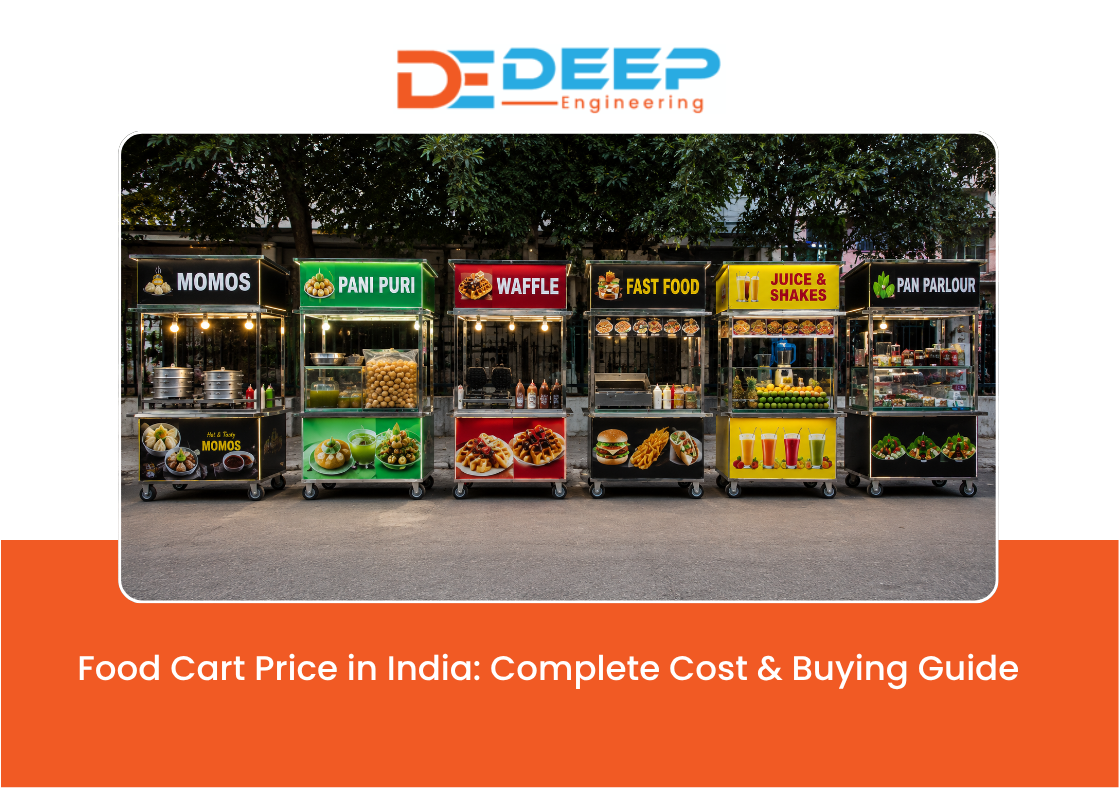
Starting a street food, snack, dessert, beverage, or mobile food business begins with one important question: how much should you budget for the cart? The Food Cart Price in India varies widely because a basic push cart and a fully customized commercial food vending cart are very different products.
Current Indian supplier listings show simple food carts around ₹25,000–₹65,000, while larger stainless steel, customized, kiosk-style, and equipment-integrated carts can move beyond ₹1 lakh and, in some cases, ₹2 lakh or more. Food vans represent another investment category and can range from roughly ₹1.5 lakh for basic configurations to several lakhs for larger commercial builds.
These figures should be treated as approximate market ranges, not fixed quotations. Size, construction material, equipment, storage, branding, electrical work, transportation, taxes, and customization can substantially change the final Food Cart Cost in India.
This guide explains realistic 2026 market pricing, different cart categories, hidden setup expenses, stainless steel versus custom carts, and what to ask a manufacturer before placing an order.
How Much Does a Food Cart Cost in India?
In 2026, a commercial food cart in India can cost approximately ₹25,000 to ₹2,00,000+, depending on its size, material, design and equipment. Basic carts start near ₹25,000–₹45,000, while stainless steel and customized commercial carts commonly cost more. Food vans can range from about ₹1.5 lakh to several lakhs.
Here is a practical price comparison based on current Indian supplier and B2B listings:
| Food Cart Type | Approx. Market Range in India | Best For | Main Cost Factors |
|---|---|---|---|
| Basic Food Cart | ₹25,000–₹65,000 | Beginners, snacks, tea | Size, frame, material |
| Stainless Steel Cart | ₹45,000–₹1,20,000+ | Commercial vendors | SS construction, storage, size |
| Panipuri Cart | ₹45,000–₹90,000+ | Chaat and pani puri | Compartments, SS worktop, dispensing |
| Momo Cart | ₹25,000–₹1,20,000+ | Momo sellers | Steamer/burner provision, size, storage |
| Fast Food Cart | ₹20,000–₹1,30,000+ | Multi-menu vendors | Cooking layout, counter, equipment |
| Waffle Cart | ₹40,000–₹1,00,000+* | Desserts and waffles | Counter, electrical layout, branding |
| Custom Food Cart | ₹50,000–₹2,00,000+* | Branded businesses | Design, size, equipment, finish |
| Premium Commercial Cart | ₹1,20,000–₹3,20,000+ | Events, larger operations | Integrated equipment, size, fabrication |
| Food Van | ₹1,50,000–₹12,00,000+ | Larger mobile operations | Vehicle, body, kitchen and equipment |
*Waffle and custom-cart ranges are broader estimates derived from current waffle, food vending, stainless-steel and customized-cart listings rather than a standardized national price category.
For context, current listings include a small food cart at ₹25,000, standard/commercial carts around ₹45,000–₹75,000, stainless steel carts around ₹85,000, and commercial vending carts reaching ₹1.2–₹2 lakh and beyond.
Important: Online prices change and specifications differ significantly. Always request a current quotation for the exact cart you need.
Food Cart Price in India by Cart Type
Basic Street Food Cart Price
A basic street food cart is generally the lowest-cost entry point. Current B2B listings show small food carts around ₹25,000, while standard mobile or push carts are commonly listed around ₹40,000–₹65,000.
These carts can work well for tea, packaged snacks, simple chaat, beverages, small fast-food menus and businesses where extensive cooking equipment is unnecessary.
A cheap cart should still be evaluated for frame strength, wheel quality, counter space, storage and ease of cleaning. Paying less initially is not useful if poor layout slows down service every day.
Buyers can compare different Food Cart formats before deciding what level of construction fits their menu.
Stainless Steel Food Cart Price
The Stainless Steel Food Cart Price commonly starts around ₹45,000 for simpler commercial carts and can exceed ₹1,00,000 for larger or more extensively equipped designs.
Current Indian listings include stainless-steel vending carts around ₹45,000–₹50,000, a six-foot SS cart around ₹85,000 and larger stainless-steel vending carts around ₹1.2–₹2 lakh.
A Stainless steel food cart is particularly relevant when the worktop will experience frequent food preparation, cleaning and daily commercial use.
Panipuri Cart Price
A commercial pani puri cart can cost approximately ₹45,000–₹90,000+, while specialized automatic dispensing systems can push pricing above ₹1 lakh.
Current supplier listings include a conventional MS/SS/ACP pani puri cart around ₹45,000 and a stainless steel push cart around ₹75,000. More advanced automatic pani puri cart systems are listed from roughly ₹70,000 to ₹1.55 lakh.
A good Panipuri Cart layout should prioritize ingredient organization, serving space, water-related requirements and easy access during busy periods.
Momo Cart Price
Current listings demonstrate why momo-cart prices should never be represented by one fixed number.
Commercial momo carts are currently listed around ₹25,000–₹35,000 at the simpler end, while customized stainless-steel carts can reach around ₹1.2 lakh.
The final price of a Momo cart depends on whether the buyer needs only a mobile counter or a more complete setup incorporating space for steamers, burners, preparation, sauces and storage.
Fast Food Cart Price
Fast-food carts have one of the widest price ranges because “fast food” can mean anything from a compact snack counter to a large multi-menu commercial setup.
Current listings range from approximately ₹20,000 for a small metal fast-food cart to ₹75,000–₹95,000 for more substantial commercial carts. Larger vending designs can cost ₹1.3 lakh or considerably more.
A Fast food stall becomes more complex when it needs space for multiple appliances, preparation areas, ingredients and serving operations.
Waffle Cart Price
A current Indian supplier listing shows a waffle cart around ₹40,000. However, this single figure should not be treated as the standard national price.
A commercially equipped Waffle Cart may require electrical provisions, appliance space, topping storage, packaging areas, lighting and branding. Those requirements can move the final investment well above the price of a basic cart.
Custom Food Cart Price
The Custom Food Cart Price can reasonably range from approximately ₹50,000 to ₹2,00,000+, depending on how far the customization goes.
Current Indian commercial-cart listings show customized and vending products from around ₹45,000–₹50,000 through ₹1.3 lakh, ₹1.55 lakh, ₹2 lakh and even ₹3.2 lakh for more substantial vending formats.
Customization may include dimensions, equipment locations, storage compartments, serving counters, canopy design, lighting, electrical points and branded exterior finishes.
Reviewing different Food Cart Design ideas before fabrication can help buyers identify which features are operational necessities and which are mainly aesthetic.
Food Van Price
A food van costs considerably more than a manual cart because it combines mobility, vehicle or mobile-platform costs and a larger food preparation environment.
Current Indian listings show basic food-van or truck configurations beginning around ₹1.5–₹2.5 lakh, while larger commercial mobile kitchens frequently move into ₹3.5–₹12 lakh territory. Specialized premium builds can cost substantially more.
Businesses comparing food van price options should evaluate the complete configuration rather than only the vehicle shell. A Food Van may require kitchen equipment, electrical systems, water facilities, ventilation, storage and branding.
What Determines Food Cart Cost in India?
Food Cart Price in India are primarily affected by cart size, construction material, fabrication complexity, storage, equipment integration, mobility, utilities and customization. A larger stainless-steel cart with cooking equipment, water facilities, electrical provisions and branding will normally cost more than a basic manual vending cart.
Several factors deserve particular attention:
- Dimensions: A larger cart requires more material and fabrication.
- Material: Stainless steel, mild steel, ACP and combinations of materials have different costs.
- Frame strength: A cart carrying heavy appliances requires suitable structural support.
- Wheels: Size, load requirements and mobility affect wheel selection.
- Storage: Drawers, cabinets, shelves and ingredient compartments add fabrication work.
- Cooking setup: Burners, griddles, steamers and other equipment can increase the total.
- Electrical provision: Lights, switches, sockets and wiring add cost.
- Water facilities: Tanks, sinks and plumbing increase complexity.
- Canopy or roof: Larger covered structures require additional fabrication.
- Branding: Exterior panels, graphics and signage affect the final budget.
- Transportation: Distance from the manufacturer to the buyer can change the landed cost.
- Taxes and accessories: Ask whether these are included in the quotation.
This is why requesting only a “food cart price list” without specifying the required configuration rarely produces a useful comparison.
Stainless Steel Food Cart Price in India: Is It Worth Paying More?
For many high-use commercial applications, paying more for suitable stainless-steel preparation surfaces and construction can make sense because buyers usually prioritize cleanability, appearance and durability. However, the correct material specification should depend on the cart’s actual use rather than price alone.
FSSAI’s hygiene framework specifically includes hygienic and sanitary requirements for petty food operators and street-food vendors, making cleanable work areas an important practical consideration.
The value of stainless steel becomes clearer in daily operation. Food spills, sauces, water and repeated cleaning put significant demands on work surfaces.
The key question is therefore not simply, “How much is the stainless steel cart?” It is, “What construction and work surfaces suit my daily workload?”
Standard vs Custom Food Cart Price in India
| Factor | Standard Food Cart | Custom Food Cart |
|---|---|---|
| Price | Usually lower | Usually higher |
| Design flexibility | Limited | High |
| Storage | Predetermined | Menu-specific |
| Branding | Basic | Can be integrated |
| Equipment integration | Limited | Can be planned |
| Best use | Simple menus/startups | Specialized operations |
| Long-term suitability | Good for straightforward needs | Better where workflow is specific |
Is a custom food cart worth it? It can be when customization solves an operational problem.
For example, a momo vendor benefits more from properly positioned steamer and sauce areas than from decorative features. A waffle seller may prioritize electrical equipment and topping storage. A pan business may need a specialized pan counter layout.
Cheap Food Cart vs Commercial Food Cart: Which Is Better?
The lowest purchase price does not automatically mean the lowest business cost.
A very basic cart may be suitable for a small menu and light use. However, buyers planning long daily operating hours should also consider maintenance, cleaning, mobility, storage and workflow.
Consider five questions before choosing purely on price:
- Can the cart support the equipment you use every day?
- Is there enough organized storage?
- Can workers clean preparation surfaces efficiently?
- Will the wheels handle expected movement and load?
- Can the cart accommodate future menu expansion?
A cart that saves ₹10,000 initially but later requires major fabrication changes may not represent better value.
Hidden Costs When Starting a Food Cart Business
The cart itself is only one part of the food cart setup cost.
Additional expenses can include cooking appliances, gas-related equipment, electrical work, utensils, ingredient containers, refrigeration or cooling, raw materials, packaging, signage, branding, transportation, maintenance, staffing and digital payment/POS equipment.
Licensing and registration requirements also need to be checked separately. FSSAI currently lists hawkers, itinerant/mobile food vendors, temporary stalls and similar small food businesses within its registration/licensing framework. Requirements depend on the business category and circumstances, so operators should confirm current requirements through the official FoSCoS system and relevant local authorities.
Do not spend your entire startup budget on fabrication. Keep enough capital for opening inventory and initial operations.
Real-Life Food Cart Buying Examples
The following are illustrative examples, not Deep Engineering customer cases.
New Momo Business
A first-time momo seller needs a compact cart with space for a steamer, gas arrangement, sauces, serving supplies and ingredient storage.
Instead of buying the cheapest available trolley, the entrepreneur should compare total working space and equipment compatibility.
Pani Puri Business
A pani puri vendor needs organized ingredient compartments, practical water management, serving space and good mobility.
Here, efficient layout may matter more than having the largest cart.
Multi-Menu Fast Food Business
Suppose the menu includes sandwiches, noodles, fries and beverages.
This operation needs more preparation space, storage and equipment capacity. The resulting Commercial Food Cart Price will naturally be higher than that of a simple snack cart.
Established Event Brand
An existing food business wants to sell at events and premium commercial locations.
Branding, lighting, customer-facing design and an organized service counter may justify investing in a customized cart rather than adapting a generic model later.
How to Choose the Right Food Cart for Your Business
Choose a food cart by defining your menu first, then matching the cart’s dimensions, workspace, storage, mobility and equipment provision to your actual operating process. Budget should determine the level of specification—not force you into a cart that cannot support the business.
Start with the menu.
Write down every appliance, utensil, ingredient container and packaging item required during a normal service period. Then decide where each item should be positioned.
Next, consider customer volume. A cart designed for occasional events has different requirements from one operating every evening in a high-footfall location.
Finally, think ahead. Spending on useful storage or an appropriate worktop today may be more economical than modifying the cart six months later.
Buyers researching food carts for sale should therefore compare specifications rather than pictures alone.
Questions to Ask a Food Cart Manufacturer Before Buying
Before approving fabrication, ask:
- What materials are being used for the frame, body and worktop?
- What are the exact cart dimensions?
- Which equipment and accessories are included?
- Can the internal layout be customized?
- How much storage is provided?
- Are gas and electrical provisions available where required?
- What wheels are specified for the cart?
- Which items are excluded from the quotation?
- Are taxes and transportation included?
- What is the estimated manufacturing and delivery schedule?
- What after-sales assistance is available?
- What information is needed before approving the final design?
Getting these answers in writing makes quotations easier to compare.
Food Cart Price in Ahmedabad, Gujarat and Other Indian Cities
Food cart pricing can differ by buyer location even when the basic fabrication cost remains similar.
For businesses in Ahmedabad, sourcing from a food cart manufacturer in Ahmedabad can make it easier to discuss specifications and understand transportation requirements. Buyers searching for a food cart manufacturer in Gujarat should compare material, dimensions and included equipment—not only quoted price.
The same principle applies to businesses looking for a food cart manufacturer in Surat, Vadodara, Rajkot, Bhavnagar or Himmatnagar.
For buyers sourcing carts in Rajasthan, including Jaipur, or businesses in Indore and other parts of Madhya Pradesh, transportation becomes part of the landed investment. Buyers in Delhi NCR, Gurgaon and Uttar Pradesh should make the same calculation.
A quotation of ₹60,000 from one supplier and ₹65,000 from another cannot be properly compared until you know what each includes.
Buyers conducting broader supplier research can also review information about Food Cart Manufacturer in India options and compare specifications carefully.
Why Consider Deep Engineering for Food Carts?
Deep Engineering’s website presents food-cart, vending-cart and mobile food-business solutions across multiple product categories. Its product range includes carts intended for businesses such as pani puri, momos, waffles and other food-vending formats.
For buyers comparing Food Cart Manufacturers, the useful approach is to match the available cart category with the business’s menu, required layout, storage and mobility.
Deep Engineering can therefore be considered by startups and established businesses seeking a Food Cart Manufacturer for commercial food-vending applications.
The decision should still be specification-driven. Discuss dimensions, equipment requirements, storage, mobility and design before requesting final pricing.
How to Get an Accurate Food Cart Price in India
The fastest way to obtain meaningful pricing is to send the manufacturer a clear requirement rather than asking only, “Food cart kitne ka hai?”
Provide:
Menu: What will you prepare and sell?
Cart type: Push cart, stainless steel cart, kiosk, stall or food van?
Dimensions: What space is available?
Equipment: Steamer, griddle, fryer, waffle machine or other appliances?
Storage: Ingredients, utensils, packaging and water requirements?
Branding: Basic cart or custom branded design?
Location: Where does the finished cart need to be delivered?
Budget: What investment range are you targeting?
Getting the specifications right before fabrication can help prevent expensive modifications later.
Explore available Food Cart options and request a current quotation based on your menu and operating requirements.
FAQs About Food Cart Price in India
A practical 2026 market range is approximately ₹25,000–₹2,00,000+ for manual and commercial carts, depending on size, material, storage, equipment and customization. Basic carts cost less, while large commercial and customized carts cost significantly more.
Current Indian supplier listings indicate roughly ₹45,000–₹1,20,000+ for many stainless-steel food carts, although larger or extensively equipped carts can cost more.
A custom food cart can cost approximately ₹50,000–₹2,00,000+, with premium commercial configurations costing more. Dimensions, fabrication, equipment, utilities and branding influence the final quotation.
Beginners generally benefit from a cart sized specifically for a focused menu rather than buying the largest available model. Prioritize usable workspace, storage, easy cleaning and manageable startup cost.
Commercial pani puri carts are currently listed around ₹45,000–₹90,000+, while automatic or equipment-heavy pani puri systems can exceed ₹1 lakh.
Size, construction material, worktop, frame, wheels, storage, cooking equipment, electrical provisions, water facilities, canopy, branding, customization, transportation and taxes can all affect the final price.
Generally, yes. Manual commercial carts commonly cost tens of thousands to a few lakh rupees, whereas commercial food vans can cost several lakhs depending on vehicle and kitchen configuration.
Yes. Depending on the manufacturer and design, dimensions, storage, work surfaces, equipment positions, exterior finish and branding can potentially be customized. Ask what is technically feasible before finalizing the quotation.
Conclusion
The Food Cart Price in India cannot be reduced to one number. Current 2026 market listings show entry-level carts beginning around ₹25,000, while stainless steel, specialized and custom commercial food carts can cost ₹1 lakh, ₹2 lakh or more. Food vans can require a substantially larger investment.
More importantly, the cheapest cart is not necessarily the right cart.
Your menu, expected customer volume, workspace, storage, mobility, cleaning requirements, equipment and expansion plans should determine the specification. A properly planned cart can make everyday preparation and serving more organized while reducing the need for expensive changes later.
Deep Engineering Food Cart Manufacturer offers multiple food-vending formats for businesses comparing commercial and customized cart solutions.
Define your menu, required equipment, preferred dimensions, storage needs and delivery location, then request a current quotation based on those specifications.
Contact Us: Deep Engineering