
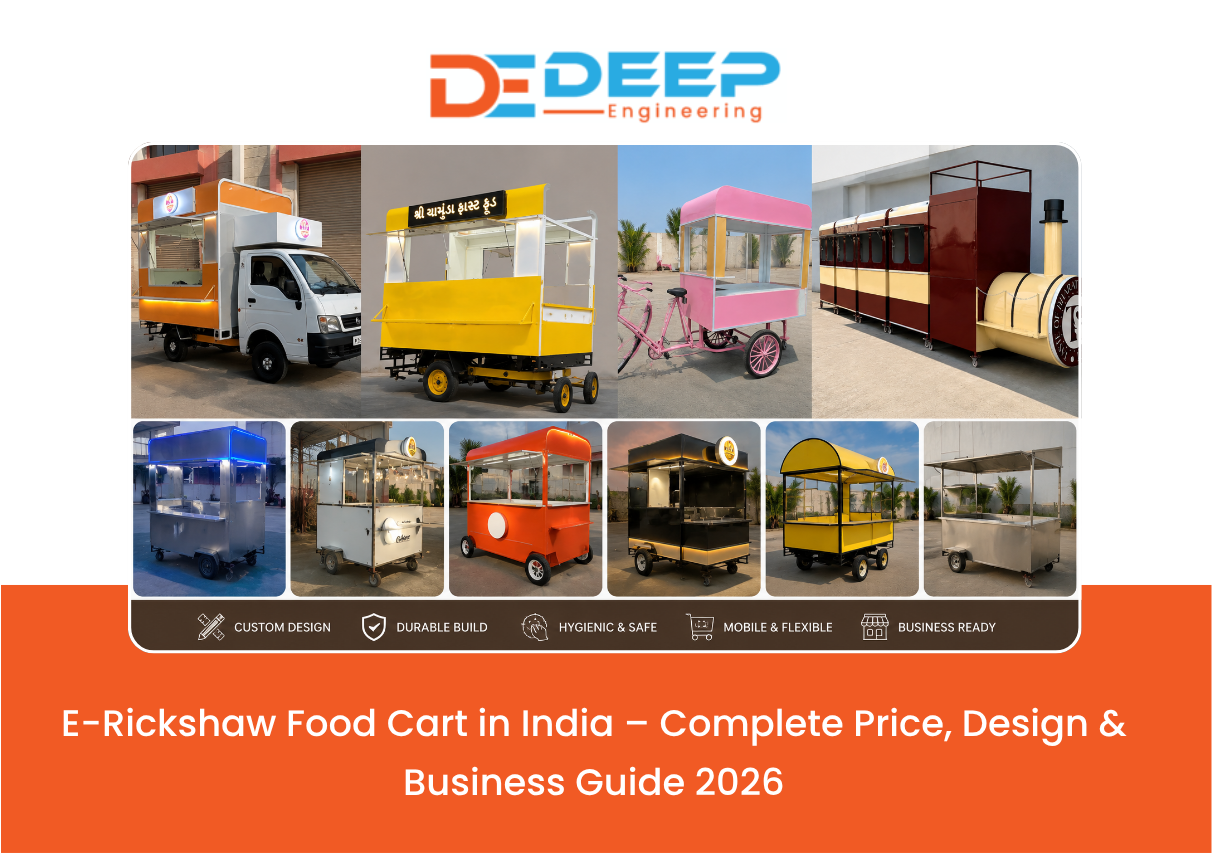
An e rickshaw food cart combines the mobility of an electric vehicle with a dedicated workspace for selling food. Instead of operating from a fixed stall, an entrepreneur can plan a mobile food setup around a specific menu, customer location, storage requirement, serving counter, cooking area, and branding.
For Indian entrepreneurs, this concept can be useful when the business depends on reaching customers in different locations such as markets, office zones, college areas, private campuses, events, residential communities, and food festivals. The biggest advantage is not simply that the cart moves; it is that the entire vending layout can be planned around the food business.
The e rickshaw food cart price does not have one standard figure. It depends on the vehicle or chassis arrangement, fabrication, equipment, electrical requirements, battery setup, storage, counter design, branding, and customization.
This guide explains how to evaluate an e-rickshaw food cart, what its design should include, how pricing is determined, how it compares with a tricycle cart, and how to select a suitable manufacturer in India.
What Is an E Rickshaw Food Cart?
An e rickshaw food cart is a mobile food vending unit built around an electric three-wheeler or similar mobile platform and customized with food-service areas. It can include counters, storage, cooking or preparation equipment, electrical systems, branding, lighting, and customer-serving areas for businesses such as momos, chaat, beverages, waffles, fast food, and snacks.
The concept gives a food entrepreneur greater mobility while providing a more organized workspace than a basic push cart.
E Rickshaw Food Cart Price in India: What Should You Expect?
There is no responsible way to quote one universal e rickshaw food cart price without knowing what the entrepreneur actually wants to sell.
A beverage-only unit and a cooking-heavy fast-food setup can have very different requirements. The same applies to a simple serving cart versus a customized mobile vending unit with multiple equipment zones.
Instead of comparing only the headline price, buyers should ask manufacturers for a quotation based on their menu and operating model.
| Factor | What It Includes | Impact on Cost |
|---|---|---|
| E-rickshaw/chassis | Base mobile platform and related requirements | High |
| Cart body | Fabrication, panels, roof and structural components | High |
| Food equipment | Cooking, preparation or serving equipment | High |
| Electrical system | Wiring, controls, lighting and equipment connections | Medium–High |
| Battery setup | Battery-related requirements based on the chosen configuration | Medium–High |
| Counter layout | Customer-facing and operator work areas | Medium |
| Storage | Cabinets, shelves and ingredient storage | Medium |
| Sink/water setup | Where required for the planned operation | Medium |
| Branding | Signage, graphics and visual identity | Low–Medium |
| Finishing | Surface treatment and appearance | Variable |
| Customization | Special layouts, equipment integration and modifications | Variable |
The practical approach is to start with the menu, not the cart.
For example, a momo business needs a different workflow from a juice business. A panipuri setup has different storage and serving requirements from a waffle cart. Once the menu is defined, the manufacturer can plan the working zones and equipment more logically.
If you are comparing broader mobile vending options, explore the Food Cart range to understand the different types of food-business setups available.
What Makes an E Rickshaw Food Cart Different?
A mobile food business can be built around several formats. Each has a different balance between mobility, space, investment and operational flexibility.
| Type | Main Advantage | Typical Consideration |
|---|---|---|
| Push cart | Simple mobile vending concept | Limited movement and workspace |
| Tricycle food cart | Compact and relatively easy to position | Smaller working area |
| E-rickshaw food cart | Mobility plus a larger dedicated vending setup | Requires careful vehicle, layout and operating planning |
| Food van | Larger workspace and equipment potential | Higher overall complexity and space requirements |
An e-rickshaw food cart sits between a compact cart and a larger food van concept.
It can make sense when the business needs more than a small counter but does not necessarily require a full-size food van. However, the available operating space, parking conditions, route, menu and local requirements should all be considered before choosing the format.
E Rickshaw Food Cart Design: What Should It Include?
Good e rickshaw food cart design starts with workflow.
The operator should not have to repeatedly move around the cart to collect ingredients, prepare food, serve customers and dispose of waste. A practical design brings related activities closer together.
Important design zones can include:
1. Customer-Facing Counter
The counter is where customers interact with the business. It should provide an organized serving point while leaving enough working space behind it.
2. Cooking and Preparation Area
Equipment should be positioned according to the sequence in which food is prepared. This reduces unnecessary movement during busy periods.
3. Storage
Storage should account for ingredients, packaging, utensils, cleaning supplies and other daily-use items. Poor storage planning can make a mobile cart feel crowded very quickly.
4. Equipment Placement
Every piece of equipment should have a defined position. Before fabrication, determine what is actually required rather than adding equipment after the cart is built.
5. Serving Window
For some businesses, a dedicated serving window can improve customer interaction and keep the preparation area organized.
6. Branding Area
The cart is also a moving advertisement. A clear brand name, menu presentation and visual identity can help customers understand what the business sells.
7. Electrical and Battery Planning
Lighting and electrically powered equipment need to be considered during the design stage. Electrical controls and battery placement should be planned with appropriate safety considerations.
8. Waste and Hygiene Area
Food preparation generates waste throughout the day. A dedicated approach to waste handling and cleaning helps maintain a more professional operation.
Before ordering, discuss your menu, equipment, storage needs and preferred customer flow with a manufacturer. Deep Engineering provides customized food cart solutions designed around different food-business requirements.
For visual inspiration and examples of different layouts, explore Food Cart Design.
Best E Rickshaw Food Cart Design Ideas for Indian Businesses
The best design depends on the menu. Here are practical concepts worth considering.
1. Momos
A momo setup can prioritize steaming or cooking equipment, ingredient storage, serving space and packaging. A dedicated Momo cart can also be considered when a smaller specialized format is more suitable.
2. Panipuri
A panipuri business needs organized ingredient and serving zones, water-related planning, containers and quick customer service. A dedicated Panipuri Cart may be more appropriate when the business is focused primarily on this menu.
3. Fast Food
Burgers, sandwiches, fries and similar items can require several preparation stages. A Fast food stall concept can help buyers think about separating preparation, cooking and serving areas.
4. Chaat
Chaat vending benefits from ingredient organization and a fast serving workflow. Multiple small storage compartments can be useful for keeping commonly used ingredients accessible.
5. Tea and Coffee
A beverage-focused cart can prioritize a serving counter, beverage equipment, cups, ingredients and waste handling rather than a large cooking workspace.
6. Sandwiches
A sandwich setup can focus on preparation space, ingredient storage, refrigeration or other equipment where required, and an efficient serving area.
7. Waffles
A waffle business needs a clear equipment and batter/preparation workflow. Entrepreneurs considering this concept can also review the Waffle Cart option.
8. Ice Gola
An ice-gola cart needs an arrangement for ice preparation or handling, flavors, serving materials and storage. Hygiene and water management deserve particular attention.
9. Juice and Shakes
The design can prioritize blending or preparation equipment, ingredient storage, cups, serving space and electrical planning.
10. Multi-Purpose Food Vending
If the menu changes throughout the day, a customized layout with flexible counter and storage zones can be more useful than designing the cart around one product.
How Does E Rickshaw Modification for Food Business Work?
E-rickshaw modification for food business should begin with the business model rather than fabrication.
A practical planning process is:
- Understand the food concept.
- Finalize the core menu.
- Estimate equipment requirements.
- Map the preparation and serving workflow.
- Design the customer-facing and operator areas.
- Select suitable fabrication materials and finishes.
- Plan electrical requirements.
- Allocate storage.
- Add branding and signage.
- Review the completed unit and test the workflow.
Vehicle modification and road operation can involve requirements relating to registration, vehicle specifications, electrical systems, safety and local rules. These requirements can vary, so buyers should verify applicable rules with the relevant authorities and vehicle professionals before operating a modified unit on public roads.
The manufacturer should also understand whether the cart will primarily operate at private events, fixed permitted locations, markets, campuses or as a regularly moving vending business.
Battery Operated Food Cart: Is It a Good Business Option?
A battery operated food cart can be attractive when mobility is an important part of the business model.
But battery planning should not be treated as an afterthought.
The entrepreneur should understand:
- What electrical equipment will be used?
- How much electrical load is required?
- When and where will charging take place?
- How will the cart be used during a typical working day?
- Is the route short or extensive?
- What happens if charging access is unavailable?
- What maintenance will the electrical system require?
Exact range, charging time and operating duration depend on the actual vehicle, battery configuration, load and operating conditions. They should be confirmed for the specific setup rather than assumed from a generic specification.
Electric Food Cart India: Where Does It Work Best?
The electric food cart India concept can be considered for environments where mobility and location flexibility matter.
Potential operating environments include:
- College areas
- Office zones
- Residential communities
- Markets
- Corporate parks
- Events
- Tourist areas
- Food festivals
- Private campuses
- Temporary food-service locations
The right location matters more than the novelty of the vehicle.
A great cart in a weak location can struggle, while a simple, well-planned setup in a high-demand area may perform much better. Permissions and operating rules also vary by location, so entrepreneurs should verify local requirements before finalizing their operating model.
Eco Friendly Food Cart: What Are the Practical Benefits?
An eco friendly food cart can use an electric mobility concept to reduce reliance on conventional fuel for movement, depending on the vehicle and energy source.
However, sustainability should be discussed realistically.
The environmental impact depends on factors such as electricity sources, battery production, maintenance, equipment consumption and how the vehicle is operated. The strongest practical argument for an electric vending setup is often operational flexibility rather than making exaggerated environmental claims.
Tricycle vs E Rickshaw Food Cart: Which Is Better?
There is no universal winner. The better option depends on the size of the menu, required workspace, mobility needs and budget.
| Factor | Tricycle Food Cart | E Rickshaw Food Cart |
|---|---|---|
| Mobility | Good for compact vending | Good where greater mobile capacity is needed |
| Space | More limited | Generally offers more scope for a dedicated setup |
| Storage | Compact | More customization potential |
| Customer-facing setup | Simple | Can accommodate a larger organized serving concept |
| Investment considerations | Often simpler | Can involve more components and customization |
| Customization potential | Moderate | Higher potential for integrated vending layouts |
| Suitable businesses | Focused menus | Broader or equipment-heavy menus |
| Operating environment | Compact spaces | Locations where the larger footprint is practical |
| Parking | Easier in smaller spaces | Requires more planning |
| Scalability | Suitable for focused operations | Can support a more developed mobile vending model |
Choose a tricycle when compactness and simplicity are the priority.
Consider an e-rickshaw format when you need more room for storage, equipment, branding and workflow and your operating locations can accommodate it.
Is an E Rickshaw Food Cart a Good Business Investment?
It can be, but the vehicle itself does not guarantee profitability.
The business case should be evaluated using:
- Menu profitability
- Expected customer volume
- Average order value
- Ingredient costs
- Operating hours
- Labor requirements
- Electricity or charging costs
- Maintenance
- Location expenses
- Permissions
- Marketing
- Repeat customers
Illustrative Example
Suppose an entrepreneur estimates that the business could generate revenue from a combination of daily orders and average order value.
Instead of starting with a target profit, calculate:
Estimated revenue − ingredients − labor − location costs − electricity/charging − packaging − maintenance − marketing − other operating expenses = estimated operating surplus.
This is only an illustrative planning method, not a guaranteed business result.
A stronger approach is to build three scenarios—conservative, expected and optimistic—and determine whether the business still makes sense if customer volume is lower than expected.
How to Choose an E Rickshaw Food Cart Manufacturer
Choosing a manufacturer is as important as choosing the vehicle concept.
Look for a manufacturer that can discuss your food business, not just the fabrication.
A useful buyer checklist includes:
- Experience in food cart manufacturing
- Ability to customize layouts
- Understanding of food-service workflow
- Practical storage planning
- Suitable fabrication approach
- Hygiene-focused design
- Electrical integration planning
- Equipment integration
- Quality of finishing
- Portfolio or previous design examples
- Transparent quotations
- Clear understanding of your menu
- After-sales support and communication
For buyers researching a Food Cart Manufacturer in India, the key question should be simple: can the manufacturer translate your menu and daily workflow into a practical mobile food setup?
If you are comparing Food Cart Manufacturers, request a quotation that clearly separates the major components. This makes comparisons more meaningful than comparing only one final number.
Why Choose Deep Engineering Food Cart Manufacturer?
Deep Engineering Food Cart Manufacturer is based in Ahmedabad, Gujarat, and focuses on food carts, mobile food vending solutions, kiosks and customized food-business equipment.
The practical advantage of working with a customization-focused manufacturer is that the cart can be discussed around the actual business model.
That includes:
- Menu-based layout planning
- Customized cart designs
- Organized food preparation areas
- Storage planning
- Equipment integration
- Branding areas
- Mobile vending concepts
- Different food-business formats
The company’s product range includes specialized and general food vending solutions. Buyers can explore Stainless steel food cart options, food carts for sale and other mobile food-business formats.
Entrepreneurs in Ahmedabad, Rajkot, Surat, Bhavnagar, Vadodara and Himmatnagar, as well as buyers evaluating suppliers from Rajasthan, Jaipur, Indore, Madhya Pradesh, Delhi NCR, Gurgaon and Uttar Pradesh, can compare manufacturers based on customization capability, manufacturing support, logistics and their specific business requirements rather than choosing only by location.
For a customized discussion around your menu, layout and mobile vending requirements, contact Food Cart Manufacturer and prepare your menu and equipment list before requesting a quotation.
Which Food Cart Should You Choose for Your Business?
Use your menu to determine the starting point.
- Momos → Consider a Momo cart.
- Panipuri → Consider a Panipuri Cart.
- Waffles → Consider a Waffle Cart.
- Fast food → Consider a Fast food stall.
- Pan products → Explore a pan counter.
- Multiple menus → Consider a customized or Stainless steel food cart setup.
- Larger mobile operation → Compare a Food Van concept.
- Price-focused research → Review the food van price option as another mobile-vending benchmark.
The goal is not to buy the largest cart. It is to choose a setup that matches the menu, location, workflow and expected business scale.
FAQs
An e rickshaw food cart is a mobile food vending setup built around an electric three-wheeler or similar platform and customized with counters, storage, food equipment and other business-specific features.
The price varies according to the vehicle or chassis, fabrication, equipment, electrical system, battery configuration, storage, branding and customization. A customized quotation is more useful than a generic market price.
It can potentially be adapted into a food-vending setup, but the feasibility and applicable vehicle, road-use, safety and regulatory requirements should be verified with relevant authorities and vehicle professionals.
Possible concepts include momos, panipuri, chaat, fast food, tea, coffee, sandwiches, waffles, ice gola, juices, shakes and other suitable mobile food offerings.
Compare manufacturers on customization ability, fabrication experience, workflow planning, equipment integration, storage, hygiene, electrical planning, quotation transparency, portfolio and communication.
Entrepreneurs can compare manufacturers and suppliers based on their ability to provide the required cart type, customization, fabrication support and business-oriented design. Deep Engineering offers food cart and mobile vending solutions from Ahmedabad, Gujarat.
Final Verdict
An e rickshaw food cart can be a practical choice for entrepreneurs who want mobility without giving up the organization of a dedicated food-selling workspace.
Its suitability depends on the business model.
If you have a focused menu and need a compact setup, a tricycle or specialized food cart may be enough. If you need additional storage, equipment, branding and workspace while maintaining mobility, an e-rickshaw-based concept may deserve consideration.
The most important decision is not simply the vehicle or the e rickshaw food cart price. It is whether the complete setup supports your daily workflow.
Before ordering, finalize your menu, identify the equipment you actually need, estimate storage requirements, understand your operating locations and establish a realistic budget. Then discuss those requirements with a manufacturer capable of customization.
Deep Engineering Food Cart Manufacturer in Ahmedabad, Gujarat, can help entrepreneurs explore customized food cart and mobile vending solutions based on different food-business models.
Start with the business plan, then the layout, and finally the fabrication. A well-planned cart can give your food business a more organized workspace, stronger visual presence and greater operating flexibility.
For the next step, explore Deep Engineering’s Food Cart solutions and discuss your menu, equipment, design and customization requirements before requesting a quotation.
Contact Us: Deep Engineering