
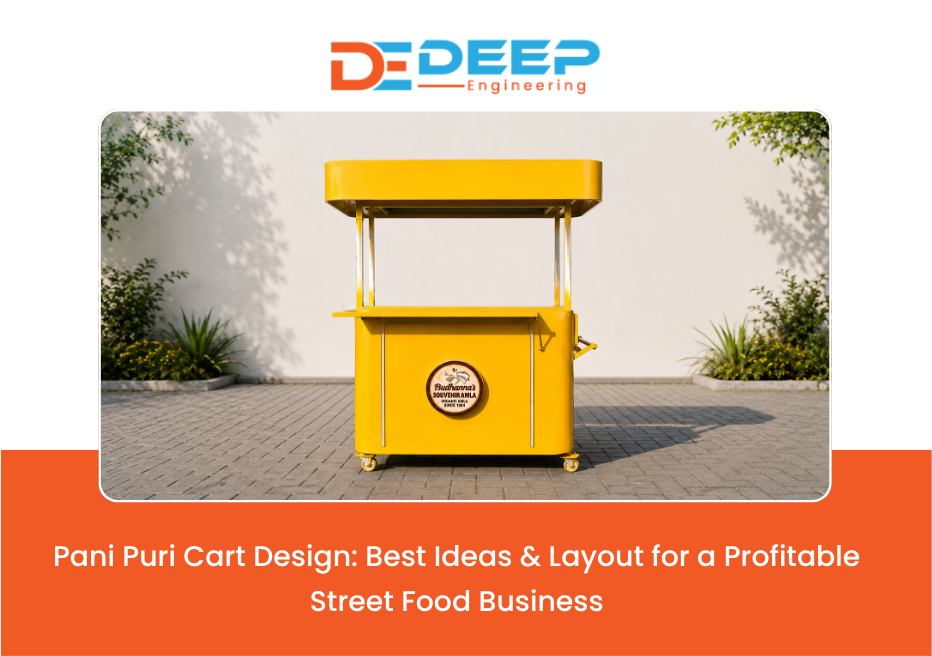
Starting a panipuri business is not only about having good taste and a busy location. The cart itself can influence how quickly you serve customers, how neatly you organize ingredients, how easily you clean the workspace, and how comfortably you can operate for several hours.
A well-planned pani puri cart design turns limited space into an efficient working station. Instead of reaching across the cart repeatedly or mixing serving items with ingredients and waste, the right layout gives every part of the operation a logical place.
For Indian street-food entrepreneurs, this becomes especially important in crowded markets, college areas, residential streets, events and high-footfall commercial locations. A modern mobile cart can also make it easier to present your business professionally while keeping the setup practical for daily use.
Deep Engineering Food Cart Manufacturer focuses on practical food-cart solutions designed around commercial use, mobility and flexible food-selling applications. Whether you are starting a new panipuri business or expanding an existing menu, the right cart should be designed around your actual workflow—not simply its appearance.
What Makes a Good Pani Puri Cart Design?
A good pani puri cart design combines an efficient serving counter, organized ingredient storage, practical water management, easy cleaning, mobility, stability and enough workspace to serve customers quickly without unnecessary movement.
The best layout starts with workflow. A vendor should be able to reach the puris, fillings, flavored water, serving items and packaging with minimal movement. Storage should keep frequently used items close to the working area, while less frequently used supplies can be placed underneath or in dedicated compartments.
Important design principles include:
- Efficient workflow: Arrange ingredients and serving tools according to the order in which they are used.
- Practical serving counter: Keep the customer-facing counter clear and easy to access.
- Organized storage: Use compartments to reduce clutter and protect supplies from unnecessary exposure.
- Water management: Plan the water area so it can be accessed and maintained without interfering with food preparation.
- Easy cleaning: Select surfaces and layouts that do not create difficult-to-clean corners.
- Mobility: Wheels and overall cart balance matter when the business needs to move.
- Stability: A mobile cart still needs a steady working platform.
- Presentation: A clean, branded cart can make the business look more professional.
- Future flexibility: If you may add another snack or beverage, consider the extra workspace before ordering.
The key is to design the cart as a working system, not simply as a decorative stall.
What Are the Best Pani Puri Cart Design Ideas for 2026?
The best pani puri cart design ideas for 2026 focus on efficient space usage, hygiene, mobility and professional presentation. A modern cart does not necessarily need to be large. It needs to make good use of every available section.
Compact and Space-Efficient Layout
A compact cart is useful when operating space is limited. Instead of increasing the overall footprint, consider using vertical and under-counter storage.
A well-designed compact food cart layout can include:
- A clear top serving counter
- Dedicated ingredient compartments
- Lower storage cabinets
- Side storage for disposable items
- A designated water section
- A practical waste area
- Branding positioned where customers can easily see it
This approach is particularly useful for college areas, busy markets and locations where vendors have limited space.
Dedicated Ingredient Storage
Panipuri service involves several ingredients and serving materials. Puri, masala, flavored water, bowls, spoons, tissues and disposable packaging should not be randomly placed around the workspace.
Dedicated food cart storage compartments make it easier to maintain order.
Frequently used items should be positioned closest to the vendor. Supplies that are used less frequently can be stored below the main counter.
This simple zoning can reduce repeated bending, searching and reaching during busy periods.
Fast-Serving Counter
The counter is one of the most important parts of a pani puri cart counter design.
Customers generally expect quick service, particularly during evening rush hours. A counter that allows the vendor to prepare and serve without constantly changing position can make the operation more efficient.
Keep the customer-facing area visually clean. Avoid filling the main counter with items that could be stored elsewhere.
Hygienic Water and Serving Setup
Water management deserves special attention in a panipuri business. A practical food cart water supply system should be planned around accessibility, separation from ingredients and ease of cleaning.
The goal is not simply to add a water container. The entire water workflow should make sense: where water is stored, where it is accessed, how the area is cleaned and how waste is handled.
Mobility and Wheel Design
A mobile pani puri cart design can be useful for vendors who operate at events, markets or changing locations.
Mobility can also help when the cart needs to be repositioned within a permitted operating area. However, mobility should be balanced with stability. The cart should remain comfortable to work from when stationary.
How to Design a Pani Puri Cart for Maximum Space
If you are wondering how to design a pani puri cart for maximum space, start by dividing the cart into functional zones rather than treating the entire surface as one workspace.
A simple process is:
- List every item used during service. Include ingredients, containers, serving tools, packaging and cleaning supplies.
- Separate frequent-use and occasional-use items. Keep frequent-use items closest to the main workstation.
- Use vertical space. Shelves and upper compartments can reduce pressure on the main counter.
- Use under-counter storage. Keep backup supplies below the working surface.
- Create separate zones. Ingredients, serving items, water and waste should have clearly defined places.
- Test the workflow. Imagine preparing and serving one order, then several customers in succession.
- Remove unnecessary movement. If the vendor repeatedly walks, bends or reaches across the cart for the same item, reconsider its location.
A successful layout is often less about adding more compartments and more about putting the right compartment in the right place.
For design inspiration and examples of different food-vending configurations, explore the Food Cart Design collection.
Stainless Steel Pani Puri Cart Design – Is It Better?
A stainless steel pani puri cart design can be a practical choice for commercial food vending because the material and finish can support an organized, professional working environment.
For a panipuri vendor, the important question is not simply whether stainless steel looks modern. Consider how the cart will be used every day.
Potential practical advantages include:
- Easier routine cleaning
- A professional food-service appearance
- Durable working surfaces
- Better suitability for repeated commercial use
- Easier maintenance of an organized workspace
- A clean-looking customer-facing counter
The design still matters. Even a stainless steel food cart can become difficult to operate if the compartments, counter and water area are poorly positioned.
If you are comparing construction options, you can review the Stainless steel food cart option and consider whether its configuration suits your menu and operating conditions.
Pani Puri Cart Interior Design: What Should Go Where?
Good pani puri cart interior design should reduce unnecessary movement and keep the workspace organized.
| Cart Area | Recommended Use | Business Benefit |
|---|---|---|
| Top counter | Serving and customer interaction | Faster service and clearer presentation |
| Center section | Puri, masala and frequently used ingredients | Easy access during preparation |
| Water section | Flavored water and related containers | Better workflow and organization |
| Lower storage | Backup ingredients and supplies | Reduces counter clutter |
| Side section | Bowls, spoons, tissues and packaging | Faster access during service |
| Waste section | Used disposable materials and waste handling | Better organization and cleanliness |
The exact configuration can vary according to the vendor’s menu, available space and operating style.
For example, a vendor selling only panipuri may dedicate more space to ingredient and water organization. A vendor selling panipuri along with snacks may need a more flexible counter and additional storage.
Modern Pani Puri Cart Design vs Traditional Thela
The traditional pani puri thela design remains popular because of its simplicity. However, entrepreneurs building a more structured food business may prefer a modern cart with dedicated storage, branding and a defined workflow.
| Factor | Traditional Thela | Modern Pani Puri Cart |
|---|---|---|
| Appearance | Basic and functional | More organized and professional |
| Mobility | Usually simple | Designed around practical movement |
| Storage | Often limited | Dedicated compartments can be added |
| Hygiene | Depends heavily on setup | Layout can support better organization |
| Branding | Usually limited | More room for signage and visual identity |
| Workflow | Basic | Can be planned around serving sequence |
| Customization | Often limited | Can be designed around menu requirements |
| Durability | Depends on construction | Can be built for commercial daily use |
| Menu flexibility | Often focused on one product | Can support additional food categories |
| Customer perception | Traditional street-food appearance | More structured food-business presentation |
A modern design does not mean abandoning the traditional street-food identity. It means adapting the cart to the practical needs of a growing business.
Pani Puri Cart Design With Water Tank and Storage
A pani puri cart design with water tank and storage should be planned carefully because water and ingredients are central to the operation.
The water section should be easy to access without disrupting the main preparation area. Storage should remain organized so containers and ingredients do not compete for the same workspace.
Consider:
- Accessibility of the water section
- Separation between water-related equipment and ingredients
- Ease of cleaning around the water area
- Space for storage containers
- A practical waste-handling area
- Easy access for routine maintenance
- Enough counter space for preparation and serving
The exact water configuration should be selected according to the cart design, operating environment and intended usage.
The same principle applies to storage: more storage is not automatically better. Storage is useful when it is positioned where the vendor can actually use it efficiently.
Can a Pani Puri Cart Be Used for Other Foods?
Yes. One of the advantages of a well-planned commercial cart is menu flexibility.
Depending on the configuration, a food cart may be adapted for products such as:
- Momos
- Tea and coffee
- Waffles
- Pizza
- Sandwiches
- Vadapav
- Samosa
- Snacks
- Soda
- Shikanji
For example, a vendor who already sells panipuri may later add momos. A dedicated Momo cart can also be considered when the menu requires a more specialized cooking setup.
Similarly, vendors exploring a dessert-oriented menu can compare the Waffle Cart format.
For broader street-food operations, a Fast food stall may be more suitable when the menu requires additional preparation or cooking equipment.
The important point is to decide whether you want a specialist panipuri cart or a flexible setup before finalizing the design.
Pani Puri Stall Design Ideas for Different Locations
The best pani puri stall design depends partly on where the cart will operate.
Busy Market
A busy market generally benefits from a high-speed serving layout. Keep frequently used ingredients close together and avoid unnecessary decoration that takes away valuable workspace.
The customer-facing side should be easy to understand at a glance, while backup stock can stay underneath.
Near Schools or Colleges
A college-area vendor may experience short periods of heavy demand. A compact design with quick access to serving items can help maintain an efficient workflow.
Mobility may also be valuable when operating conditions or available space change.
Corporate Areas
A corporate-area setup may benefit from a cleaner, more polished visual presentation. Branding, organized storage and a professional serving counter can help communicate a more structured food business.
Events and Festivals
Event vendors may prioritize mobility and visibility. A cart that is easy to reposition and has enough room for the expected menu can be more practical than a fixed-style setup.
Residential Areas
A residential vendor may value compactness and storage. If the cart needs to be moved or stored regularly, overall size, mobility and practical organization become especially important.
Custom Pani Puri Cart Design – When Should You Choose Customization?
A custom pani puri cart design makes sense when a standard configuration does not match your actual workflow.
Customization can be useful when you need:
- Specific brand colors
- Custom signage
- A particular counter height
- Additional storage
- Space for extra menu items
- A specific water arrangement
- Additional equipment
- A compact configuration for restricted operating space
- A particular customer-facing appearance
Customization should solve a business problem.
For example, if you plan to sell panipuri and beverages together, the ideal layout may differ from a cart dedicated entirely to panipuri. If your operating space is narrow, a compact configuration may be more valuable than additional decorative elements.
Before ordering, write down your menu, equipment, storage needs and expected customer flow. Then discuss the layout with the manufacturer.
Affordable Pani Puri Cart Design Ideas for Startups
For entrepreneurs looking for affordable pani puri cart design ideas for startups, the best approach is to prioritize essential functionality first.
Start with:
- A practical working counter
- Appropriate ingredient storage
- Useful water management
- Easy-to-clean surfaces
- Reliable mobility
- Basic but effective branding
- Room for the equipment your menu actually requires
Avoid paying for features that you will not use.
At the same time, cutting costs by removing essential storage or choosing a configuration that makes daily work difficult can create problems later.
A better approach is to separate your requirements into three categories:
Essential: Features required for daily operation.
Useful: Features that improve efficiency but are not immediately necessary.
Future: Features you may add when the business expands.
This helps create a practical pani puri cart design ideas for small investment business strategy without treating the lowest initial cost as the only objective.
For a broader selection of commercial carts, you can browse food carts for sale and compare configurations according to your requirements.
How Much Does a Pani Puri Cart Cost?
There is no single price that applies to every pani puri cart because the final cost depends on the configuration.
Important factors can include:
- Overall cart size
- Construction material
- Storage requirements
- Water setup
- Customization
- Branding
- Equipment requirements
- Counter configuration
- Quantity and order specifications
The right question is therefore not simply, “What is the cheapest cart?”
Instead, ask whether the cart provides the workspace, mobility, storage and durability required for your actual business.
If you are comparing a cart with a larger mobile food setup, a Food Van represents a different operating format. You can also compare the available food van price information when evaluating whether a larger setup makes sense for your business stage.
For a current pani puri cart quotation, it is best to discuss your menu, size, customization and operating requirements directly with the manufacturer.
Why Choose Deep Engineering Food Cart Manufacturer?
Choosing a food cart manufacturer is an important part of the buying process because the design should work in real daily operations.
Deep Engineering Food Cart Manufacturer can be considered by entrepreneurs looking for practical food-cart solutions with an emphasis on:
- Commercial daily use
- Durable construction
- Practical layouts
- Mobility
- Customization possibilities
- Multi-purpose food-selling applications
- Organized working spaces
The broader Food Cart Manufacturer in India information can help readers understand the company’s food-cart focus.
You can also learn more about the business through the Food Cart Manufacturers page.
The right manufacturer should be willing to understand your menu and operating conditions rather than simply supplying a generic box on wheels.
For a broader overview of the available product range, visit the Food Cart collection.
Which Pani Puri Cart Design Is Right for Your Business?
There is no universal best design. The right choice depends on how and where you plan to operate.
| Business Type | Recommended Design |
|---|---|
| Beginner vendor | Compact basic design |
| High-footfall market | High-speed serving layout |
| Event vendor | Mobile design |
| Premium brand | Modern branded design |
| Multi-menu seller | Flexible multi-purpose design |
| Growing business | Custom expandable design |
If you are starting with a small menu, avoid paying for unnecessary complexity. If you already know that your menu will expand, consider flexibility from the beginning.
A vendor who expects heavy evening traffic may prioritize serving speed. Someone operating at events may prioritize mobility. A branded business near corporate offices may give more attention to presentation.
The best pani puri cart design for street food business is therefore the one that fits the actual operating model.
Real-Life Illustrative Examples
Busy Ahmedabad Market
Imagine a vendor operating in a busy Ahmedabad market during evening hours. Customers arrive in groups, so the cart needs quick access to puris, filling, flavored water and serving items.
A compact layout with frequently used ingredients near the main working area can reduce unnecessary movement. Lower compartments can hold backup supplies while the top counter remains clear for serving.
This is an illustrative example, not a real customer case study.
College-Area Vendor
Consider a new vendor serving students near a college. The available operating space is limited and demand changes quickly between class breaks.
A compact mobile layout could prioritize quick service, simple storage and easy repositioning. Instead of creating a large permanent stall, the entrepreneur could focus on making every section of the cart useful.
Again, this is an illustrative business scenario.
Multi-Menu Entrepreneur
Suppose an entrepreneur begins with panipuri but plans to add momos or another snack category later.
A flexible cart design can reserve appropriate counter and storage space for the future menu. This may be more practical than buying a highly specialized layout and redesigning the entire setup later.
This is an illustrative example rather than a claim about a particular business.
Frequently Asked Questions About Pani Puri Cart Design
The best design is one that supports your menu, location and customer flow. A good cart should provide an organized serving counter, practical storage, water management, mobility, easy cleaning and enough workspace for daily operations.
A practical layout can include a serving counter, ingredient compartments, water area, lower storage, space for serving materials and a designated waste-handling section.
Stainless steel can be a practical choice for food vending because it provides a professional working surface and can be easier to maintain and clean. The overall cart layout remains equally important.
Use vertical storage, under-counter compartments and functional zoning. Keep frequently used items close to the main workstation and separate serving, ingredient, water and waste areas.
Check the cart’s layout, construction, mobility, storage, cleaning access, water arrangement, workspace, branding possibilities and suitability for your exact menu and operating location.
Conclusion: Choose the Layout Before You Choose the Cart
A pani puri cart is more than a place to display ingredients. It is the vendor’s complete working station.
The right pani puri cart design can help organize ingredients, reduce unnecessary movement, support faster service, improve the appearance of the business and make daily cleaning and maintenance easier. For entrepreneurs working in compact Indian market spaces, thoughtful layout can be more valuable than simply choosing a larger cart.
Prioritize the features that directly affect your business: a practical serving counter, organized storage, sensible water management, mobility, easy cleaning and enough flexibility for your menu.
Ahmedabad and other Indian markets—from Rajkot, Surat, Vadodara and Bhavnagar to Jaipur, Indore, Delhi NCR, Gurugram, MP and UP—can present very different operating conditions. Your cart should therefore be selected around your actual location, available space, customer flow and menu rather than copying another vendor’s setup.
If you are ready to compare options, explore the Panipuri Cart and discuss the configuration that fits your business.
For entrepreneurs considering other street-food formats, a pan counter is another example of how equipment can be designed around a specific food-selling workflow.
Choose your layout before ordering so your cart is built around your actual menu, space and serving workflow. Contact Deep Engineering Food Cart Manufacturer to discuss your requirements, customization options and current pricing.