
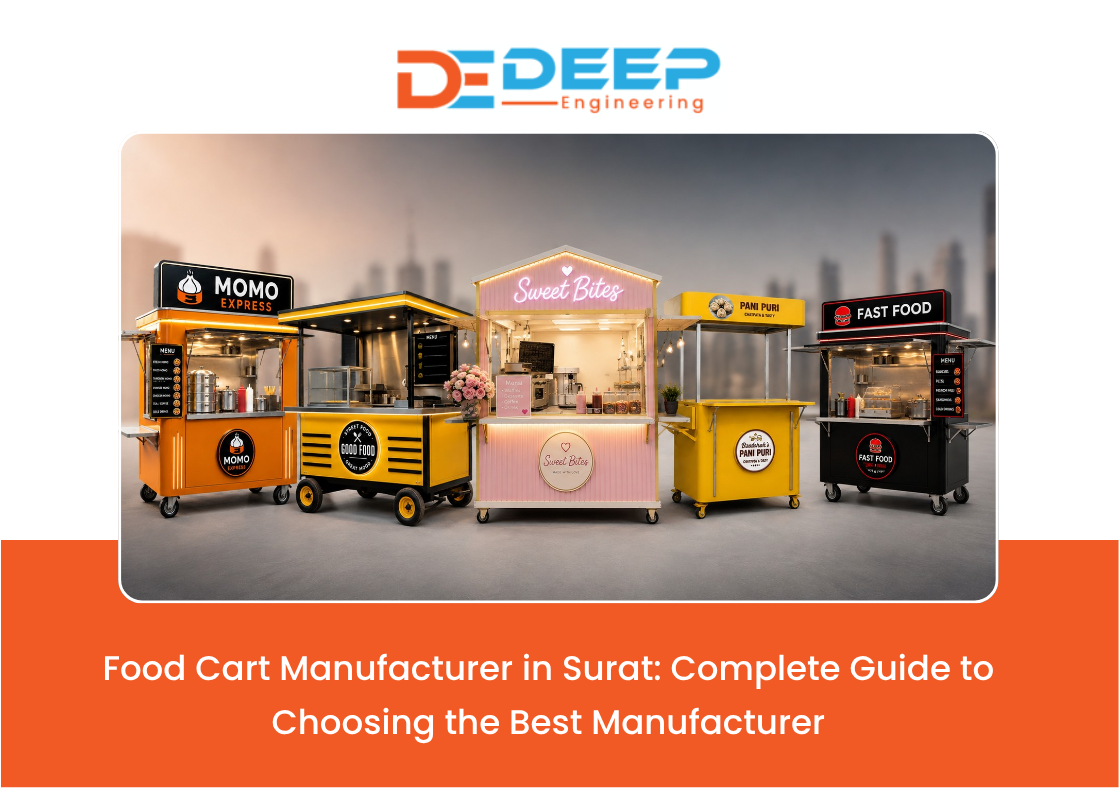
Choosing a Food Cart Manufacturer in Surat is not simply about finding a cart that looks attractive or has the lowest quotation. For a street food entrepreneur, the cart becomes the place where ingredients are prepared, food is cooked, customers are served, supplies are stored, and daily operations take place.
That makes the design, construction, workflow, hygiene, mobility, and storage of the cart important business decisions.
A poorly planned cart can create unnecessary movement, limited storage, awkward equipment placement, and difficult cleaning. A well-planned food cart can make the working area more organized and practical for everyday commercial use.
Deep Engineering Food Cart Manufacturer focuses on food carts, mobile food vans, kiosks, and food vending solutions designed around practical business requirements. Whether you are planning a panipuri setup, momo business, fast-food concept, waffle counter, or multi-purpose street food operation, choosing the right manufacturer starts with understanding what your business actually needs.
How do you choose the best food cart manufacturer in Surat?
Choose a food cart manufacturer in Surat by evaluating build quality, material, layout, storage, mobility, hygiene, customization, finishing, manufacturing capability, and after-sales communication. Most importantly, the manufacturer should understand your menu and working process so the finished cart supports efficient daily operations rather than simply looking good.
What Should You Look for in a Food Cart Manufacturer in Surat?
A reliable food cart manufacturer should be able to translate your food concept into a practical working setup. Look beyond appearance and compare the manufacturer’s ability to understand layout, materials, storage, equipment placement, mobility, and customization.
Before ordering, consider these factors:
- Manufacturing capability: Understand whether the supplier actually builds food vending structures or primarily resells standard products.
- Material selection: Ask what materials are proposed for the surfaces, structure, counters, storage, and other components.
- Functional layout: The cart should support preparation, cooking, serving, and storage without creating unnecessary movement.
- Customization: A standard cart may work for some businesses, while a specialized menu may require a custom arrangement.
- Storage: Ingredients, packaging, utensils, cleaning supplies, and backup stock need an organized place.
- Mobility: Wheels, overall dimensions, and operating requirements should match where the cart will be used.
- Hygiene: Food-contact and working surfaces should be practical to clean and maintain.
- Finishing: A professional finish can improve presentation while making everyday ownership easier.
- Quotation clarity: The quotation should make it clear what is included and what is an additional requirement.
For entrepreneurs comparing a food cart manufacturer in Surat Gujarat, the objective should be to find a manufacturing partner that understands the business behind the cart.
For a broader look at the company’s manufacturing focus, you can explore Food Cart Manufacturers.
Why Does Choosing the Right Manufacturer Matter for a Food Business?
A food cart is effectively a compact commercial kitchen and service counter. Its design affects how people work during every service period.
Consider a busy evening when several customers arrive together. Ingredients stored far from the preparation area can make the operator move around the cart repeatedly. A poorly positioned serving counter may also make customer interaction awkward. Limited working space can create another challenge when equipment takes up too much room, making food preparation less convenient.
A better layout connects the main activities:
Storage → Preparation → Cooking → Serving
This does not mean every cart should follow exactly the same arrangement. A panipuri cart, momo cart, waffle cart, and fast-food cart all have different workflows.
The right manufacturer should therefore start by understanding the menu rather than simply asking which standard model you want.
What Types of Food Carts Can You Buy in Surat?
The Surat market can support many food concepts, but the right cart depends on what you intend to prepare and sell.
Panipuri Cart
A panipuri setup needs convenient access to puris, flavored water, masala, serving materials, and customer-facing space.
The design should keep frequently used ingredients within practical reach while maintaining an organized serving area. Storage below or around the main counter can help keep supplies from occupying the working surface.
If panipuri is your primary concept, you can review the dedicated Panipuri Cart option for a product-specific reference.
Momo Cart
A momo cart typically needs a logical relationship between steaming or cooking equipment, ingredients, preparation space, and the serving counter.
For a business selling several momo varieties, ingredient organization becomes particularly important. The operator should be able to move from preparation to cooking to serving without repeatedly crossing the same working area.
See the dedicated Momo cart option when evaluating this type of setup.
Waffle Cart
A waffle business may require space for the cooking appliance, ingredients, toppings, packaging, and customer-facing presentation.
Because the finished product is often assembled in front of the customer, the serving and presentation area can be particularly important. A compact but organized arrangement can help keep preparation and presentation separate.
For a dedicated model, explore the Waffle Cart page.
Fast Food Cart
A fast-food cart may need greater flexibility because the menu can include multiple preparation methods and ingredients.
The manufacturer should understand which products require cooking, which require assembly, and which ingredients need frequent access. A flexible counter and storage arrangement can be more useful than simply maximizing the number of appliances.
A related Fast food stall can also help buyers understand the difference between a cart and a larger food-stall concept.
Stainless Steel Food Cart
Stainless steel is commonly considered for food-service environments because it provides a professional-looking surface that can be wiped and maintained as part of a regular cleaning routine.
The specific material and construction should still be discussed with the manufacturer according to the intended application.
See the Stainless steel food cart option for a dedicated product reference.
Multi-Purpose Cart
A multi-purpose cart can be useful when the entrepreneur wants to sell more than one related menu category.
For example, a compact snack concept might combine preparation, serving, and storage requirements within one structure. The important point is to avoid making the cart “multi-purpose” at the expense of workable space.
How to Choose a Food Cart Manufacturer in Surat: 10-Step Buyer Framework
1. Define Your Food Concept
Start with the menu.
Write down what you will prepare, what needs cooking, what needs refrigeration or storage, what needs assembly, and what will be handed directly to customers.
Why it matters: The menu determines the working zones and equipment requirements.
2. Decide Your Required Cart Size
Think about where the cart will operate and how many people will work around it.
Why it matters: A larger cart is not automatically better. The useful size is the size that fits the operating environment without creating unnecessary obstacles.
3. Choose the Right Material
Discuss material choices with the manufacturer based on the surfaces, structure, usage, and maintenance requirements.
Why it matters: Material affects appearance, cleaning, durability, and long-term commercial usability.
4. Plan the Workflow
Map the journey of an order from ingredient storage through preparation, cooking, assembly, and serving.
Why it matters: A logical workflow can reduce unnecessary movement during busy service periods.
5. Check Storage
Identify where ingredients, packaging, utensils, cleaning materials, and backup supplies will go.
Why it matters: Poor storage quickly turns a compact food cart into a cluttered workspace.
6. Evaluate Mobility
Consider how frequently the cart will be moved and where it will operate.
Why it matters: A mobile food cart may be used across markets, events, changing operating points, or other locations where repositioning is useful.
7. Consider Hygiene
Discuss working surfaces, cleaning access, storage organization, and areas where waste can be managed.
Why it matters: A cart must be practical to clean every day, not merely look clean when it is new.
8. Discuss Customization
Tell the manufacturer exactly which equipment, counters, storage sections, branding elements, and operating zones you require.
Why it matters: Customization can make the cart fit the business instead of forcing the business to adapt to a generic layout.
9. Compare Quotations
Compare quotations on the basis of what is actually included.
Why it matters: A lower headline price may not represent the same material, customization, storage, equipment, finishing, or logistics requirements.
10. Confirm the Final Design Before Manufacturing
Review dimensions, layout, equipment positions, storage, branding, and other agreed requirements before production begins.
Why it matters: Clarifying the design early can reduce misunderstandings between the buyer and manufacturer.
How Does Food Cart Design Affect Daily Workflow?
Good food cart design is a business tool. It should make the operator’s routine more logical rather than simply adding decorative features.
A useful way to think about a cart is through six zones:
- Cooking zone: Equipment required to prepare or heat food.
- Preparation zone: Ingredients and utensils needed before cooking or assembly.
- Serving zone: Customer-facing area where finished food is handed over.
- Storage zone: Ingredients, packaging, utensils, and backup supplies.
- Waste zone: A practical location for temporary waste handling.
- Customer-facing zone: Counter, menu presentation, branding, and interaction area.
| Cart Area | Purpose | Business Benefit |
|---|---|---|
| Main counter | Serving | Faster customer interaction |
| Prep area | Ingredient preparation | Better workflow |
| Storage | Supplies and ingredients | Less clutter |
| Equipment zone | Cooking | Easier operation |
| Lower compartments | Backup stock | Better organization |
| Waste area | Disposal | Improved cleanliness |
For a detailed visual reference, the company’s Food Cart Design section can help buyers think about different design approaches.
What Makes a Stainless Steel Food Cart Useful?
For many food businesses, a stainless steel food cart offers a clean, professional appearance and surfaces that can be practical to wipe and maintain.
The material can be particularly useful where the operator expects frequent cleaning and regular commercial use. However, buyers should still discuss the actual construction and intended application with the manufacturer rather than assuming that every stainless steel cart has identical specifications.
When comparing a stainless steel food cart Surat option, ask:
- Which areas use stainless steel?
- What is the proposed working-surface arrangement?
- How are storage areas organized?
- How will the cart be cleaned?
- Which parts are customized?
- What equipment will be installed?
- How does the proposed design support the menu?
The goal is not simply to select a material. It is to select a food-service setup that works for the operating environment.
How Much Does a Food Cart Cost in Surat?
There is no single useful price for every food cart because the final quotation can depend on the configuration.
Factors can include:
- Cart dimensions
- Construction material
- Design complexity
- Equipment
- Storage
- Branding
- Customization
- Electrical requirements
- Water systems
- Order quantity
- Finishing requirements
- Delivery arrangements
This is why someone searching for food cart price in Surat should compare quotations based on the complete specification rather than selecting the lowest number immediately.
A useful quotation should make it easier to understand what you are actually purchasing.
If you are considering a larger mobile setup, you can also compare the dedicated food van price information when evaluating the difference between a compact cart and a vehicle-based concept.
Food Cart vs Food Van: Which Is Better for Your Business?
A food cart and food van solve related but different operating problems.
| Factor | Food Cart | Food Van |
|---|---|---|
| Initial setup | Generally more compact | Larger mobile setup |
| Space required | Lower | Higher |
| Mobility | Easy repositioning | Vehicle-based mobility |
| Menu potential | Small to medium | Medium to large |
| Operating style | Street vending / compact locations | Mobile route-based business |
| Branding area | Moderate | Larger |
| Best suited for | Small and growing businesses | Larger mobile food concepts |
A cart may suit an entrepreneur who wants a compact operating setup, while a food van can make more sense when the business concept requires a vehicle-based mobile environment.
You can explore the dedicated Food Van option when comparing the two models.
The right choice depends on the menu, operating locations, staffing, required equipment, and business model—not simply on which option looks larger.
Explore Food Cart Options
If you already know your food concept, the next step is to compare practical cart configurations rather than browsing randomly.
Consider your menu, available operating space, storage requirements, equipment, mobility, and branding before selecting a model. You can explore available Food Cart options and then discuss whether a standard or customized setup is more appropriate.
When Should You Order a Custom Food Cart in Surat?
A custom food cart Surat solution can be useful when a standard layout does not match the business.
Customization may involve:
- Dimensions
- Counters
- Storage
- Equipment placement
- Branding
- Signage
- Lighting
- Menu boards
- Water systems
- Electrical arrangements
- Cooking zones
- Serving zones
When should I order a custom food cart?
Consider custom manufacturing when space is limited, your menu needs specialized equipment, you sell multiple product categories, branding is important, or a standard layout does not support your workflow.
For example, a waffle seller may need a different appliance arrangement from a momo seller. A panipuri business may prioritize ingredient and serving access, while a fast-food operator may need a more flexible cooking and assembly area.
Customization should solve a business problem. It should not add features simply because they are available.
Why Is Mobility Important for a Mobile Food Cart in Surat?
A mobile food cart Surat business can benefit from having a setup that can adapt to different operating requirements.
Potential contexts include:
- Markets
- Events
- College areas
- Corporate areas
- Festivals
- Changing customer-footfall patterns
Mobility does not guarantee higher sales. What it can provide is operating flexibility.
An entrepreneur may need to change the operating point, participate in an event, or use the same cart concept in different settings. The cart should therefore be designed around the actual level of movement expected.
Four Illustrative Food Cart Business Examples
The following are illustrative examples only, not Deep Engineering customer case studies.
A Small Startup in Surat
A first-time entrepreneur wants to start a compact panipuri or snack business.
Instead of investing in unnecessary features, the entrepreneur prioritizes a workable counter, ingredient storage, serving space, and practical cleaning access.
The result is a setup designed around the first menu rather than an oversized structure.
A Momo Business Near a High-Footfall Area
A momo seller expects busy service periods and needs cooking equipment, ingredients, packaging, and finished-food serving to work together.
The layout therefore places frequently used ingredients close to preparation and keeps the serving area accessible to customers.
A Café Expanding Into Street Food
A café owner wants an additional outdoor or mobile sales channel.
A branded food cart can create a separate serving point while keeping the visual identity connected to the existing business.
The important considerations are branding, menu compatibility, equipment, storage, and customer flow.
An Event Food Vendor
An event vendor may operate in different locations and need a mobile setup with organized storage.
In this case, mobility, compact organization, equipment placement, and quick access to supplies can be more important than having a large permanent counter.
How to Start a Food Cart Business in Surat
A food cart business in Surat should begin with a business concept, not with the cart itself.
Work through these questions:
- What food will you sell?
- Where do you expect to operate?
- How many people will work at the cart?
- What equipment is essential?
- What ingredients need regular storage?
- How much customer-facing space is required?
- How frequently will the cart move?
- What branding will customers see?
- How will the cart be cleaned at the end of the day?
- What future upgrades might you need?
Surat entrepreneurs should also confirm applicable local permissions, food-safety requirements, and municipal rules before beginning operations. Requirements can depend on the business model and operating location.
The manufacturer can help with the physical food vending setup, but the entrepreneur remains responsible for confirming the permissions and operational requirements that apply to the business.
What Should “Food Cart Manufacturer Near Surat” Mean to a Buyer?
When comparing a food cart manufacturer near Surat, physical distance is only one consideration.
Also evaluate:
- Communication
- Design discussions
- Customization process
- Logistics
- Delivery arrangements
- After-sales communication
- Ability to understand your business requirements
A manufacturer that can clearly discuss your menu, dimensions, workflow, storage, and equipment requirements may be more useful than simply choosing a supplier based on proximity.
Can You Find a Food Cart Manufacturer in Surat With Home Delivery?
Delivery availability depends on factors such as the cart size, destination, logistics requirements, order specifications, and manufacturer policies.
If you are searching for a food cart manufacturer in Surat with home delivery, confirm the delivery arrangement before placing the order.
Ask:
- Is delivery available to my destination?
- Is delivery included in the quotation?
- Is unloading included?
- Does the cart require special transport?
- What happens if customization changes the dimensions?
- Is installation required after delivery?
Do not assume that every cart or every destination has the same delivery terms.
How Can Startups Find an Affordable Food Cart Manufacturer in Surat?
An affordable food cart manufacturer in Surat for startups should be evaluated based on value, not simply the smallest upfront quotation.
A startup can control initial investment by prioritizing:
- Essential equipment
- Practical dimensions
- Efficient storage
- Durable construction
- Necessary branding
- Future upgrade possibilities
For example, if an expensive decorative feature does not improve workflow or customer service, it may not be a priority at launch.
At the same time, cutting costs in critical areas such as working space, storage, or practical construction can create problems later.
A sensible approach is to build the cart around the essentials and discuss which upgrades can be added when the business expands.
What Should You Know About Food Cart Fabrication in Surat?
Food cart fabrication Surat buyers should understand that the visible counter is only one part of the finished setup.
Discuss:
- Frame construction
- Surface finishing
- Counter layout
- Storage fabrication
- Equipment placement
- Wheels
- Hinges and openings
- Branding structures
The exact construction approach should be confirmed with the manufacturer based on the intended cart design.
A good fabrication discussion should answer a simple question:
Will this cart remain practical when it is being used every day?
That question is more useful than judging the cart solely from photographs.
How Should Food Cart Design in Gujarat Adapt to the Business?
Good food cart design Gujarat businesses can vary significantly because the menu, location, climate, available space, customer flow, and mobility requirements differ.
A cart intended for a fixed commercial location may be designed differently from one used at events.
Similarly, a business operating with one primary product may need a highly focused layout, while a multi-menu business may need more flexible storage and equipment placement.
Design should therefore respond to:
- Menu
- Available space
- Operating location
- Customer flow
- Mobility requirements
- Branding
- Cleaning requirements
A visually impressive cart that is difficult to operate is not necessarily a good business investment.
Food Stall Manufacturer Gujarat: Cart, Stall or Kiosk?
A generic fabricated stall, purpose-built food stall, mobile food cart, and kiosk can serve different business models.
Generic Fabricated Stall
Useful when the business primarily needs a fixed counter structure.
Purpose-Built Food Stall
Better suited when the layout is designed around a specific food-service workflow.
Mobile Food Cart
Useful for compact vending and situations where repositioning is part of the operating model.
Food Kiosk
Can suit businesses that need a more structured customer-facing setup in a designated location.
The correct choice depends on the operating environment, menu, available space, and mobility requirements.
For another related vending concept, the pan counter option illustrates how specialized food-service counters can differ from general-purpose carts.
What Should a Food Cart Cost in Gujarat Include?
When comparing food cart cost in Gujarat, request a quotation that clearly separates the main components.
Ask whether the quotation covers:
- Base cart
- Materials
- Equipment
- Customization
- Branding
- Electrical work
- Storage
- Delivery
- Installation, if applicable
This makes it easier to compare two manufacturers fairly.
For example, one quotation may appear cheaper because equipment or delivery has been excluded. Another may include more of the required setup.
The important comparison is therefore:
Total required setup cost + usability + construction + included components
rather than the headline cart price alone.
What Should You Prioritize When Buying a Food Cart?
| Priority | Why It Matters |
|---|---|
| Durable construction | Supports regular commercial use |
| Efficient layout | Reduces unnecessary movement |
| Storage | Keeps supplies organized |
| Mobility | Helps adapt to operating locations |
| Hygiene | Supports cleaner daily service |
| Customization | Matches menu and workflow |
| Branding | Improves professional presentation |
| Maintenance | Makes daily ownership easier |
If your budget is limited, use this list to distinguish between essential business functions and optional features.
Why Consider Deep Engineering?
Deep Engineering Food Cart Manufacturer focuses on practical food vending solutions, including food carts, food vans, kiosks, and food vending equipment.
The business focuses on solutions built around:
- Durable construction
- Organized layouts
- Mobility
- Custom designs
- Modern finishes
- Practical daily commercial use
- Food business requirements
This makes the manufacturer relevant to entrepreneurs who need more than a generic fabricated structure and want to discuss the physical setup around their menu and workflow.
For more information about the company and its manufacturing focus, visit Food Cart Manufacturers.
How Should You Evaluate Food Carts Before Buying?
Before choosing among available food carts for sale, avoid starting with appearance or price alone.
Evaluate each option against:
- Food category
- Available operating space
- Equipment
- Storage
- Mobility
- Material
- Customization
- Branding
- Budget
- Daily cleaning requirements
A useful approach is to score each quotation against the same checklist.
For example, if Cart A costs less but lacks required storage and equipment space, while Cart B costs more but includes a layout that fits your workflow, the second option may provide greater practical value.
The goal is not to buy the most expensive cart. It is to buy a setup that makes sense for the business.
Buyer Checklist: Before Ordering a Food Cart
Before placing an order, confirm:
- Menu
- Cart dimensions
- Material
- Layout
- Equipment
- Storage
- Mobility
- Branding
- Electrical requirements
- Water requirements
- Cleaning needs
- Delivery arrangements
- Final quotation
- Customization details
Keeping this checklist beside the quotation can make supplier comparison much easier.
FAQ
Choose a manufacturer that can understand your menu, workflow, dimensions, storage, equipment, mobility, hygiene, and customization requirements. Compare the construction and complete quotation rather than selecting a supplier solely because of a low price. A good manufacturer should be able to explain how the proposed cart fits your intended business operation.
Food cart pricing in Surat depends on dimensions, materials, design complexity, equipment, storage, branding, customization, electrical or water requirements, finishing, order quantity, and delivery. Instead of relying on a generic price figure, ask for a detailed quotation based on your actual cart requirements and compare what each supplier includes.
A food cart is generally a more compact vending setup that can suit street-food and small-business operations. A food van is a vehicle-based mobile food solution with more physical space and a larger branding area. The appropriate option depends on the menu, operating model, locations, equipment requirements, and scale of the planned business.
Delivery depends on the cart’s dimensions, destination, logistics requirements, order specifications, and manufacturer policies. Confirm delivery availability, transportation charges, unloading arrangements, and any installation requirements before placing the order. Do not assume that the same delivery terms apply to every location or cart configuration.
A food cart can be suitable for many street food concepts when its design matches the menu, operating location, equipment, storage, customer flow, and mobility requirements. Entrepreneurs should also confirm applicable local permissions, food-safety requirements, and municipal rules before starting operations.
Conclusion
Choosing a Food Cart Manufacturer in Surat should begin with your business requirements, not with a photograph or the cheapest quotation.
The right cart needs to support the way you actually work. Your menu, equipment, storage, preparation process, serving method, customer flow, mobility needs, branding, and cleaning routine should all influence the final design.
Durability matters because a commercial cart is used repeatedly. Layout matters because unnecessary movement can make daily service harder. Storage matters because a compact workspace quickly becomes cluttered when supplies do not have a logical place. Customization matters when a standard configuration cannot accommodate the menu.
For buyers comparing manufacturers, the best approach is to define the business first and then ask manufacturers to build around those requirements.
Deep Engineering Food Cart Manufacturer offers food carts, food vans, kiosks, and food vending solutions with a focus on durable construction, organized layouts, mobility, customization, modern finishes, and practical commercial use.
If you are planning a new street food business, upgrading an existing cart, or developing a mobile food concept, discuss your cart type, dimensions, menu, workflow, customization requirements, budget, and delivery needs before finalizing the design.
Start your discussion with Food Cart Manufacturer and make the cart a practical part of your business plan—not just a structure for displaying food.