
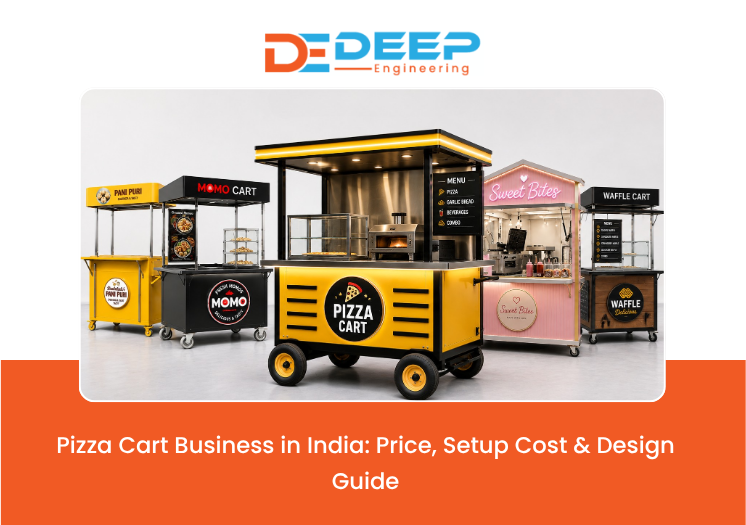
A Pizza Cart can be a practical way to enter the food business without immediately taking on the space, interiors and overheads of a full restaurant. For an entrepreneur with a focused menu, the right cart can combine cooking, preparation, storage, branding and customer service within a compact footprint.
The important question is not simply, “How much does a pizza cart cost?” The better question is: What cart, equipment and workflow does your particular pizza business actually need?
This guide explains pizza cart price in India, setup cost, equipment, design, mobility, business ideas, location considerations and how to evaluate a manufacturer before placing an order.
Pizza Cart Business at a Glance
- Pizza cart price: There is no universal price. It depends on size, material, fabrication, equipment, storage, branding and customization.
- Setup cost: Your total investment can include the cart, pizza oven, refrigeration, utensils, raw materials, packaging, branding, transportation and applicable permissions.
- Equipment: A typical setup may require an oven, preparation counter, ingredient storage, refrigeration, pizza tools, packaging storage, lighting and cleaning equipment.
- Best suited for: First-time entrepreneurs, street-food vendors, cafés, QSR operators, event sellers and businesses testing a new location or concept.
- Major advantages: Mobility, compact space requirements, organized workflow, branding opportunities and the ability to build a focused grab-and-go menu.
The right setup should be designed around your menu, expected production volume, location and operating process rather than buying the largest cart available.
What Is a Pizza Cart and How Does the Business Work?
A pizza cart is a compact food-vending unit designed to prepare and sell pizza from a mobile or semi-mobile setup. Depending on its configuration, it may include a cooking area, preparation counter, storage, refrigeration, service counter and branding surfaces.
Unlike a conventional restaurant, the business is built around a smaller operational footprint. That can make it useful in places where customers want quick food but a full restaurant premises may not be practical.
For example, a pizza cart near a college, office cluster, residential neighbourhood, evening market or food zone can operate with a short menu focused on quick preparation and takeaway.
The operating model is straightforward:
- Prepare dough and ingredients.
- Store ingredients in an organized manner.
- Assemble pizzas at the preparation counter.
- Cook them using the selected oven.
- Cut, package and serve.
- Clean and restock the cart for the next service period.
This makes workflow particularly important. If the oven, preparation surface, ingredients and packaging are badly positioned, even a visually attractive cart can become difficult to operate during busy periods.
Why Start a Pizza Cart Business in India?
A pizza cart can fit several types of Indian food-business models, particularly where customers prefer quick, affordable and convenient food.
Some potential advantages include:
- Compact setup: Less physical space may be required than for a conventional restaurant.
- Mobility: Depending on the cart design and local rules, the business can have greater flexibility in location.
- Branding potential: The cart itself becomes part of the customer-facing identity.
- Focused menu: A small menu can simplify preparation and inventory management.
- Location testing: Entrepreneurs can assess demand before committing to a larger premises.
- Grab-and-go format: Pizza, slices, personal pizzas and combinations can work with takeaway-focused service.
- Menu flexibility: Pizza can be combined with garlic bread, beverages or other complementary products.
For someone researching a low investment food business, a pizza cart can therefore be worth evaluating alongside other QSR business ideas.
The pizza on wheels business model can also suit entrepreneurs who want to experiment with different customer environments, subject to local permissions and practical access.
The broader mobile food business trends 2026 are also relevant here: customers increasingly encounter food concepts through compact, visually branded and convenient formats. However, demand still depends heavily on location, pricing, food quality and execution.
Pizza Cart Price in India – What Should You Expect?
There is no single standard pizza cart price in India because carts are built according to different specifications.
The final quotation may depend on:
- Cart dimensions
- Stainless steel and other material specifications
- Body and frame construction
- Wheels and mobility requirements
- Countertop configuration
- Storage capacity
- Pizza oven
- Refrigeration
- Preparation area
- Electrical arrangement
- Gas or other equipment requirements
- Sink or water system, if required
- Branding and signage
- Lighting
- Custom fabrication
- Transportation and installation requirements
A useful way to compare options is to understand the type of setup rather than comparing only headline prices.
| Pizza Cart Type | Suitable For | Main Advantage | Major Cost Factors |
|---|---|---|---|
| Basic Pizza Cart | Beginners | Compact entry point | Basic fabrication and storage |
| Standard Pizza Cart | Regular street vending | Better workflow | Equipment and customization |
| Premium Pizza Cart | Professional branding | Strong presentation | Advanced equipment and finish |
| Pizza Kiosk | Fixed locations | More workspace | Larger structure and installation |
| Pizza Food Van | Larger mobile operations | Higher production capacity | Vehicle, conversion and equipment |
When requesting quotations, give the manufacturer your required size, menu, equipment and operating location. A customized quotation is more useful than comparing two carts that have completely different specifications.
Pizza Cart Setup Cost – What Goes Into the Investment?
The pizza cart setup cost should be viewed as a complete business setup rather than the fabrication cost alone.
Your initial budget may include:
- Cart fabrication – Body, frame, counter, wheels and storage.
- Pizza oven – Selected according to the cooking method and expected output.
- Preparation equipment – Work surfaces, dough tools, trays and containers.
- Refrigeration – Useful for ingredients that require controlled storage.
- Storage – Shelves, drawers and ingredient compartments.
- Utensils – Peel, cutters, pans, measuring equipment and preparation tools.
- Branding – Signage, menu board, graphics and lighting.
- Initial inventory – Dough ingredients, cheese, sauces, toppings and beverages.
- Packaging – Boxes, bags, tissues and takeaway materials.
- Permissions and compliance – Applicable food and local business requirements.
- Transportation – Moving the cart to its operating location.
- Contingency – A reserve for unexpected setup or operating expenses.
It helps to separate one-time investment from recurring expenses. Ingredients, packaging, fuel or electricity, labour, location charges and maintenance can continue after launch.
Pizza Cart Equipment List – What Do Beginners Actually Need?
A practical pizza cart equipment checklist for beginners should start with the menu.
A typical setup may include:
- Pizza oven
- Dough preparation area
- Stainless steel work counter
- Refrigeration or cooling arrangement
- Ingredient storage
- Sauce containers
- Cheese and topping containers
- Pizza peel
- Pizza cutter
- Trays and pans
- Measuring tools
- Dough-handling tools
- Packaging storage
- Waste bin
- Cleaning supplies
- Lighting
- Electrical arrangement
- Fire-safety equipment where applicable
You may not need every item in every cart.
For example, an entrepreneur selling a very limited personal-pizza menu may need a simpler preparation arrangement than a larger operation producing multiple pizza styles and toppings.
The objective should be functional equipment integration, not filling every available section of the cart with equipment.
How to Choose the Best Mobile Pizza Cart Design
A good mobile pizza cart design should make the operator’s work easier during both slow and busy periods.
Think about the cart as a small commercial kitchen.
A practical layout can have:
- Customer-facing zone: Service counter, menu board and branding.
- Cooking zone: Oven and heat-related equipment positioned for safe operation.
- Preparation zone: Dough and topping assembly area.
- Storage zone: Frequently used ingredients within easy reach.
- Refrigeration zone: Chilled ingredients stored appropriately.
- Packaging zone: Boxes and takeaway materials close to the service area.
- Cleaning zone: Accessible surfaces and waste-management provisions.
Operator movement matters. The person preparing a pizza should not have to repeatedly walk around the cart to collect ingredients, open storage or reach packaging.
The best design for a beginner is usually not the most elaborate design. It is the one that supports a simple, repeatable workflow.
What Makes a Good Stainless Steel Pizza Cart?
A stainless steel pizza cart can be particularly practical for food-service operations because properly selected and fabricated stainless steel surfaces can be easier to clean and maintain.
The benefit is not simply appearance.
A well-planned stainless steel food cart can support:
- Easier routine cleaning
- A professional food-service appearance
- Organized preparation
- Durable daily use
- Better access to work surfaces
- Practical maintenance
Buyers should still ask the manufacturer about material specifications, frame construction, joints, welding and finishing. A shiny exterior alone does not tell you how well a cart has been fabricated.
For comparison, you can also review the specifications and design approach of a Stainless steel food cart before deciding what configuration suits your business.
Pizza Kiosk Design vs Mobile Pizza Cart
The right choice depends mainly on how and where you plan to sell.
| Factor | Pizza Cart | Pizza Kiosk |
|---|---|---|
| Mobility | High | Low/fixed |
| Space | Compact | More space |
| Setup | Flexible | Location dependent |
| Branding | High | Very high |
| Storage | Moderate | Higher |
| Best for | Mobile/street sales | Malls, markets and fixed sites |
A cart makes more sense when mobility and compactness are priorities. A kiosk may be preferable when you already have a fixed, high-visibility location and want additional workspace.
Neither is automatically better. The business location should drive the decision.
Pizza Cart vs Pizza Truck – Which Is Better?
For many first-time entrepreneurs, a cart can be a simpler starting point than a food truck. A truck offers greater internal space and potentially higher production capacity, but it also introduces vehicle-related costs, maintenance and location considerations.
| Factor | Pizza Cart | Pizza Truck |
|---|---|---|
| Initial complexity | Lower | Higher |
| Operating space | Compact | Larger |
| Equipment capacity | Limited by cart size | Higher potential capacity |
| Mobility | Good | Good |
| Vehicle maintenance | Minimal compared with truck | Significant |
| Parking requirements | Location dependent | More demanding |
| Staffing | Can be compact | Often requires more coordination |
| Branding | Strong | Very strong |
| Suitable for | Small/startup concepts | Larger mobile operations |
So, pizza cart vs pizza truck – which is better? If your priority is testing a focused concept with a compact setup, a cart may be more appropriate. If your model requires higher production, more equipment and a larger service operation, a truck may justify its additional complexity.
Pizza Cart Business Ideas for Indian Markets
The strongest idea is usually one that matches a clear customer group and location.
Consider these practical concepts:
- College-area pizza cart – Personal pizzas, slices and affordable combos.
- Evening market cart – Quick-service pizza for shoppers and families.
- Office-area lunch concept – Smaller pizzas and fast takeaway.
- Residential evening cart – Focus on families and nearby residents.
- Event and festival setup – Mobile service for temporary gatherings, where permitted.
- Sports-ground setup – Quick food for spectators and participants.
- Premium personal-pizza concept – Higher emphasis on ingredients and presentation.
- Pizza and beverage combo – Simple food-plus-drink offering.
- Pizza and garlic bread concept – A focused menu using overlapping ingredients.
- Weekend pop-up – Test demand before expanding into a permanent operation.
A simple menu can make a compact food cart kitchen easier to operate. It can also reduce the number of ingredients, containers and preparation steps required.
Pizza Cart Business Cost and Profit Margin – What Should You Calculate?
There is no universal pizza cart profit margin because selling price, food cost, location, volume, labour and operating expenses differ substantially.
A basic calculation is:
Selling Price
− Food Cost
− Packaging
− Fuel/Electricity
− Staff Cost
− Location Cost
− Transportation
− Maintenance
= Approximate Operating Contribution
For example, suppose a hypothetical pizza is sold for ₹180. If ingredients, packaging and direct operating costs together consume ₹100, the remaining ₹80 is not automatically profit. Other expenses such as staff, rent or location charges, transportation, maintenance, taxes and business overheads still need to be considered.
This distinction matters when calculating pizza cart business cost and profit margin.
Track actual numbers after launch instead of relying on generic online profit estimates.
How to Start a Pizza Cart Business in India – Step-by-Step
If you’re wondering how to start a pizza cart business in India, use this sequence:
1. Research Local Demand
Study customer behaviour, existing competitors, pricing and peak hours around potential locations.
2. Choose Your Target Customer
Decide whether you are targeting students, office workers, families, shoppers or event customers.
3. Finalize the Menu
Start with a manageable number of pizzas and complementary products.
4. Select the Cart Format
Choose between a mobile cart, fixed kiosk, larger cart or food van based on your operating model.
5. Decide Equipment
Select the oven, refrigeration, preparation surfaces and storage according to your menu.
6. Plan the Workflow
Map the journey from ingredient storage to preparation, cooking, packaging and handover.
7. Check Applicable Permissions
Food businesses can be subject to food-safety, local vending, municipal, fire-safety or other requirements depending on the location and operating model. Verify current requirements with the relevant government and local authorities before starting.
8. Select a Manufacturer
Compare fabrication quality, specifications, customization, equipment integration and quotation terms.
9. Build Your Branding
Use the cart as a visible extension of your brand through signage, colours, menu presentation and lighting.
10. Test Operations
Run a controlled trial to identify workflow problems before committing to full-scale operations.
11. Launch
Begin with a location and menu that you can manage consistently.
12. Track Results
Monitor sales, food cost, waste, customer feedback, peak periods and repeat demand.
How to Choose a Pizza Cart Manufacturer in India
Choosing a pizza cart manufacturer India buyers can work with should involve more than checking photographs and the lowest quotation.
Ask about:
- Manufacturing and fabrication experience
- Material specifications
- Customization capability
- Equipment integration
- Welding and fabrication quality
- Storage design
- Mobility
- Surface finishing
- Hygiene considerations
- Workflow planning
- Quotation transparency
- Transportation and installation terms
- Warranty or service terms, where offered
- Previous designs or gallery examples
- Understanding of your menu and business model
A manufacturer should be able to discuss how your cart will actually be used.
For broader research, entrepreneurs can review this Food Cart Manufacturer in India resource before comparing configurations.
Why Work With Deep Engineering Food Cart Manufacturer?
Deep Engineering Food Cart Manufacturer focuses on food-vending equipment including food carts, mobile food vans, kiosks and customized vending solutions.
Its product approach covers applications such as momo carts, panipuri carts, ice gola carts, fast-food carts, street-food carts and multi-purpose stainless steel carts.
For a pizza business, the practical value lies in being able to plan the cart around the operator’s requirements: mobility, storage, work surfaces, organized preparation and a professional customer-facing finish.
A buyer can discuss requirements such as cart dimensions, equipment placement, storage and branding instead of treating the cart as a generic ready-made box.
Entrepreneurs researching a food cart manufacturer India can also review the company’s broader background through Food Cart Manufacturers.
Other Food Cart Options You Can Consider
Pizza is only one possible food-vending model. If your location or target audience suggests another menu may perform better, comparing different cart formats can be useful.
For example, a dessert-focused concept may benefit from a Waffle Cart, while a traditional Indian snack business could consider a Panipuri Cart.
For other quick-service menus, options such as a Momo cart, Fast food stall or pan counter may be more appropriate.
The key is to select the equipment format according to your menu, customer profile, location and expected workflow.
Explore Food Cart and Food Van Options
If you’re still comparing formats, you can explore the broader Food Cart range rather than committing immediately to one design.
Entrepreneurs comparing ready-to-configure options can also review food carts for sale.
For businesses that need more space or mobility, compare a Food Van and review the considerations around food van price.
The correct investment depends on production requirements, mobility, equipment capacity and the type of location you intend to serve.
Food Cart Design and Customization
Customization should solve operational problems, not simply make the cart look different.
When reviewing Food Cart Design, look at:
- Counter arrangement
- Customer-facing branding
- Storage access
- Cooking area
- Preparation surface
- Menu board placement
- Equipment positioning
- Cleaning access
- Lighting
- Operator movement
For a pizza business, the ideal design should make the journey from dough and toppings to oven, cutting, packaging and customer handover as straightforward as possible.
That is also why customization can be valuable. A cart designed around your actual workflow may be more useful than a larger but poorly organized standard model.
Food Cart Manufacturer Locations and Service Considerations
Entrepreneurs often begin with location-specific searches such as food cart manufacturer in Ahmedabad, food cart manufacturer in Rajkot, food cart manufacturer in Surat or food cart manufacturer in Bhavnagar.
Across Gujarat, searches may also include a food cart manufacturer in Vadodara, food cart manufacturer in Himmatnagar or a broader food cart manufacturer in Gujarat.
Outside Gujarat, buyers may search for a food cart manufacturer in Rajasthan, food cart manufacturer in Jaipur, food cart manufacturer in Indore, food cart manufacturer in Delhi NCR, food cart manufacturer in Gurugram, or manufacturers serving MP and Uttar Pradesh.
Rather than choosing a manufacturer only because it appears closest in a search result, compare:
- Transportation arrangements
- Customization
- Installation requirements
- Communication
- Fabrication quality
- Design support
- Equipment integration
- Quotation transparency
These factors can matter more to the final buying experience than the city name alone.
FAQs About Pizza Carts
A pizza cart is a compact mobile or semi-mobile food-vending unit designed to prepare and sell pizza. Depending on the configuration, it can include an oven, preparation area, storage, refrigeration and customer-facing service counter.
Pizza cart cost varies according to dimensions, material, construction, equipment, storage, branding and customization. The most reliable approach is to request a quotation based on your exact requirements.
Common equipment includes a pizza oven, preparation counter, refrigeration or cooling, ingredient storage, pizza peel, cutter, trays, pans, packaging storage, lighting and cleaning equipment. The exact list depends on the menu and cooking method.
A pizza cart is generally more compact and simpler to operate, while a pizza truck provides more internal space and potentially greater equipment capacity. The choice depends on budget, production volume, mobility and location requirements.
Yes. A pizza cart can be planned around requirements such as size, storage, preparation areas, equipment placement, branding, lighting and other operational features, subject to the chosen construction and equipment specifications.
Food-service areas commonly benefit from appropriately specified stainless steel because it can provide a practical, professional and cleanable surface. Buyers should confirm the actual material specifications and construction quality with the manufacturer.
Compare material specifications, fabrication quality, customization, equipment integration, workflow design, storage, quotation transparency, transportation, installation and service terms. Do not evaluate a manufacturer only on the lowest price.
Conclusion
A pizza cart is most useful when it is designed around the business rather than purchased as a generic piece of equipment. Before investing, define your menu, target customer, location, production requirements, equipment and budget.
If you are planning a pizza business and want to discuss a customized configuration, you can connect with the Food Cart Manufacturer to discuss the required cart size, equipment arrangement, storage, branding and operating workflow.
The goal should be a food cart that is practical to operate every day—not simply attractive on launch day.
Plan the cart around your menu, location and workflow. For a customized pizza cart quotation, discuss your required size, equipment, storage and branding requirements with Deep Engineering before placing an order.