
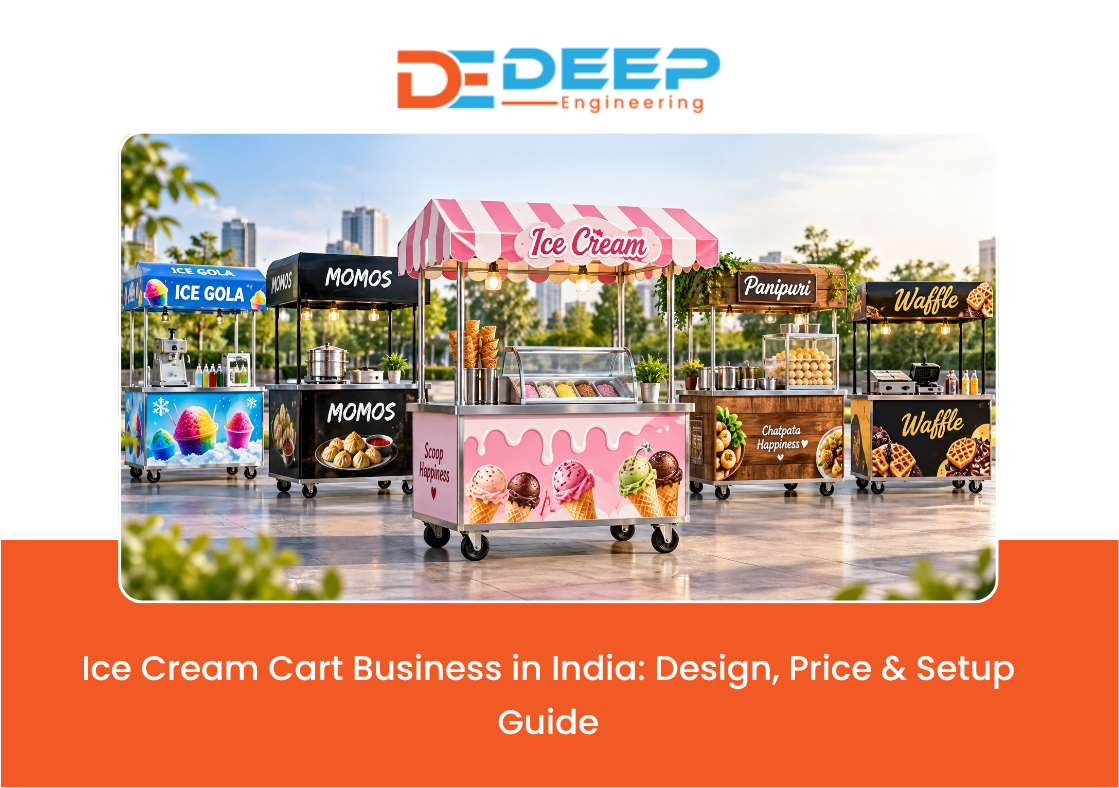
An ice cream cart can be a practical way to enter India’s mobile food and dessert market without starting with a conventional shop. The model is particularly useful in locations where customer demand changes by time of day, season, event, or footfall.
But the cart itself should not be treated as an afterthought. Its design affects how easily the operator works, how products are stored, how the serving area is maintained, how visible the brand is, and how easily the business can move between suitable locations.
For a new entrepreneur, the right approach is to plan the product range, location, storage, mobility, hygiene and cart configuration together.
Deep Engineering manufactures food carts and mobile vending solutions with customization as an important part of the process. Entrepreneurs exploring different formats can also review its Food Cart Manufacturer in India offering before deciding what type of setup fits their business.
What Is an Ice Cream Cart Business?
An ice cream cart business is a mobile or semi-mobile food-vending model in which packaged or prepared ice cream products are sold from a purpose-built cart at suitable customer locations.
The model can work particularly well where there is consistent pedestrian activity, subject to applicable permissions and operating requirements.
Common locations can include:
- Parks and recreational areas
- Residential communities
- Markets
- Tourist locations
- Events and exhibitions
- School or college areas where vending is permitted
- Busy evening areas
- Private premises with permission
- Seasonal gatherings
The major advantage is location flexibility. Instead of depending entirely on customers visiting a permanent shop, a mobile ice cream cart can potentially be positioned closer to the relevant customer base.
That does not mean mobility automatically creates a profitable business. The location, product selection, purchasing cost, wastage, operating hours, competition, weather and local requirements all matter.
For some entrepreneurs, a compact cart is also a useful way to test demand before considering a larger kiosk, shop or Food Cart.
How to Start an Ice Cream Cart Business in India
A sensible setup process starts with the business model rather than the cart catalogue.
1. Choose the business model
Decide what you will actually sell.
Possibilities include:
- Packaged ice cream
- Cups and cones
- Ice cream bars
- Scoops, where the required equipment and handling process are appropriate
- Premium desserts
- Combination ice cream products
- Branded products under a dealership or distribution arrangement
The product range determines the storage and serving requirements.
2. Select the selling location
A cart needs customers, not simply an attractive road-facing position.
Study:
- Footfall by time of day
- Customer profile
- Nearby competitors
- Evening demand
- Parking and access
- Seasonal changes
- Permission requirements
- Whether the cart can be safely positioned and moved
3. Decide the product range
Avoid buying a large cart simply because it looks impressive.
A smaller product range can make inventory and daily operations easier when starting out.
4. Choose cart size and design
The cart should accommodate the required storage, serving surface, branding and operator workspace without becoming unnecessarily difficult to move.
5. Plan storage and cooling requirements
This is one of the most important decisions.
A cart selling products that require temperature-controlled storage needs a different solution from a cart selling products that can be handled through another approved cold-storage arrangement.
Do not assume that every ice cream cart requires the same refrigeration system. Discuss the product and operating model with the manufacturer before finalizing the design.
6. Consider branding and customization
A clean canopy, visible brand name, menu panel and appropriate lighting can make the cart easier for customers to identify.
Branding should support the business rather than consume useful working or storage space.
7. Understand local permissions and operating requirements
Requirements can vary by city and business model. Verify the latest applicable municipal, food-safety, vending, electrical and other requirements for your location before operating.
8. Estimate working capital
Your starting budget is not only the cart.
Allow for inventory, packaging, transportation, cooling or electricity requirements where applicable, maintenance, branding, staff and other operating expenses.
9. Plan daily operations
Decide who will:
- Transport the cart
- Load inventory
- Clean the serving area
- Manage stock
- Handle payments
- Monitor wastage
- Maintain the required storage conditions
10. Launch and test the location
If possible, evaluate the first location carefully instead of assuming that the busiest-looking location is automatically the best one.
An evening location may behave differently from the same location during the afternoon.
How Much Does an Ice Cream Cart Cost in India?
There is no single useful price for every ice cream cart because the final ice cream cart price in India depends heavily on configuration.
A quotation can change according to:
- Overall cart dimensions
- Construction material
- Applicable stainless-steel specification
- Insulation requirements
- Storage arrangement
- Cooling or refrigeration requirements
- Serving counter
- Wheels and mobility hardware
- Canopy
- Lighting
- Branding
- Electrical provisions
- Fabrication complexity
- Accessories and equipment
- Customization
A basic cart and a purpose-built commercial vending cart may therefore represent very different investments.
This is why comparing only the headline price can be misleading. A cheaper cart may not provide the storage layout, mobility, cooling compatibility or working space your business actually requires.
For a customized project, it is generally more useful to give the manufacturer your product range, expected operating environment, desired dimensions, storage requirements and branding needs and then compare quotations on a like-for-like basis.
If you are comparing several configurations, also consider the total cost of ownership—not just the initial purchase amount.
Ice Cream Cart Design: What Should a Good Cart Include?
A good ice cream cart design should make daily selling easier.
Storage and organization
Storage should be planned around the products and accessories you actually carry.
Think about:
- Product storage
- Packaging
- Napkins
- Spoons
- Cups
- Cleaning materials
- Payment equipment
- Small consumables
Poor organization can turn a compact cart into a frustrating workspace.
Serving counter
The serving surface should provide enough room for the actual serving process without unnecessarily increasing the cart footprint.
Hygiene and cleaning
Food-contact and working surfaces should be practical to clean.
An easy-to-clean surface can make daily operations more manageable, particularly when the cart is being used for several hours.
Mobility
Consider wheel size, overall weight, maneuverability and the actual terrain where the cart will be moved.
A cart that works well on smooth private premises may behave differently on uneven surfaces.
Customer visibility
The customer should be able to understand what is being sold quickly.
Menu space, product display and branding should be visible without blocking the operator’s workspace.
Branding
A cart can effectively act as a small moving storefront.
Branding areas may include:
- Canopy
- Front panel
- Side panels
- Menu board
- Product graphics
Ergonomics
The operator may spend hours at the cart. Counter height, reach distance and access to storage should therefore be considered before fabrication.
Weather protection
If the cart is intended for outdoor use, consider the effect of sun, rain, dust and changing weather conditions on the operating setup.
Cooling and storage requirements
This deserves special attention. A refrigerated food cart, insulated storage solution or another cold-storage configuration should be selected according to the products and operating process—not simply because a particular design looks attractive.
Maintenance
Ask how accessible the components are for routine cleaning, inspection and maintenance.
Best Ice Cream Cart Design for Small Investment
The best small-investment design is usually not the cart with the fewest features. It is the cart that provides the essential functions without paying for features the business does not need.
A beginner should prioritize:
- Appropriate storage
- Easy cleaning
- Adequate serving space
- Reliable mobility
- Practical dimensions
- Basic but effective branding
- Compatibility with the chosen cooling/storage arrangement
- Straightforward maintenance
For example, if the business sells a limited packaged range, there may be little reason to build a very large preparation workspace.
This is the difference between low initial cost and low total cost of ownership. Saving money upfront is less useful if the cart later creates problems with storage, movement, maintenance or daily workflow.
Why Choose a Stainless Steel Ice Cream Cart?
A stainless steel ice cream cart can be a practical choice for food-service operations because stainless steel provides an easy-to-clean working surface and a professional appearance while being suitable for everyday commercial use.
Useful considerations include:
- Ease of routine cleaning
- Professional presentation
- Practical food-service use
- Durability for normal operating conditions
- Resistance to everyday wear
- Compatibility with customized layouts
The exact material specification should still be confirmed with the manufacturer rather than assuming that every stainless-steel cart has identical construction.
For entrepreneurs comparing options, Deep Engineering’s Stainless steel food cart provides a relevant reference point for the type of food-service construction being considered.
Mobile Ice Cream Cart vs Fixed Kiosk: Which Is Better?
A mobile cart and fixed kiosk solve different business problems.
| Factor | Mobile Ice Cream Cart | Fixed Ice Cream Kiosk |
|---|---|---|
| Mobility | High | Low |
| Location flexibility | Higher | Limited to one site |
| Space requirement | Usually compact | Can accommodate more space |
| Branding | Cart-based branding | Larger storefront-style branding |
| Storage | Needs careful planning | Usually easier to expand |
| Investment | Depends on configuration | Can increase with site and fit-out |
| Maintenance | Cart and mobile equipment | Premises plus equipment |
| Ideal for | Testing locations and mobile selling | Stable high-demand locations |
| Scalability | Can add or reposition units | Can expand the fixed outlet |
If your demand depends heavily on different locations, a mobile ice cream cart may be more practical.
If you already have a reliable site and need more customer seating, display or storage, a kiosk can make more sense.
Ice Cream Cart vs Ice Gola Cart – Which Is Better?
Both can fit into the broader summer food business market, but they serve different product experiences.
| Factor | Ice Cream Cart | Ice Gola Cart |
|---|---|---|
| Main product | Ice cream and related desserts | Ice gola / flavoured shaved ice |
| Customer appeal | Broad dessert audience | Strongly associated with refreshing summer treats |
| Storage | Product-specific cold storage may be required | Requires planning for ice, syrups and ingredients |
| Preparation | Depends on product format | More preparation at point of sale |
| Seasonality | Can be seasonal or extended depending on products | Often strongly seasonal |
| Equipment | Storage/cooling and serving setup | Ice preparation/serving setup |
| Location | Parks, markets, events, residential areas | High-footfall summer locations and events |
| Upselling | Multiple flavours, toppings or complementary desserts | Syrups, flavours and add-ons |
| Best choice | Depends on product strategy and customer base | Depends on demand and preparation model |
There is no universal winner.
An ice gola cart may suit a business built around highly seasonal, visually appealing summer products, while an ice cream cart can suit a broader packaged or dessert-oriented product strategy.
The right decision depends on the location, customer demand, product sourcing, operating model and storage arrangements.
Ice Cream Cart Business Ideas for Indian Entrepreneurs
An ice cream cart can be adapted to several business models.
School and college-area vending
Where vending is legally and practically permitted, student-heavy areas can provide a relevant customer segment.
Parks and recreational areas
Family-oriented locations can be suitable for evening dessert sales.
Residential communities
Apartment complexes and gated communities may provide opportunities through permitted events, scheduled vending or private arrangements.
Tourist locations
Seasonal tourist traffic can create a different demand pattern from a regular neighborhood.
Events and exhibitions
A branded cart can be used for temporary vending at private events, exhibitions and gatherings where the organizer permits it.
Seasonal stalls
Entrepreneurs can use the warmer months to test a food-vending concept before deciding whether to operate throughout the year.
Branded mobile vending
A cart can be developed around a recognizable dessert brand rather than operating as a generic vendor.
Combination dessert cart
Depending on the equipment and workflow, a business could combine ice cream with selected complementary dessert products.
The important point is to design the cart around the business model instead of trying to make one cart do everything.
Ice Cream Cart Business Cost and Profit Margin
The economics of an ice cream cart should be evaluated through contribution margin and net operating costs, rather than by looking at selling price alone.
Potential costs include:
- Cart investment
- Ice cream procurement
- Initial inventory
- Packaging
- Electricity or cooling requirements
- Transportation
- Staff
- Location-related costs
- Maintenance
- Cleaning supplies
- Wastage
- Payment-related expenses
- Branding and promotional costs
A useful distinction is:
Gross margin is what remains after direct product costs.
Net profit is what remains after the broader operating expenses are considered.
Illustrative example
Suppose a hypothetical vendor sells several ice cream products during an evening shift.
The vendor should calculate:
Sales revenue − product cost − packaging − transport − staff allocation − location costs − electricity/cooling − wastage − other operating expenses = operating surplus before other business costs
This is only an illustration of the calculation method, not a profit forecast or guarantee.
Actual results can vary substantially according to city, season, footfall, purchasing terms, product mix, selling price, competition and operating model.
A sensible entrepreneur should test the numbers for the specific location before making a larger investment.
What Should You Check Before Buying an Ice Cream Cart?
Use this checklist before approving a design:
- Material: What material and applicable specifications are being used?
- Fabrication: Are joints, panels, shelves and fittings appropriate for regular use?
- Wheels: Are they suitable for the surfaces where the cart will actually move?
- Storage: Is there enough usable storage for the product and accessories?
- Cooling: Does the design support the required storage/cooling arrangement?
- Counter: Is the serving height comfortable for the operator?
- Cleaning: Can working areas and difficult-to-reach sections be cleaned properly?
- Branding: Is there enough useful space for the business identity?
- Customization: Can dimensions and layout be adjusted?
- Delivery: What delivery arrangement applies to the finished cart?
- Quotation: Does the quotation clearly state what is included?
- Maintenance: Can components requiring routine attention be accessed easily?
- Future needs: Can the design accommodate a reasonable expansion in product range?
If you are comparing multiple manufacturers, request drawings, dimensions, specifications and an itemized quotation rather than comparing only photographs.
Why Customization Matters in a Food Cart
There is no single ideal cart layout for every ice cream business.
A cart for a small evening vendor may need a compact footprint and straightforward storage.
A branded mobile dessert business may need more visible branding, lighting and customer-facing display space.
Customization can account for:
- Product type
- Storage requirements
- Operator height
- Serving method
- Branding
- Location
- Mobility
- Available space
- Power requirements
- Cooling requirements
- Additional equipment
This is why discussing the business before fabricating the cart can be more useful than selecting a standard model without considering the workflow.
For visual inspiration, you can also review Deep Engineering’s Food Cart Design examples and discuss which elements are relevant to your own concept.
Why Choose Deep Engineering for Your Food Cart?
For an entrepreneur, choosing a food-cart manufacturer is not only about fabrication. The manufacturer needs to understand how the cart will actually be used.
Deep Engineering positions its offering around food-cart manufacturing, customization, practical workspace planning, mobility, organized storage and food-service applications.
For an ice cream vending project, the discussion can focus on:
- Cart dimensions
- Product-specific storage
- Serving layout
- Stainless-steel options
- Mobility
- Branding
- Workspace organization
- Cooling or storage compatibility
- Business-specific customization
Entrepreneurs can learn more about the company’s approach through Food Cart Manufacturers and contact the Food Cart Manufacturer to discuss a suitable configuration.
The goal should be to select a cart that makes the intended business easier to operate—not simply a cart that looks good in a photograph.
Other Food Cart Options for Growing Entrepreneurs
An ice cream business does not have to be the only food-vending opportunity you explore.
For entrepreneurs evaluating additional concepts, Deep Engineering’s product range includes options such as:
- Waffle Cart for dessert-oriented vending
- Panipuri Cart for Indian street-food operations
- Momo cart for a popular snack format
- Fast food stall for broader quick-service menus
- pan counter for pan-related vending
If the business eventually needs a larger mobile setup, a Food Van can offer a different operating format. Entrepreneurs comparing vehicle-based investment can also review food van price information before moving beyond the cart model.
For broader comparison, food carts for sale can also help entrepreneurs explore different food-vending formats.
How to Choose an Ice Cream Cart Manufacturer Near Me
Searching for an ice cream cart manufacturer near me is a useful starting point, but proximity should not be the only selection criterion.
Ask the manufacturer:
- Can the cart be customized to my product range?
- What material is being used?
- What storage or cooling solution is possible?
- What dimensions are available?
- Can the cart be branded?
- What exactly is included in the quotation?
- What delivery options are available?
- What maintenance or support is provided?
- Can the manufacturer show previous designs or relevant products?
- Can the manufacturer explain the practical trade-offs between different configurations?
For buyers in Gujarat, searches may naturally include food cart manufacturer in Ahmedabad, Rajkot, Surat, Bhavnagar, Vadodara or Himmatnagar.
Similarly, entrepreneurs elsewhere may search for manufacturers serving Rajasthan, Jaipur, Indore, Delhi NCR, Gurgaon, MP or UP.
However, a location keyword should not replace due diligence. A manufacturer does not need a physical branch in every city to potentially serve customers there, and delivery capability should be confirmed directly.
If you are based in Gujarat or another Indian market and planning a seasonal launch, it is sensible to finalize the design early enough to allow time for branding, testing, procurement and location planning.
FAQ Section
The ice cream cart price in India varies according to cart size, materials, storage, cooling requirements, wheels, branding, accessories, fabrication and customization. Instead of relying on one generic price, request a configuration-specific quotation.
An ice cream cart can be profitable, but profitability depends on location, footfall, product margins, procurement cost, wastage, staff, transportation, seasonality and other operating expenses. There is no universal profit figure that applies to every vendor.
Yes. A stainless steel ice cream cart can be suitable for food-service operations because stainless steel provides a practical, easy-to-clean working surface and professional appearance. The construction specification still matters.
The required storage or cooling depends on the type of ice cream products, packaging, operating duration and handling process. Discuss the actual product range with the cart manufacturer and ensure the planned setup is appropriate for the applicable food-safety requirements.
Compare manufacturers on customization, materials, fabrication, storage, cooling compatibility, dimensions, branding, quotation clarity, delivery and support. Location is useful, but the manufacturer’s ability to build a cart suitable for your business is more important than proximity alone.
Final Verdict: Is an Ice Cream Cart a Good Business in India?
An ice cream cart can be a practical business model in India, particularly for entrepreneurs who understand their local customer base and choose a cart around the actual products they intend to sell.
The strongest decisions usually come down to five areas:
- Location: Footfall and customer fit matter.
- Product: Your product range determines storage and serving requirements.
- Cart design: Good organization can make everyday operations easier.
- Economics: Profit depends on sales volume, purchasing cost, wastage and operating expenses.
- Manufacturer: A well-planned cart should match the business instead of forcing the business to work around the cart.
For a first-time entrepreneur, the safest approach is not to start with the biggest or most elaborate setup. Start by understanding the location, product range and operating model, then build the cart around those requirements.
If you are planning an ice cream vending business and want to compare dimensions, storage, mobility, branding and suitable construction options, Deep Engineering can discuss a customized food-cart configuration based on your requirements. A clear brief will help you request a more useful quotation and avoid paying for features your business does not need.