
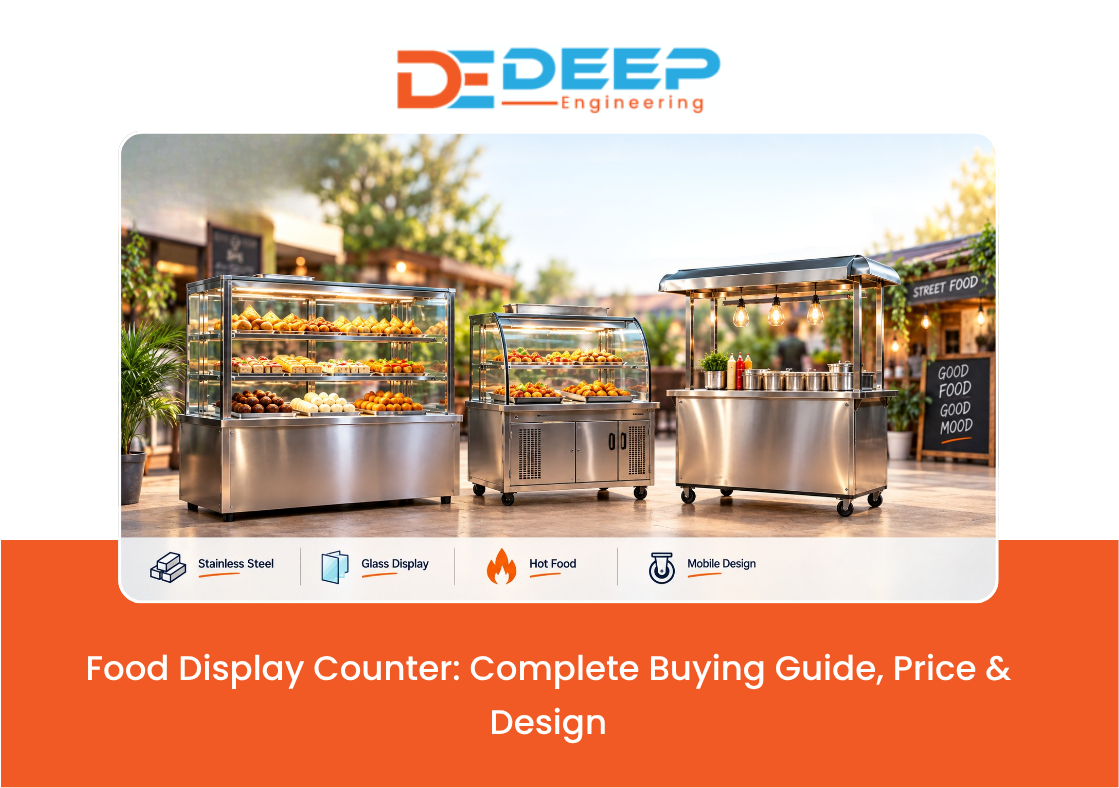
A well-designed food display counter does more than hold food. It helps customers see what you offer, keeps your serving area organized, supports cleaner operations, and gives your business a more professional appearance.
For street food vendors, cafés, snack stalls, kiosks, and small food businesses in India, choosing the right counter is an important investment. The ideal option depends on the food you sell, available space, mobility requirements, material, storage needs, and budget.
In this guide, you will learn what a food display counter is, the different types and designs available, the factors affecting its price in India, how to compare stainless steel and glass counters, and how to choose a practical solution for your food business.
What Is a Food Display Counter?
A food display counter is a commercial furniture or equipment unit designed to present, protect, organize, and sometimes serve food products in a customer-facing area.
Depending on its design, a counter may include a display surface, glass protection, storage compartments, preparation space, serving space, or dedicated warming equipment. Some models are fixed, while others are designed for mobility.
Food display counters are commonly used in:
- Street food stalls and food carts
- Cafés and restaurants
- Bakery and sweet shops
- Snack and beverage businesses
- Food kiosks and quick-service outlets
- Catering and event food setups
- Markets and temporary food-selling locations
The right unit should support both food presentation and daily workflow. A visually attractive counter is useful, but it should also make preparation, storage, serving, and cleaning practical.
Why Is a Food Display Counter Important for a Food Business?
A counter is often one of the first things customers notice. Its value comes from how it supports the business, not simply from its appearance.
1. Improves Food Visibility
A clear, well-organized display helps customers understand what is available. For snacks, bakery items, sweets, and ready-to-serve products, visibility can make the selection process easier.
2. Builds Customer Confidence
A neat serving area communicates care and professionalism. When food is presented in an organized and appropriately protected space, customers can feel more comfortable evaluating the products.
3. Supports Hygiene and Food Protection
A suitable display can help reduce unnecessary exposure to dust and handling, particularly when products are protected by glass or another appropriate barrier. However, a counter alone does not guarantee food safety; proper food handling, cleaning, storage, and temperature control remain essential.
4. Keeps Ingredients and Products Organized
Storage shelves, drawers, and cabinets can reduce clutter. When frequently used items have designated places, staff or vendors can spend less time searching for supplies.
5. Makes Service More Efficient
A counter designed around the menu can separate preparation, display, and serving areas. This can help create a smoother workflow during busy periods.
6. Creates a Professional Business Appearance
A thoughtfully finished counter can make a small stall, café, or kiosk look more organized and consistent with its brand.
7. Makes Better Use of Limited Space
For compact businesses, every inch matters. A counter with integrated storage or preparation space can serve multiple purposes without requiring separate furniture.
8. Helps Attract Customer Attention
A visible product arrangement, clean surfaces, and clear branding can make a food-selling area easier to notice. The display should support the food rather than make the serving process difficult.
Types of Food Display Counters for Different Businesses
There is no single counter that works for every food business. A bakery may prioritize glass visibility, while a street food vendor may need mobility, storage, and preparation space.
Stainless Steel Food Display Counter
A stainless steel food display counter is a practical choice for businesses that need a durable, easy-to-maintain, commercial-looking surface.
Key advantages include:
- Durability: Suitable for regular commercial use when fabricated with appropriate materials and construction.
- Easy cleaning: Smooth, properly finished surfaces are generally easier to wipe and maintain.
- Professional appearance: Stainless steel creates a clean, functional look.
- Versatility: It can be used for preparation, serving, storage integration, or as part of a larger food cart.
- Practical maintenance: It is a useful option for businesses that expect frequent cleaning and daily handling.
Stainless steel is especially suitable when the counter needs to support active food preparation or serving rather than only product presentation.
For a broader mobile solution, explore the Stainless steel food cart as an example of how stainless steel can be used in food vending equipment.
Glass Display Counter for Food
A glass display counter for food is designed to make products visible while providing a degree of separation from the surrounding environment.
It is commonly considered for:
- Bakery products
- Sweets and confectionery
- Packaged snacks
- Ready-to-serve food
- Café display areas
- Dry or appropriately stored food products
Glass can improve product visibility and help reduce unnecessary customer handling. However, buyers should distinguish between a glass display enclosure and a food preparation surface. Glass may be excellent for viewing products, while a separate suitable work surface may be needed for preparation.
When selecting a glass-front unit, consider accessibility for serving, cleaning access, glass protection, product arrangement, and whether the displayed food requires temperature control.
Hot Food Display Counter
A hot food display counter is intended for displaying warm food, such as prepared meals, snacks, or other products that require controlled holding conditions.
It is important to distinguish between:
- A simple display counter, which presents food without actively heating it.
- A food warmer counter, which includes equipment intended to maintain food at an appropriate holding temperature.
- A cooking counter, which is designed for active food preparation or cooking.
If a heated unit is required, ask the manufacturer about the heating method, temperature control, electrical requirements, insulation, cleaning access, and intended use. Food must be held and handled according to applicable food-safety practices. A display unit should not be assumed to maintain safe temperatures unless its specifications support that use.
Mobile Food Display Counter
A mobile food display counter is designed to be moved between suitable locations, making it useful for vendors who operate at markets, events, exhibitions, or changing selling points.
Important features to evaluate include:
- Strong and stable frame
- Suitable wheels or mobility system
- Locking or stabilizing arrangements where needed
- Adequate working height
- Storage for ingredients and supplies
- Easy-to-clean surfaces
- Practical customer-facing layout
- Protection for displayed products
A mobile counter is not the same as a vehicle-based food van. A mobile counter is a movable selling unit, while a food van is a vehicle-based food business solution.
Food Display Counter for Street Vendors
A food display counter for street vendors should be designed around the realities of outdoor and high-frequency use.
A practical street food counter may need:
- Compact dimensions
- Durable construction
- Easy-clean surfaces
- Customer-facing display space
- Storage for ingredients, packaging, and utensils
- A dedicated serving area
- Protection from unnecessary dust and handling
- A layout that supports quick service
The design should also reflect the menu. A pani puri seller, momo vendor, and tea stall will not necessarily need the same counter configuration.
Snacks Display Counter and Food Warmer Counter
A snacks display counter may be used for products such as:
- Samosa
- Kachori
- Pakora
- Sandwiches
- Burgers
- Bakery snacks
- Ready-to-serve street food
Some businesses need only a dry display area, while others may require a warming system. These functions should not be confused.
A display counter presents food. A food warmer counter is designed to maintain suitable warmth through a dedicated system. A cooking unit, meanwhile, performs active preparation. Before purchasing, clarify which function your business actually needs.
Choosing a Counter for Your Menu
If you sell waffles, for example, the counter may need preparation space, ingredient storage, and a customer-facing serving area. A Waffle Cart can help illustrate a menu-specific mobile vending approach.
Similarly, a Panipuri Cart may require a different arrangement for ingredients, water-related workflow, serving, and storage. The lesson is simple: the best counter design begins with the food business, not just the counter’s appearance.
Planning a custom setup? Consider discussing your menu, workspace, storage, and mobility requirements with a manufacturer before selecting a standard design. This can help you avoid paying for features you do not need.
Popular Food Display Counter Design Ideas in India
The right food display counter design should make daily operations easier while presenting products attractively. Here are several practical design approaches.
Straight Counter Design
A straight counter works well along a wall, in a compact shop, or in a simple service line. It can combine a display area with storage or preparation space behind it.
Compact Single-Service Counter
This design is suitable for small stalls or businesses with a focused menu. It keeps the display and serving area close together without requiring a large footprint.
Glass-Front Display Counter
A glass-front design is useful when product visibility is a priority. It is often considered for bakery items, sweets, snacks, and ready-to-serve products that benefit from protected presentation.
Stainless Steel Commercial Counter
This design emphasizes practical working surfaces, durability, and easy maintenance. It may suit food preparation, serving, and businesses that need a functional commercial setup.
Mobile Push-Counter Design
A push-counter layout can be useful for vendors who need flexibility at events, markets, or temporary selling locations. Mobility should be balanced with stability and storage.
Counter with Storage Compartments
Integrated shelves, drawers, or cabinets can help keep packaging, utensils, ingredients, and cleaning supplies organized. Storage should be accessible without obstructing service.
Counter with Preparation Workspace
For made-to-order foods, a preparation surface can be more valuable than a large display area. The layout should allow ingredients, equipment, and serving materials to be positioned logically.
Branding-Focused Kiosk Counter
A kiosk counter can incorporate a signboard, brand colors, menu panel, or logo area. Branding should improve recognition while leaving enough room for practical operations.
Modular Multi-Purpose Counter
A modular design may combine display, serving, storage, and preparation functions. This can be useful for businesses that want flexibility as their menu develops.
What Makes a Design Practical?
Before choosing a design, ask:
- Does it match the menu?
- Can customers see the products easily?
- Is the serving workflow clear?
- Is storage sufficient?
- Does it fit the available space?
For inspiration, you can explore Deep Engineering’s Food Cart Design gallery to review different food vending and kiosk design approaches.
How to Choose a Food Display Counter for Your Food Cart
If you are wondering how to choose a food display counter for your food cart, use the following practical steps.
1. Identify the Food You Will Sell
Start with the menu. Dry snacks, pani puri, momos, waffles, beverages, bakery products, and cooked meals may require different layouts.
Consider whether you need:
- Display space
- Preparation space
- Cooking equipment
- Serving space
- Ingredient storage
- Packaging storage
2. Decide Between Hot, Cold, or Dry Display
Do not purchase heating features simply because they look useful. They add complexity and may not be necessary for your menu.
3. Select the Right Material
Common choices include stainless steel, glass, and combinations of materials.
- Stainless steel: Practical for working surfaces, cleaning, and frequent use.
- Glass: Useful when product visibility is a priority.
- Combined construction: Can balance display visibility with durable working surfaces.
Choose materials based on the actual function of each part of the counter.
4. Measure the Available Space
Measure the location where the counter will operate. Check width, depth, height, access paths, and space needed for customers and staff.
For a cart, also consider whether the unit can move through the intended route and fit into storage when not in use.
5. Consider Mobility Requirements
If you operate at events or changing locations, wheels and a movable structure may be important. If the counter will remain in one shop, a fixed layout may provide better use of space.
Mobility should not compromise stability, safe operation, or working comfort.
6. Check Storage and Workspace
Think about what must be stored during service. Ingredients, cups, plates, packaging, utensils, and cleaning materials should have logical locations.
A counter with insufficient storage may look good initially but become difficult to use during busy hours.
7. Prioritize Hygiene and Easy Cleaning
Look for surfaces and layouts that are practical to clean. Avoid unnecessary hard-to-reach spaces where food debris can accumulate.
Also consider how displayed food will be protected, how spills can be managed, and whether cleaning access is convenient.
8. Evaluate Durability and Finish
Ask about the construction, material specifications, frame strength, surface finish, and suitability for the intended workload.
A counter used daily in a busy food business should be selected for practical durability, not appearance alone.
9. Consider Branding and Customer Visibility
A logo panel, menu board, or branded finish can make the counter more recognizable. However, branding should not block the display or reduce useful workspace.
10. Compare Customization and After-Sales Support
A clear discussion at the beginning can help prevent misunderstandings later.
Stainless Steel vs Glass Food Display Counter: Which Is Better?
Neither material is universally better. The right choice depends on whether your priority is preparation, durability, visibility, food protection, or a combination of these.
| Factor | Stainless Steel Counter | Glass Display Counter | Best Suited For |
|---|---|---|---|
| Durability | Practical for frequent commercial use when properly fabricated | Requires appropriate glass selection and careful handling | Stainless steel for heavy working surfaces; glass for protected display |
| Visibility | Usually limited unless combined with glass or open display | Excellent product visibility | Bakery, sweets, snacks, and ready-to-serve products |
| Cleaning | Smooth surfaces are generally easy to wipe and maintain | Requires cleaning of glass and supporting surfaces | Both, depending on design and access |
| Appearance | Functional, professional, commercial look | Attractive, presentation-focused appearance | Stainless steel for work areas; glass for customer-facing display |
| Food protection | Depends on whether the design is open or enclosed | Can provide a barrier against dust and unnecessary handling | Glass-front or enclosed display designs |
| Customization | Can be fabricated into varied layouts and storage configurations | Can be integrated into custom display structures | Businesses needing a combination of functions |
| Typical applications | Preparation, serving, food carts, commercial counters | Bakery, sweets, snacks, packaged or ready-to-serve display | Menu-dependent |
| Maintenance considerations | Check finish, joints, and cleaning access | Check glass condition, seals or frames, and cleaning access | Both require routine care |
Practical conclusion: Choose stainless steel when working durability and easy maintenance are central. Choose glass when visibility and protected presentation are more important. For many businesses, a combination of both is the most useful approach.
Food Display Counter Price in India 2026: What Affects the Cost?
The food display counter price in India 2026 depends on the specifications rather than one universal market rate. A basic counter and a custom mobile unit with glass, storage, branding, and warming equipment can have very different costs.
Deep Engineering’s exact quotation should be requested based on your requirements. Avoid comparing counters only by headline price; compare what is included in the construction and configuration.
Main Factors That Affect Food Display Counter Price
| Price Factor | How It Affects Cost |
|---|---|
| Counter size | Larger counters generally require more material and workspace |
| Material | Stainless steel, glass, and finish choices affect cost |
| Design complexity | Custom layouts and special fabrication can increase cost |
| Storage | Drawers, shelves, and cabinets add functionality and expense |
| Mobility | Wheels, frame strength, and mobility features affect pricing |
| Heating/warming | Food warmer components may increase the total cost |
| Branding | Signage, colors, graphics, and finishing affect customization |
| Quantity | Bulk orders may have different quotation terms |
Other considerations may include packaging, transport arrangements, electrical components, and the level of fabrication required. These should be clarified in the quotation rather than assumed.
How to Request a Useful Quotation
To receive a more accurate estimate, share:
- Food type and menu
- Required counter dimensions
- Fixed or mobile requirement
- Preferred material
- Display or glass requirements
- Storage needs
- Heating or warming requirements, if applicable
- Branding preferences
- Quantity required
- Delivery location and timeline expectations
For a broader understanding of available equipment categories, visit the Food Cart shop page. The exact counter configuration and quotation should still be confirmed with the manufacturer.
Best Food Display Counter for Small Food Business: What Should You Prioritize?
For a small food business, the best counter is not necessarily the largest or most expensive. It is the one that provides the functions you need without taking away valuable working space or creating unnecessary maintenance.
Prioritize:
- Compact footprint
- Multi-purpose use
- Easy cleaning
- Sufficient storage
- Clear food visibility
- Reasonable investment
- Easy movement when required
- Menu-specific customization
- Future business scalability
Examples for Different Small Businesses
Pani puri seller: A pani puri setup may need organized ingredient placement, a practical serving area, storage, and a layout that supports clean handling. The counter should be designed around the serving process rather than only visual display.
Momo vendor: A momo business may need space for preparation, cooking equipment, serving, packaging, and ingredient storage. A Momo cart can be a useful reference for a menu-specific mobile vending concept.
Waffle seller: A waffle business may need preparation workspace, equipment placement, ingredient storage, and a visible serving area. The counter should support both production and customer interaction.
Tea and snack stall: A tea stall may need a compact serving counter, storage for cups and ingredients, and a separate arrangement for snacks. If warming is required, the equipment should be specified according to the products and intended holding conditions.
Small bakery or fast-food counter: A bakery may prioritize glass display and product visibility, while a fast-food business may need a combination of preparation, cooking, serving, and storage. A Fast food stall may be relevant when exploring a more complete food-selling setup.
The goal is to make the counter support your actual operation. It should help you serve efficiently today while leaving room for sensible upgrades later.
Food Display Counter for Hygiene and Customer Attraction
A good counter can support cleaner presentation, but hygiene depends on the entire food-handling process.
Useful design considerations include:
- Protected display: Glass or suitable barriers can reduce unnecessary contact with displayed food.
- Easy-to-clean surfaces: Smooth, accessible surfaces make routine cleaning more practical.
- Organized serving areas: Separating display, preparation, and serving zones can reduce clutter.
- Raw and ready-to-eat separation: Where relevant, keep raw ingredients and ready-to-eat food handled and stored appropriately.
- Safe food handling: Follow applicable food-safety practices for storage, preparation, serving, and temperature control.
- Clear product presentation: An attractive display should make food easy to identify without compromising cleanliness.
A visually impressive counter is not a substitute for safe practices. The strongest setup combines presentation, organization, and responsible food handling.
Custom Food Display Counter vs Ready-Made Counter
Both options can be useful, depending on the business.
| Consideration | Custom Counter | Ready-Made Counter |
|---|---|---|
| Dimensions | Can be designed around available space | Usually based on standard sizes |
| Menu layout | Can match specific preparation and serving needs | May require adaptation |
| Storage | Can be planned for required items | Storage may be limited or predetermined |
| Branding | More flexibility for colors, signage, and identity | Branding options may be limited |
| Mobility | Can be specified for the intended use | Depends on the existing design |
| Budget | May cost more depending on customization | May offer a simpler initial purchase |
| Lead time | May require fabrication and planning | May be quicker if available |
| Long-term usability | Can be tailored to workflow and future needs | Works best when standard design already fits |
When Is Custom Fabrication More Useful?
Custom fabrication may be worth considering when:
- Your space has unusual dimensions.
- Your menu requires a specific workflow.
- You need integrated storage or equipment.
- You want a particular mobile layout.
- Branding is important to the business.
- A generic counter would require too many compromises.
A ready-made counter may be suitable when your requirements are simple and a standard configuration meets them. The decision should be based on total usefulness, not only the initial purchase price.
Why Choose Deep Engineering Food Cart Manufacturer for Your Food Counter?
Deep Engineering Food Cart Manufacturer provides food carts, mobile food vans, kiosks, and food vending equipment designed for street food vendors, small businesses, cafés, restaurants, and food entrepreneurs.
Its approach focuses on practical business requirements, including:
- Manufacturing and supply expertise: Solutions for different food vending and serving needs.
- Hygienic and practical designs: Surfaces, workspace, storage, and presentation are important parts of the overall setup.
- Options for street food vendors and small businesses: Suitable concepts for vendors starting or upgrading a food operation.
- Mobile food carts and kiosks: Solutions for businesses that need organized food preparation, serving, and display.
- Business-focused layouts: The emphasis is on useful workspace, storage, mobility, and customer-facing presentation.
- Professional appearance: Designs can help create a more organized and recognizable selling environment.
If you are comparing Food Cart Manufacturers review the manufacturer’s product range and discuss your exact counter requirements before placing an order.
You can also explore the Food Cart Manufacturer website to understand the available food vending solutions. For businesses considering a vehicle-based setup, the Food Van and food van price pages may be useful starting points for exploring that category.
For buyers looking for different purchasing options, food carts for sale can also be explored as part of the broader food equipment selection.
Ready to plan your counter? Share your menu, preferred size, material, display requirements, and mobility needs with Deep Engineering to discuss a suitable food cart or kiosk configuration and request a customized quotation.
Food Display Counter Buying Checklist
Before finalizing your purchase, review this checklist:
- Correct counter size for the available space
- Suitable material for the intended use
- Clear and practical display visibility
- Adequate storage for ingredients and supplies
- Mobility features, if required
- Easy-to-clean surfaces and accessible areas
- Durable construction and appropriate finish
- Branding space without reducing functionality
- Budget aligned with the actual requirements
- Customization options clearly explained
- Manufacturer reliability and quotation clarity
- Heating or warming specifications confirmed, if applicable
A careful checklist can help you compare options more objectively and avoid choosing a counter based only on appearance.
FAQs About Food Display Counters
A food display counter is used to present, organize, protect, and sometimes serve food products. Depending on its design, it may also include storage, preparation space, or warming equipment.
Stainless steel is practical for durable working surfaces and frequent commercial use, while glass is useful for product visibility and protected presentation. The best material depends on the menu and counter function.
The price varies based on size, material, design, glass, storage, mobility, branding, and any heating or warming components. Request a customized quotation for an accurate cost rather than relying on an assumed universal price.
Yes, a mobile counter can be suitable for street vendors, markets, and events when mobility is needed. Check stability, wheels, workspace, storage, and the suitability of the design for the intended selling environment.
Start by sharing your menu, dimensions, material preference, display needs, storage requirements, mobility needs, and delivery expectations. Ask for a detailed quotation and confirm the final design and included features before placing the order.
Final Thoughts: Choose a Counter That Supports Your Business
The right food display counter should do more than look attractive. It should support hygiene, food presentation, organization, durability, and efficient daily service.
Whether you operate a pani puri stall, momo cart, waffle business, tea counter, bakery, café, or food kiosk, the best design is the one that matches your menu, space, mobility needs, and budget.
A thoughtful choice can help you create a more practical and professional food-selling environment without investing in features that do not serve your business.
Planning a new counter or upgrading an existing setup? Connect with Deep Engineering Food Cart Manufacturer to discuss your requirements and request a customized food display counter quotation designed around your business needs.