
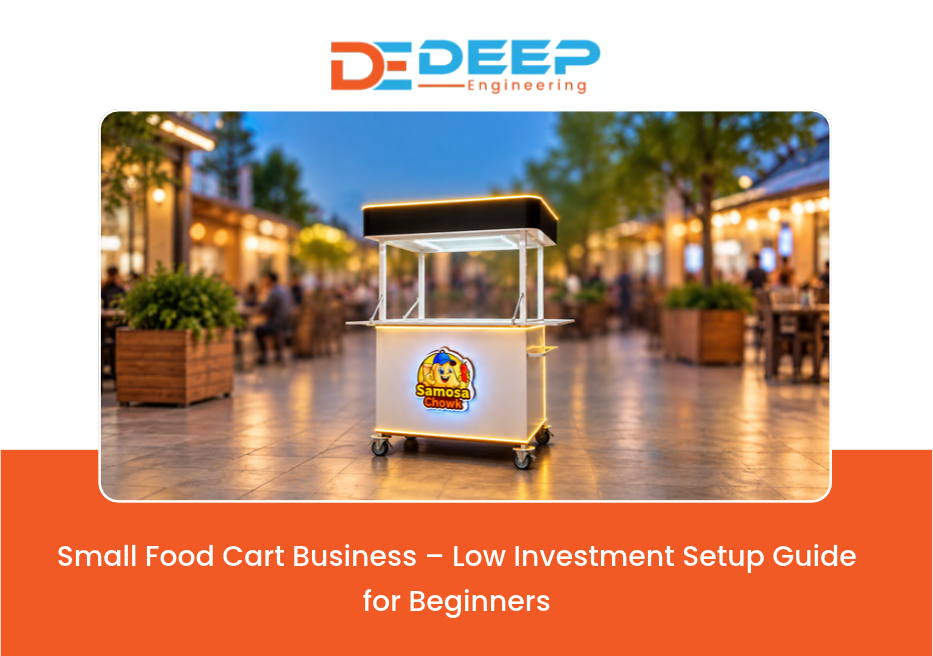
Starting a food business does not always require a large restaurant, expensive interiors, or a full-sized food van. For many first-time entrepreneurs in India, a small food cart can provide a more compact way to test a focused menu, operate in a limited space, and build a food vending business around a specific customer location.
A small cart can be used for tea, coffee, momos, waffles, panipuri, snacks, breakfast items, fast food, and other focused menus. However, the cart itself should not be the starting point of the decision. Your menu, preparation process, available space, storage needs, equipment, mobility requirements, and local operating conditions should determine the design.
This guide explains how to evaluate a small food cart, understand the small food cart price in India, plan your setup cost, select materials, compare different vending formats, and choose a manufacturer. It is intended for beginners considering a low-investment street food business as well as existing vendors who want to upgrade to a more organized setup.
What Is a Small Food Cart?
A small food cart is a compact mobile food-serving structure designed to provide preparation, cooking, storage, and customer-serving space within a relatively limited footprint. Depending on the menu, it can accommodate equipment, ingredients, utensils, a serving counter, storage compartments, branding, and other practical features.
For a beginner, the main advantage is that the layout can be built around a focused menu instead of trying to accommodate an entire commercial kitchen.
A small food cart generally differs from other formats in these ways:
- Small food cart: Compact, mobile, and designed around a focused food operation.
- Mini food cart: Usually emphasizes an even smaller footprint and simpler equipment arrangement.
- Food stall: May have a more permanent location and can provide additional working or storage space.
- Food van: Provides a larger enclosed working environment and can generally accommodate more equipment, storage, and menu complexity.
The right size depends on workflow. A tea cart, for example, may need a different counter arrangement from a momos cart or waffle setup. Before selecting dimensions, map out where ingredients enter, where food is prepared, where cooking happens, where finished food is served, and where payment takes place.
Is a Small Food Cart a Good Option for a Low-Investment Business?
A small food cart can be considered for a low-investment food business because a focused menu may require fewer appliances, less storage, and a smaller operating footprint than a larger food outlet. Its suitability depends on the menu, location, equipment, permissions, operating expenses, and the entrepreneur’s available budget.
A compact setup may offer practical advantages such as:
- Lower equipment requirements for a simple menu
- Efficient use of limited operating space
- Easier movement where mobility is required
- A focused menu that is simpler to manage
- Potentially simpler daily preparation and cleaning
- A customer-facing counter that combines serving and presentation
However, a smaller cart does not automatically mean higher profitability. Business performance depends on factors such as location, customer footfall, menu pricing, ingredient costs, packaging, operating hours, waste, transportation, utilities, permits, and marketing.
The better approach is to first calculate what your chosen menu actually requires. Then select the smallest practical cart that can support that workflow without creating unnecessary congestion.
If you are ready to compare available configurations, you can explore the available Food Cart options and match the layout to your intended menu.
Small Food Cart Ideas for Beginners
Choosing the food concept before ordering the cart is one of the most important decisions for a new vendor. The following ideas can work particularly well with compact layouts when the equipment and menu are planned together.
Tea and Coffee Cart
A tea and coffee cart can focus on beverages, with space for a preparation counter, beverage equipment, cups, ingredients, water or cleaning arrangements, and storage.
The layout should keep frequently used ingredients within easy reach. If snacks are also offered, reserve separate storage and serving space so the counter does not become crowded.
Momos Cart
A momos operation can be organized around steaming, preparation, sauces, serving, and payment. A compact cart may work well when the menu is deliberately focused.
A dedicated Momo cart can be considered when the business is centered around momos and requires a layout designed around that preparation process.
Waffle Cart
A waffle concept typically needs space for the waffle-making equipment, batter or ingredients, toppings, serving materials, packaging, and customer-facing presentation.
A Waffle Cart can be relevant for entrepreneurs building a focused waffle and dessert vending concept. Beverage service can also be considered if sufficient workspace remains.
Panipuri Cart
Panipuri requires a very different workflow from cooked fast food. The cart needs organized ingredient placement, serving space, containers, hygiene arrangements, and easy access to frequently used components.
A dedicated Panipuri Cart can be evaluated when panipuri is the primary menu rather than trying to fit unrelated equipment into the same compact space.
Fast Food Cart
A fast food cart may serve items such as sandwiches, burgers, rolls, fries, or other quick-service foods. Because cooking equipment can occupy substantial space, menu selection should be controlled carefully.
A Fast food stall can be useful as a reference when considering a more structured quick-service layout.
Snacks and Quick-Bites Cart
A snack cart can focus on a small selection of popular items rather than attempting to sell everything. The equipment requirement depends heavily on whether the food is cooked on-site or prepared elsewhere and finished at the cart.
Breakfast or Regional Snack Cart
Breakfast items and regional snacks can also work with compact setups. The key consideration is whether the cart can safely accommodate preparation, serving, ingredient storage, waste management, and cleaning.
For some traditional or specialized menus, a pan counter or another purpose-built format may make more sense than a generic cart.
Small Food Cart Price in India – What Determines the Cost?
There is no single universal small food cart price in India because two carts of similar size can have very different configurations. The final quotation depends on materials, dimensions, equipment, storage, finish, customization, and other specifications.
The phrase small food cart price and features in India should therefore be considered together rather than treating price as the only selection criterion.
Important cost factors include:
- Cart dimensions
- Construction material
- Stainless steel or alternative materials
- Countertop specification
- Storage compartments
- Shelving
- Wheel type and mobility requirements
- Canopy or weather protection
- Lighting
- Electrical fittings
- Cooking equipment
- Sink or water arrangements where required
- Branding and signage
- Number of workstations
- Custom fabrication
- Surface finish
- Additional food cart equipment
A basic serving cart and a customized cooking cart can have substantially different requirements. Likewise, adding several appliances can change the space, electrical, ventilation, storage, and workflow requirements.
If an exact current quotation is not available, it is better to request a configuration-specific price rather than relying on a generic online number. Buyers should provide the manufacturer with their menu, preferred dimensions, equipment list, storage requirements, branding needs, and operating conditions.
Small Food Cart Business Cost – What Should Beginners Budget For?
The small food cart business cost should be considered as a complete startup budget rather than only the cart purchase price.
One-Time Setup Costs
Potential one-time or initial expenses include:
- Cart fabrication
- Cooking or preparation equipment
- Utensils and basic tools
- Initial branding and signage
- Menu board
- Initial packaging stock
- Initial ingredient purchase
- Transportation or setup-related expenses
Recurring Operating Costs
Recurring expenses may include:
- Ingredients
- Packaging
- Gas, electricity, or other utilities where applicable
- Water and cleaning supplies
- Transportation
- Maintenance
- Marketing
- Location-related expenses where applicable
- Replacement of consumables
- Other business operating costs
Applicable licenses and permissions should also be checked according to the location and nature of the food business.
Keeping an emergency or working-capital reserve is useful because sales and expenses may not be consistent every day. Do not assume that the cheapest cart automatically produces the lowest total business cost; an unsuitable layout can create operational problems that become more expensive over time.
Best Small Food Cart Design for a Beginner
The best design is not necessarily the most decorative one. It is the design that supports your menu and allows you to work efficiently.
A practical cart design should consider:
- Compact footprint
- Efficient workflow
- Easy cleaning
- Adequate storage
- Safe cooking area
- Customer-facing serving counter
- Waste management
- Ingredient organization
- Mobility
- Branding visibility
- Weather considerations
- Comfortable working height
Think about the complete customer journey. Ingredients should be accessible without blocking cooking. Finished food should reach the serving counter without crossing dirty or waste areas. Frequently used utensils should not be buried inside storage compartments.
It is also useful to review different Food Cart Design examples before finalizing a layout.
The most attractive cart on a photograph may not be the right cart for your menu. Design should follow the workflow, equipment, storage requirements, and customer service process.
Stainless Steel vs Other Materials – Which Small Food Cart Should You Choose?
Material selection should be based on the intended application, cleaning requirements, durability expectations, appearance, budget, and customization requirements.
| Factor | Stainless Steel Cart | Other/Alternative Construction |
|---|---|---|
| Hygiene | Smooth, practical surfaces can be suitable for food-service environments when properly designed and maintained | Suitability depends on the specific material and finish |
| Cleaning | Generally practical for routine cleaning when surfaces are appropriately designed | Cleaning requirements vary by material |
| Durability | Can provide a durable construction option for many food-service applications | Durability depends on material, fabrication, and use |
| Appearance | Clean, professional appearance | Can offer different visual finishes and design possibilities |
| Maintenance | Routine maintenance still depends on construction and equipment | Maintenance requirements vary considerably |
| Customization | Can be fabricated around specific layouts and equipment | Customization depends on the selected construction |
| Suitable Use | Useful for many food preparation and serving applications | May suit serving, display, decorative, or specialized applications |
A Stainless steel food cart may be worth considering when the business needs a practical food-service surface and organized working environment.
The important point is to evaluate the complete construction rather than choosing material based only on appearance.
Small Food Cart vs Mini Food Cart vs Food Van
A common question is whether to start with a small cart, mini cart, or food van. The answer depends on menu complexity, available space, mobility, budget, and how much equipment the business needs.
| Factor | Small Food Cart | Mini Food Cart | Food Van |
|---|---|---|---|
| Initial setup complexity | Generally lower for focused menus | Generally simpler for very limited menus | Higher because of vehicle-based setup |
| Mobility | High, depending on construction | High | Vehicle-based mobility |
| Space requirement | Compact | Very compact | Requires vehicle parking/operating space |
| Menu capacity | Suitable for focused menus | Best suited to limited menus | Can support broader operations |
| Equipment capacity | Moderate, depending on design | Limited by footprint | Generally greater |
| Branding potential | Counter and cart branding | Compact branding area | Large vehicle branding potential |
| Suitable business stage | Beginner or focused vending concept | Very small/simple operation | Businesses needing a larger mobile workspace |
| Operational considerations | Workflow must be carefully planned | Strong space constraints | Vehicle, equipment, utilities, and operating requirements add complexity |
If you are considering a vehicle-based model, review the Food Van option and research the current food van price based on the required specification rather than assuming it will match the cost of a compact cart.
How to Start a Small Food Cart Business With Minimum Investment
A practical way to control unnecessary spending is to build the business around the menu rather than buying equipment first.
Step 1: Choose a Focused Food Concept
Select one primary category such as momos, waffles, tea, panipuri, snacks, or a focused fast-food menu.
Step 2: Research Your Target Location
Consider customer footfall, nearby competition, operating restrictions, accessibility, peak hours, and applicable local requirements.
Step 3: Define Your Menu
A smaller menu can make equipment, ingredient storage, preparation, and purchasing easier to organize.
Step 4: Calculate Equipment Requirements
List every appliance, utensil, storage container, preparation surface, and serving item required.
Step 5: Decide Cart Dimensions
Choose dimensions based on the equipment and workflow rather than selecting a size first and trying to fit everything afterward.
Step 6: Select Material and Construction
Compare stainless steel and other suitable construction options based on the operating environment and cleaning requirements.
Step 7: Plan Storage and Workflow
Separate raw ingredients, preparation tools, finished food, packaging, and waste as much as practical.
Step 8: Check Applicable Local Permissions
Food vending requirements can vary by location and business model. Check the permissions, registrations, and food-business requirements applicable to your operation.
Step 9: Arrange Branding and Signage
Use clear branding and an easy-to-read menu so customers can understand your offering quickly.
Step 10: Purchase the Cart
Once the design, equipment, material, and specifications are confirmed, request a current quotation.
Step 11: Test Operations Before Launch
Simulate a busy service period. Check whether two people can work comfortably if needed, whether ingredients are reachable, and whether customers can order and receive food without creating congestion.
Step 12: Track Daily Sales and Expenses
Record sales, ingredient purchases, packaging, utilities, transportation, and other expenses. This gives you actual business data instead of relying only on assumptions.
Small Food Cart Setup Checklist for Beginners
Before launch, use this checklist:
- Cart structure
- Customer counter
- Storage compartments
- Cooking equipment
- Preparation tools
- Utensils
- Ingredients
- Packaging
- Waste bins
- Water and cleaning arrangement
- Electricity or gas requirements where applicable
- Menu board
- Branding
- Lighting
- Payment options
- Cleaning supplies
- Basic sales and expense records
This checklist can also help you identify equipment you do not need. For a low-investment operation, avoiding unnecessary equipment can be just as important as selecting affordable equipment.
How to Choose the Right Food Cart Manufacturer in India
Choosing a manufacturer should involve more than comparing photographs or headline prices. A useful manufacturer discussion should begin with your menu and operating requirements.
Evaluate:
- Fabrication quality
- Material specifications
- Customization options
- Layout planning
- Storage arrangements
- Mobility
- Surface finish
- Hygiene considerations
- Communication
- Ability to understand your menu
- Clarity of quotation
- Product photographs or examples
- Delivery and installation terms
Deep Engineering is described as a manufacturer and supplier of food carts, mobile food vans, kiosks, and food vending equipment for street food vendors, small businesses, cafes, and food entrepreneurs. Its supplied product range includes customizable food carts such as momos carts, panipuri carts, ice gola carts, fast food carts, street-food carts, and multi-purpose stainless steel carts.
Entrepreneurs researching a Food Cart Manufacturer in India can use the manufacturer’s available product information to compare designs and determine which configuration fits their business.
Similarly, people researching Food Cart Manufacturers should ask specific questions about dimensions, materials, equipment, storage, customization, and delivery terms.
For a direct manufacturer option, Food Cart Manufacturer can be reviewed alongside the exact specifications you want.
The goal should be a clear quotation based on your actual configuration rather than a vague comparison of starting prices.
Real-World Examples
The following are planning examples, not claims about actual customer results.
Beginner Momos Business
Imagine a beginner planning a momos-only operation. Instead of adding multiple unrelated foods, the cart could be organized around steaming, preparation, sauces, packaging, serving, and payment.
Storage should keep wrappers, fillings, sauces, disposable containers, and utensils organized. The serving counter should remain clear enough for quick customer handover.
Waffle and Beverage Cart
A waffle and beverage concept could allocate one area for waffle preparation, another for toppings and ingredients, and a separate space for cups, packaging, and serving.
The entrepreneur should check whether the selected electrical equipment can operate within the available power arrangement and whether the workflow leaves enough room for customer service.
Street Snack Cart
A street snack vendor with a limited menu could use a compact setup with only the essential cooking, preparation, storage, and serving equipment.
The key is avoiding unnecessary appliances. If the menu requires only a few preparation steps, the cart should not be overloaded with equipment intended for products that are not being sold.
Planning for Different Indian Markets
The same cart design may not be equally suitable everywhere. Entrepreneurs in Ahmedabad, Rajkot, Surat, Bhavnagar, Vadodara, and Himmatnagar may have different location, customer, weather, and operating considerations. Similar planning applies to businesses in Rajasthan and Jaipur, Indore and other parts of Madhya Pradesh, Delhi NCR and Gurugram, or markets across Uttar Pradesh.
Rather than searching only for a generic phrase such as “food cart manufacturer in Ahmedabad” or “food cart manufacturer in Surat,” compare manufacturers based on whether they can understand your menu and provide the configuration you actually require.
The same principle applies when researching a food cart manufacturer in Gujarat, Rajasthan, Jaipur, Indore, Delhi NCR, Gurugram, MP, or UP: the cart should be selected around the operating model rather than simply the city name.
FAQs About Small Food Carts
Start by selecting a focused food concept, researching the operating location, defining the menu, calculating equipment requirements, planning the cart dimensions, checking applicable permissions, and obtaining a quotation based on the required configuration.
A beginner should plan the cart around the menu and include the necessary preparation area, cooking equipment, storage, serving counter, utensils, packaging, waste arrangements, cleaning supplies, lighting, and payment setup.
Dimensions, material, countertop, storage, wheels, canopy, lighting, electrical fittings, cooking equipment, water arrangements, branding, customization, finish, and additional equipment can all affect the final quotation.
Stainless steel can be a practical option for many food-service applications because of its cleanable surfaces and durable construction possibilities. Other materials may also be appropriate depending on the cart’s purpose, design, budget, and operating conditions.
Choose according to your menu, available budget, required workspace, mobility needs, equipment capacity, and operating model. A compact cart may suit a focused menu, while a food van can provide a larger mobile workspace with greater complexity.
Compare fabrication, materials, customization, layout planning, storage, finish, communication, quotation clarity, product examples, and delivery terms. Give the manufacturer your complete menu and equipment requirements before requesting the final quotation.
Final Thoughts
A small food cart can be a practical format for entrepreneurs who want to build a focused food vending business without starting with a larger setup. The most important decision is not simply finding the cheapest cart; it is creating a setup where the menu, equipment, storage, workflow, customer service, and available operating space work together.
Start with the food concept. Then calculate the equipment, determine the required dimensions, select suitable construction, plan storage and cleaning, check applicable local requirements, and compare manufacturers based on the actual specification.
If you are ready to move from planning to purchasing, you can review food carts for sale and compare configurations that fit your intended business model.
Deep Engineering provides food carts, mobile food vans, kiosks, and food vending equipment based on the supplied business information. For a customized setup, discuss your menu, dimensions, equipment, storage requirements, branding, and operating needs before requesting a current quotation.
A well-planned cart should make your daily operation more organized—not simply look good from the outside. Choose the configuration that matches what you actually plan to prepare and serve, and use your initial setup as a practical foundation for building the business.