
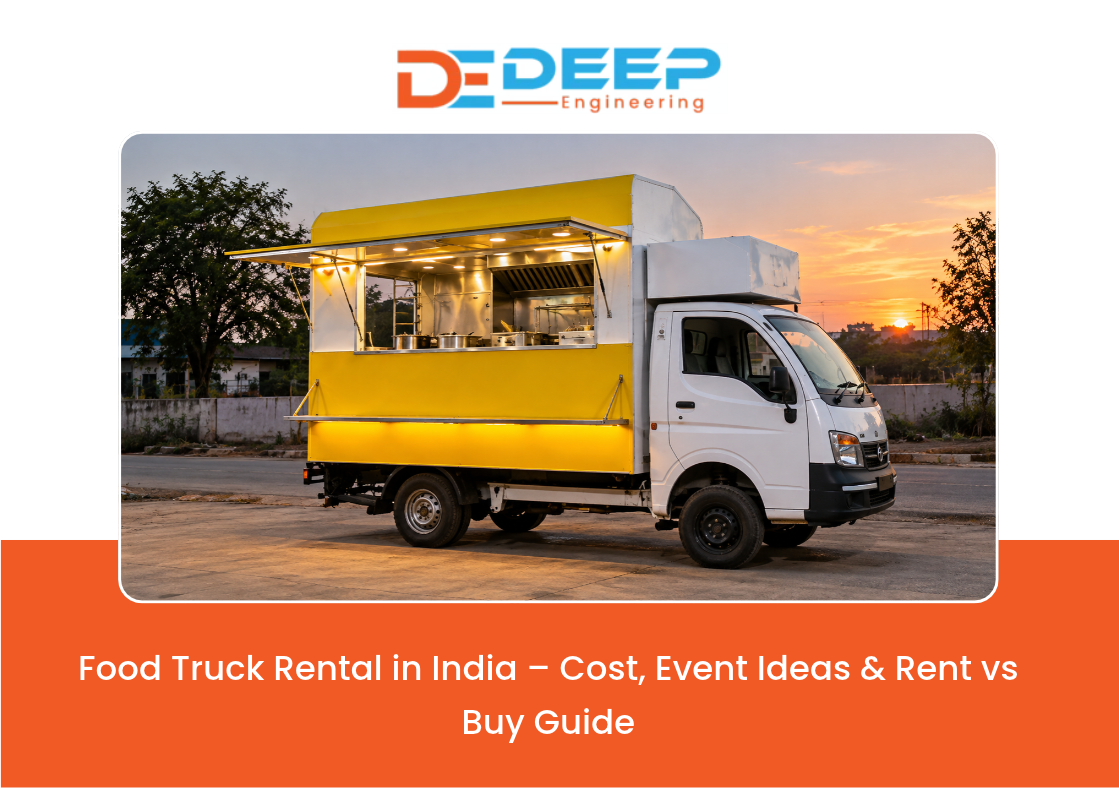
Food Truck Rental is an option worth exploring when planning a wedding, corporate gathering, birthday party, exhibition, or outdoor festival in India. A mobile food setup can bring food preparation and serving closer to guests while creating a distinctive experience for the event.
However, choosing the right arrangement involves more than finding a vehicle. You need to consider the menu, guest count, service duration, venue access, equipment requirements, staff, transportation, and total budget.
If you are planning a one-day event, renting may be convenient. If you want to operate a food business regularly, purchasing a food cart, food van, or kiosk may deserve closer consideration.
This guide explains food truck rental costs, suitable event formats, booking requirements, and the differences between renting and buying. It also explores how aspiring entrepreneurs can evaluate a mobile food truck rental business and choose suitable food vending equipment.
What Is Food Truck Rental and How Does It Work in India?
Food truck rental means arranging temporary access to a food truck or mobile food setup for a specified period, usually for an event, promotion, private celebration, or commercial activity.
The exact arrangement depends on the provider. Some businesses may offer a complete food service, while others may provide only a vehicle or mobile kitchen.
A food truck rental package might include:
- A vehicle or mobile food vending unit.
- Cooking or serving equipment.
- Food ingredients and menu preparation.
- Service staff and food handlers.
- Transportation to the venue.
- Setup and dismantling.
- Electricity or generator arrangements.
- Temporary branding or event-specific decoration.
These are possible inclusions, not guaranteed features of every rental package. Confirm each item with the provider before making a booking.
Food truck rental versus mobile kitchen rental
A food truck is generally a vehicle configured for mobile food preparation or service. A mobile kitchen may refer to a broader range of movable cooking setups, including trailers and specialised units.
A rental provider might supply the equipment without operating the food service. Alternatively, a caterer might provide a complete package that includes the vehicle, menu, staff, and serving arrangements.
Before booking, clarify whether you are hiring the vehicle, the food service, or both.
How Much Does Food Truck Rental Cost in India?
There is no single standard food truck rental price in India. The total cost depends on the vehicle, location, event duration, menu, guest count, staffing, transportation, equipment, and services included in the quotation.
A basic serving setup and a fully equipped food truck with cooking facilities may have substantially different requirements. Similarly, a local private party and a multi-day corporate event may require different budgets.
Rather than relying on an unverified online price, request an itemised quotation for your specific event.
Factors that influence food truck rental price in India
1. Event duration
A short event may require a different package from a full-day celebration or a multi-day exhibition. Ask whether the quotation includes setup, operating hours, and removal after the event.
2. Location and transportation
The distance between the provider’s base and the venue can affect transportation costs. Confirm any additional charges for travel, fuel, parking, and access to remote locations.
3. Food truck size and configuration
A full-size truck, food trailer, compact mobile kitchen, and food cart differ in space and functionality. Select a format that fits your menu and venue instead of paying for unnecessary capacity.
4. Menu and ingredients
A beverage counter, dessert station, and cooking-intensive street food setup have different equipment and ingredient requirements. Menu complexity may also affect preparation time and staffing.
5. Guest count and service capacity
A setup serving 50 guests may not suit an event with several hundred attendees. Estimate peak demand, not just total attendance, when planning service capacity.
6. Staffing requirements
The number of cooks, servers, and support staff can influence the quotation. Confirm who is responsible for food preparation, serving, cleaning, and supervision.
7. Power, water, and cooking facilities
Some setups may require electricity, water connections, refrigeration, or a generator. Clarify which facilities the provider supplies and which the venue must arrange.
8. Branding and decoration
Custom signage, event logos, temporary graphics, and themed decorations may add to the total cost.
9. Cleaning, waste disposal, and permissions
Ask whether post-event cleaning and waste management are included. Depending on the venue and operating arrangement, additional permissions or safety provisions may be necessary.
10. Taxes and other charges
Check whether the quotation includes applicable taxes, overtime, deposits, and other fees.
A sample food truck rental quotation framework
Use the following table when requesting prices from rental providers.
| Cost component | Amount |
|---|---|
| Vehicle or mobile setup rental | To be quoted |
| Food and ingredients | To be quoted |
| Staff and service | To be quoted |
| Transportation | To be quoted |
| Electricity or generator | To be quoted |
| Branding and decoration | To be quoted |
| Cleaning and waste disposal | To be quoted |
| Taxes and additional charges | To be confirmed |
| Total estimated event cost | To be calculated |
This is a quotation template, not an estimate of prevailing market rates.
For a meaningful comparison, obtain quotations from multiple providers using the same event date, operating hours, guest count, and menu requirements.
What Types of Events Are Suitable for Food Truck Rental?
Food trucks and mobile food setups can suit different occasions, provided the equipment, menu, and venue are appropriate.
Food Truck Rental for Weddings
A wedding food truck can complement traditional catering by introducing a separate food station or a distinctive serving experience.
Potential applications include:
- Wedding receptions and engagement parties.
- Mehendi and sangeet celebrations.
- Late-night snack counters.
- Dessert and beverage stations.
- Regional street food stalls.
- Live food preparation areas.
For example, a couple hosting an outdoor reception might consider a dedicated snack station serving selected street food while the main caterer manages the primary meal.
A food truck should not automatically replace the main catering arrangement. Consider guest numbers, service speed, menu variety, and the venue’s available space before deciding.
When booking a food truck rental for weddings, confirm access timings, parking, power requirements, cooking arrangements, and whether the provider can serve the expected number of guests.
Food Truck Rental for Corporate Events
Corporate food truck booking can be considered for employee celebrations, product launches, office events, conferences, and brand activations.
Companies may use mobile food setups to create a dedicated refreshment area or provide a specialised menu during an event.
The main considerations include:
- A professional appearance.
- Efficient service during scheduled breaks.
- Clear menu displays.
- Food safety and hygiene.
- Adequate staffing.
- Branding permissions.
- Reliable setup and removal schedules.
For a product launch, for example, an organiser might arrange a beverage cart and a snack station rather than a large food truck. The appropriate choice depends on the venue, guest flow, and catering plan.
Food Truck Rental for Birthday Parties and Private Celebrations
Food trucks can be considered for children’s birthday parties, anniversaries, family gatherings, and private outdoor celebrations.
Smaller formats may work well where the available space is limited. A dessert cart, ice cream counter, snack cart, or temporary kiosk might provide the required service without occupying the space needed for a full-size vehicle.
Before booking, check the venue’s vehicle access, noise restrictions, power availability, food preparation rules, and weather arrangements.
Food Truck Rental for Festivals, Exhibitions, and College Events
Festivals, college celebrations, trade fairs, exhibitions, and outdoor markets can create demand for convenient food service at designated locations.
Organisers should consider:
- Expected visitor numbers.
- Peak serving periods.
- Queue management.
- Menu preparation time.
- Safe movement around the serving area.
- Waste collection.
- Electricity and water.
- Site permissions and operating hours.
At a college festival, several smaller food stalls may be more practical than a single large truck. At another venue, a mobile kitchen could be useful if sufficient access and operating space are available.
The decision should be based on the event layout and food service requirements.
What Are the Best Food Truck Rental Options for Weddings and Parties?
Not every event requires a full-size food truck. Comparing different formats can help you select a practical solution.
| Format | Suitable applications | Important consideration |
|---|---|---|
| Full-size food truck | Large outdoor events and extensive food service | Requires suitable vehicle access and parking |
| Compact mobile kitchen | Events needing a dedicated preparation area | Check cooking facilities and utility requirements |
| Food trailer | Suitable venues with space for a trailer-based setup | Confirm towing, positioning, and access arrangements |
| Food cart | Snacks, beverages, street food, and specialised menus | Check storage, mobility, and equipment requirements |
| Dessert or beverage cart | Parties, receptions, and refreshment stations | Consider refrigeration, power, and serving capacity |
| Temporary food kiosk | Exhibitions, indoor venues, and designated food zones | Confirm footprint, ventilation, and venue restrictions |
A food cart is not necessarily a road-legal vehicle, and a kiosk does not automatically include a complete kitchen. These formats should not be treated as interchangeable.
If your event is indoors or has restricted vehicle access, a cart or kiosk may be more practical. If the menu requires extensive preparation and multiple cooking stations, a suitable mobile kitchen may be a better option.
Food Truck Booking for Corporate Events – What Should You Check?
A structured booking process helps event organisers avoid unexpected costs and logistical problems.
Step 1: Confirm the event date and venue
Share the venue address, event timings, setup window, and removal deadline. Ask whether the provider can accommodate the schedule.
Step 2: Estimate guest numbers
Provide the expected attendance and approximate peak demand. Ask the provider to explain the planned serving capacity and staffing requirements.
Step 3: Finalise the menu
Decide whether you need snacks, meals, beverages, desserts, or a combination. Discuss dietary requirements, food preparation arrangements, and menu availability.
Step 4: Confirm the equipment
Clarify whether the package includes a vehicle, food preparation equipment, serving counters, refrigeration, and storage.
Step 5: Arrange utilities
Determine who will provide electricity, water, fuel, and any generator required for the setup.
Step 6: Confirm staffing responsibilities
Establish who will prepare food, serve guests, supervise the setup, and clean the operating area.
Step 7: Check venue access
Verify vehicle entry, parking, unloading space, operating restrictions, and the route to the serving location.
Step 8: Review permissions and food safety
Ask the provider which permissions, food safety arrangements, and documents are applicable to the proposed service. Coordinate with the venue where necessary.
Step 9: Confirm payment and cancellation terms
Check the deposit, payment milestones, cancellation policy, refund conditions, and arrangements for changes in the event schedule.
Step 10: Obtain a written quotation
Request a breakdown of rental charges, food costs, transport, staff, utilities, taxes, and other fees.
Step 11: Finalise setup and removal
Agree on arrival time, installation, service start, closing time, cleaning, and removal.
Step 12: Get written confirmation
Keep the final menu, price, timings, inclusions, responsibilities, and cancellation terms documented.
Practical tip: Do not compare providers solely by their headline rental price. A higher quotation may include food, staff, transport, and equipment that another provider charges separately.
Food Truck Rental vs Buying a Food Truck – Which Is Better?
Renting and buying serve different purposes. The right option depends on how frequently you need the setup and whether you are operating a recurring business.
| Factor | Renting | Buying |
|---|---|---|
| Initial investment | Usually avoids purchasing the entire unit | Requires capital or financing for the purchase |
| Short-term events | Often suitable for occasional requirements | May be difficult to justify for a single event |
| Long-term business use | Repeated rental charges can accumulate | May suit regular operations |
| Maintenance responsibility | Depends on the rental agreement | The owner generally manages maintenance |
| Customisation | Limited to the provider’s available options and agreement | Greater control over the unit’s design |
| Storage | Usually the provider’s responsibility for the rented unit | The owner must arrange suitable storage or parking |
| Availability | Depends on provider availability and booking dates | The purchased unit is generally available to its owner |
| Operational flexibility | Limited by the agreement and available equipment | Greater control over daily use, subject to applicable rules |
| Revenue opportunities | Depends on the rental arrangement | Can support a business if demand and costs justify it |
| Long-term ownership | No ownership of the rented unit | Creates an owned asset, subject to financing and other obligations |
When is renting the better option?
Renting may be appropriate when:
- You need a food truck for a wedding or private party.
- Your business is testing an event concept.
- You organise occasional corporate gatherings.
- You need temporary food service for an exhibition.
- You are unsure whether long-term mobile food operations are viable.
For occasional use, renting can reduce the need to purchase, store, and maintain a complete unit.
When should you consider buying?
Buying may be worth evaluating when:
- You plan to operate regularly at events or markets.
- You want to establish a dedicated mobile food business.
- You need a specialised layout for your menu.
- You require consistent branding.
- You expect to use the equipment over an extended period.
However, buying is not automatically cheaper. Your calculation should include the purchase price, financing, maintenance, insurance where applicable, permits, storage, fuel, staff, and potential downtime.
Compare these costs against the total rental expenditure you realistically expect to incur.
For example, an entrepreneur planning to sell snacks at several events every month could compare annual rental quotations with the complete annual cost of owning a suitable cart or food van.
The outcome will depend on actual usage, operating expenses, revenue, and equipment requirements.
When Should You Buy a Food Cart, Food Van, or Kiosk Instead?
If your main objective is to operate a food business rather than organise a one-time event, purchasing a suitable mobile vending unit may be a practical alternative.
A purpose-built unit can provide greater control over layout, storage, branding, and menu-specific equipment. These benefits need to be evaluated alongside purchase and operating costs.
For example, a small entrepreneur selling momos may need a different preparation counter from a vendor serving pani puri or waffles.
Explore relevant options such as a Momo cart, a Panipuri Cart, or a Waffle Cart, depending on your menu and operating requirements.
A Stainless steel food cart may also be worth considering when material selection, cleaning, and day-to-day use are important factors.
For operations requiring a vehicle-based setup, compare the available Food Van options and clarify the configuration needed for your business.
Before choosing, consider:
- Whether the layout supports your complete menu.
- How ingredients and utensils will be stored.
- Whether the cooking equipment fits the available space.
- How easily the surfaces can be cleaned.
- Whether the unit suits the intended location.
- How branding and signage will be incorporated.
- What maintenance and operating costs you will incur.
If you are comparing purchasing options, explore the Food Cart Manufacturer in India page to understand the manufacturer’s offering.
Deep Engineering Food Cart Manufacturer manufactures and supplies food carts, mobile food vans, kiosks, and food vending equipment. It is a purchasing option to investigate, not a verified food truck rental provider.
If you expect to participate in recurring events or operate a mobile food business, consider discussing your menu, available space, and equipment requirements with the manufacturer before choosing a configuration.
How to Start a Mobile Food Truck Rental Business in India
Starting a mobile food truck rental business is different from hiring a truck for your own event. In this model, the entrepreneur invests in or arranges access to equipment and rents it to customers.
A viable business requires more than purchasing a vehicle. You need to identify demand, calculate expenses, define the service offering, and understand the responsibilities involved.
1. Research local demand
Investigate potential customers such as wedding planners, event management companies, caterers, corporate offices, colleges, and exhibition organisers.
Study the types of events held in your target area and the equipment they commonly require.
In Ahmedabad and other parts of Gujarat, for example, your research might focus on the event formats and venue requirements relevant to your intended customer segment. Do not assume demand without speaking to potential buyers.
2. Choose a business model
Possible models include:
- Renting a complete food truck.
- Renting a food trailer or mobile kitchen.
- Supplying food carts and kiosks for temporary events.
- Partnering with existing truck owners.
- Offering equipment rental alongside separately arranged catering services.
These models have different capital requirements, operating responsibilities, and potential regulatory obligations.
3. Decide whether to purchase or partner
Buying a unit gives you more direct control but requires capital and maintenance planning.
Partnering with existing operators may reduce the need to purchase equipment immediately, although availability, revenue sharing, responsibilities, and service standards must be agreed upon.
4. Prepare a financial plan
Estimate the initial investment and ongoing expenses.
Include equipment acquisition, financing, maintenance, insurance where applicable, storage, transport, fuel, cleaning, staffing, marketing, and administration.
Allow for periods when the equipment is not booked. Revenue should not be calculated on the assumption that the unit will be rented every day.
5. Develop packages and pricing
Define what customers receive in each package.
For example, one package might cover equipment rental only, while another could include transport, setup, and removal. Any food service, staff, or utilities should be clearly specified.
Set prices using your actual costs, expected utilisation, market research, and required business margin.
6. Establish maintenance procedures
Create a routine for inspecting equipment, checking electrical and cooking systems, cleaning surfaces, and addressing damage between bookings.
If the unit is vehicle-based, include applicable vehicle maintenance and documentation requirements.
7. Build industry relationships
Develop relationships with caterers, event planners, wedding venues, corporate event agencies, and exhibition organisers.
A clear equipment catalogue, accurate quotations, and documented operating procedures can help potential customers evaluate your service.
8. Create a reliable booking process
Document availability, deposits, cancellation terms, damage responsibilities, transport charges, setup requirements, and customer obligations.
9. Verify regulatory requirements
Depending on the business model, location, and activities, you may need to investigate food safety registration or licensing, vehicle requirements, local permissions, tax obligations, and venue-specific rules.
If you only rent out an empty vehicle, the applicable obligations may differ from those of an operator who prepares and sells food. Confirm the requirements relevant to your actual activities.
10. Measure business performance
Track booking enquiries, confirmed bookings, equipment utilisation, operating expenses, cancellations, customer acquisition costs, and net profitability.
Use actual results to determine whether expanding the fleet or adding specialised equipment makes financial sense.
There is no guaranteed level of earnings. Business viability depends on local demand, pricing, costs, utilisation, and operational execution.
Food Truck Rental Checklist for Event Organizers
Use this checklist before confirming a food truck booking.
Event details
- Event date and service timings confirmed.
- Venue address and access arrangements verified.
- Expected guest count established.
- Setup and removal deadlines agreed.
Food and service
- Menu finalised.
- Dietary requirements discussed.
- Service capacity confirmed.
- Food preparation and serving responsibilities documented.
- Staffing arrangements agreed.
Equipment and logistics
- Truck, trailer, cart, or kiosk format selected.
- Parking and vehicle access confirmed.
- Electricity and water arrangements clarified.
- Fuel or generator requirements checked.
- Weather protection discussed.
Costs and documentation
- Itemised quotation received.
- Transportation and additional charges confirmed.
- Applicable taxes clarified.
- Deposit and cancellation terms reviewed.
- Relevant permissions and insurance requirements checked.
- Cleaning and waste disposal responsibilities assigned.
- Final agreement confirmed in writing.
Completing these checks before paying a deposit can help reduce avoidable misunderstandings.
How to Choose the Right Food Cart or Mobile Vending Equipment
If purchasing is more appropriate than renting, select equipment based on the way you intend to prepare and sell food.
Match the design to your menu
A pani puri counter, waffle cart, and fast-food cart require different working layouts. Consider preparation space, serving access, ingredient storage, and equipment placement before selecting a design.
Consider materials and cleaning
Review the materials, finish, joints, work surfaces, and cleaning access. Choose a design that suits your menu and intended working conditions.
Plan storage and workflow
Separate ingredient storage, utensils, packaging, and serving areas where the layout allows. An organised arrangement can make daily work more practical.
Check mobility and operating location
Consider whether you will move the unit frequently or keep it at a fixed location. Wheel configuration, access routes, available space, and surface conditions can affect suitability.
Evaluate equipment compatibility
Confirm the dimensions, power requirements, ventilation needs, and installation arrangements for the equipment you intend to use.
Plan branding and customisation
A suitable design can accommodate signage, menu displays, and business branding. Discuss the available customisation options and any associated costs before placing an order.
Review the complete cost
Compare the unit’s purchase price with the equipment, installation, transportation, maintenance, and other expenses required to make it operational.
A well-matched setup should support your actual workflow rather than simply look attractive in photographs.
Explore Food Cart and Food Van Solutions from Deep Engineering
Deep Engineering Food Cart Manufacturer manufactures and supplies food carts, mobile food vans, kiosks, and food vending equipment for entrepreneurs and established food businesses.
Its product range includes options for specialised food concepts, such as momos, pani puri, waffles, and other street food applications.
For customers who need a dedicated setup for recurring business operations, purchasing a suitable unit may be worth exploring as an alternative to repeated rentals.
Start by reviewing the available Food Cart options and comparing the configurations relevant to your menu.
You can also explore food carts for sale or review the available Food Cart Design examples to help identify suitable layouts.
If you are comparing manufacturers, the Food Cart Manufacturers page provides another starting point for understanding the business.
Deep Engineering is a manufacturer and supplier, not a food truck rental provider based on the information available for this article. Customers should confirm product availability, pricing, transport, installation, and customisation directly with the company.
Planning a mobile food business? Explore the available product range, shortlist a suitable design, and discuss your menu, space, and equipment requirements before requesting a quotation.
Frequently Asked Questions About Food Truck Rental in India
Food truck rental prices vary according to event duration, location, vehicle configuration, menu, guest count, staffing, transport, and package inclusions. Request an itemised quotation for your specific event rather than relying on a generic price. Compare the complete cost, including additional services and applicable taxes.
Yes, you can investigate food truck rental options for wedding receptions, engagement parties, sangeet celebrations, and outdoor wedding functions. Confirm the menu, guest capacity, venue access, power requirements, staffing, setup timings, and total charges. A food cart or dessert station may be more suitable than a full-size truck at some venues.
Depending on the provider, a package may include the vehicle, equipment, transportation, food, staff, setup, or branding. These inclusions vary and should never be assumed. Ask for a written quotation that identifies exactly what is included, what costs extra, and which responsibilities remain with the event organiser.
Contact providers as soon as your event date, venue, and approximate requirements are known. Availability depends on the provider, season, location, and event type. Ask about booking deadlines, deposits, cancellation conditions, and setup schedules. Confirm the final menu, price, and service details in writing.
A food cart may suit smaller menus, compact venues, and specialised serving stations. However, it may not provide the cooking capacity, storage, weather protection, or mobility required for a larger operation. Compare the available space, menu, equipment, and expected demand before choosing between a cart and a truck.
Final Thoughts – Should You Rent or Buy a Food Truck?
Choosing between food truck rental and purchasing depends on your purpose, usage frequency, budget, and operating requirements.
Renting may be appropriate for weddings, corporate functions, festivals, and other occasional events. It can provide temporary access to a suitable setup without requiring you to purchase and maintain the entire unit.
Buying may be worth considering if you intend to operate regularly, develop a dedicated mobile food business, or need greater control over your equipment layout and branding. For smaller operations, a food cart or kiosk may be a more practical alternative to a full-size truck.
Before deciding, compare the total rental expenditure with the complete cost of ownership. Consider equipment, transportation, maintenance, storage, staffing, applicable permissions, and expected utilisation.
If you are planning to establish or expand a food business, explore the food carts, mobile food vans, and kiosks available from Deep Engineering Food Cart Manufacturer.
Ready to explore your options? Visit the Food Cart catalogue, compare designs, and contact the manufacturer to discuss your menu and equipment requirements.