
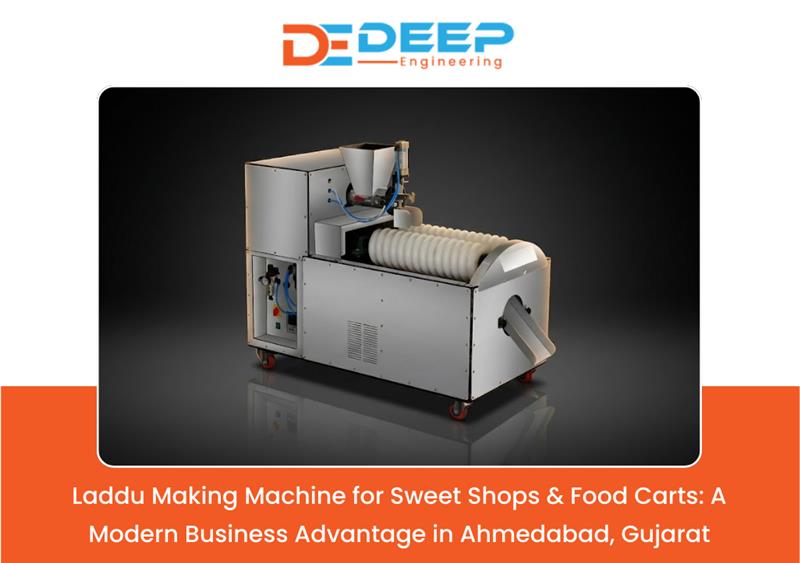
Laddu has a special place in Indian culture — whether it’s festival season, wedding celebrations, prasad distribution, or routine retail sales, demand remains consistent year-round. In cities like Ahmedabad, Gujarat, the sweet market continues to grow as more traditional products become commercially scalable. This rising demand has opened up opportunities for sweet manufacturers, street vendors, food cart operators, food kiosk brands, and cloud kitchens to modernize production.
One of the most impactful innovations in this space is the laddu making machine, also known as a laddu maker, designed to automate the process of shaping laddus in commercial quantities. When paired with the right food cart, food van, kiosk setup, or retail sweet operations, it becomes a system that improves speed, hygiene, and profitability.
In this article, we will break down how a laddu making machine works, business use cases, cost considerations, how to set up with food carts, and why choosing the right food cart manufacturer & kiosk provider matters for your food venture in Ahmedabad and across Gujarat.
Why Laddu Making Machines Are in Demand in Ahmedabad & Gujarat
Ahmedabad has a large market for:
✔ Sweet shops
✔ Catering businesses
✔ Temple prasad vendors
✔ Festival gift packaging companies
✔ Street food & snack carts
✔ Corporate event catering
✔ Mobile sweet vans
✔ Franchise kiosk chains
Traditional laddu rolling by hand is slow and requires skilled labor that can be inconsistent during peak seasons. A laddu making machine helps businesses:
1. Increase Production Capacity
A good laddu maker can produce hundreds to thousands of laddus per hour, depending on mixture consistency and size variations.
2. Improve Standardization & Consistency
Customers expect uniform size and shape, especially for packaged mithai and retail gifting.
3. Reduce Labor Costs
Less dependency on skilled manual staff means more stable margins and better operational efficiency.
4. Maintain Better Hygiene
Machines minimize hand contact with ingredients — a critical factor for modern food safety regulations and consumer expectations.
5. Enable Business Mobility
With food carts, kiosks, and food vans becoming mainstream in Gujarat, machines help scale production without large factory investments.
What Is a Laddu Making Machine & How It Works
A laddu making machine automates the laddu shaping process. Typical workflow includes:
✔ Feeding mixture into hopper
✔ Compression and rolling mechanism
✔ Ejecting uniform laddus
✔ Ready for packaging or selling
Most machines are built using food-grade stainless steel, ensuring:
- Durability
- Easy cleaning
- Hygiene compliance
- Rust resistance
For example, machines supplied on DeepEngineeringFoodCart.com utilize stainless steel for structure and food-contact components, supporting long-term commercial operation.
Types of Laddus Supported
Modern laddu makers can handle a variety of mixtures commonly sold in Ahmedabad, such as:
🍬 Motichoor Laddu
🍬 Boondi Laddu
🍬 Besan Laddu
🍬 Dry Fruit Laddu
🍬 Coconut Laddu
🍬 Mawa Laddu
🍬 Til Laddu
🍬 Atta Laddu
🍬 Festive Assorted Laddus
Consistency varies by moisture content and binding ratio — but commercial-grade machines handle most formats.
Integrating Laddu Machines With Food Carts & Kiosks
Sweet production is no longer restricted to traditional mithai shops. Vendors in Gujarat are increasingly adopting:
✔ Food carts
✔ Mobile kiosks
✔ Stainless steel food carts
✔ Food vans
✔ Cloud kitchen + cart retail combos
✔ Festival & seasonal pop-ups
When combined with a laddu maker, this provides:
On-Site Production
Customers love watching food being made fresh — boosting trust and sales.
High Output With Limited Space
Food carts in Ahmedabad markets (e.g., Law Garden, Manek Chowk, CG Road) operate with limited space. Machines help maximize output.
Mobility & Low Investment
Compared to opening a storefront:
- No rent burden
- No large showroom investment
- No high staffing requirement
This makes it attractive for first-time entrepreneurs.
Why Stainless Steel Food Carts Are Ideal for Sweet Businesses
Food carts manufactured with stainless steel offer:
✔ Hygiene & food safety
✔ Rust resistance (important in humid or monsoon seasons)
✔ Compliance with food standards
✔ Long service life
✔ Smooth cleaning & maintenance
✔ Modern aesthetic appeal
Local businesses in Ahmedabad often opt for custom stainless steel food carts because they can hold:
- Laddu maker machine
- Packaging containers
- Display shelves
- Power supply setup
- Branding boards
- Cash counter
- Storage drawers
Understanding Food Van Pricing for Sweets & Snacks
Another emerging model is the food van or mini food truck. Small vehicles like Tata Ace, Bolero pickup, and custom mini vans can be converted into:
✔ Mobile sweet shops
✔ Festival vans
✔ Catering vehicles
✔ Corporate food vehicles
✔ Event vending vans
Food van pricing is influenced by:
| Factor | Impact |
|---|---|
| Vehicle base model | High |
| Fabrication material (Stainless steel preferred) | Medium |
| Equipment (Laddu maker, roti maker machine, etc.) | High |
| Branding + graphics | Medium |
| Electrical setup | Medium |
| Interior storage | Low-Medium |
Sweet manufacturers in Ahmedabad often expand into vans during festivals like:
- Diwali
- Raksha Bandhan
- Navratri
- Janmashtami
- Uttarayan
This seasonal demand makes mobility profitable.
Additional Equipment Pairings for Food Cart Businesses
A modern food cart or van does not need to be limited to sweets. Many operators combine multiple SKUs such as:
✔ Roti maker machine – for catering businesses
✔ Momos cart / momo cart – high-margin item
✔ Waffle cart – youth-driven dessert market
✔ Panipuri cart – high-volume snack traffic
✔ Potato peeler machine / potato peeling machine – for chips & catering operations
Cross-selling increases both footfall and survival of the cart business across seasons.
Business Use Cases in Ahmedabad & Gujarat
Based on market trends, the laddu maker + cart model can be used for:
✔ Mithai Shops (expanding production)
✔ Catering Businesses
✔ Temple & Prasad Vendors
✔ Sweet Gift Packaging Businesses
✔ Mobile Sweet Vans
✔ Event & Festival Food Stalls
✔ Cloud Kitchen + Street Counter
✔ College & Corporate Kiosks
✔ Malls & Food Courts
✔ Franchise Rollout Models
Factors to Consider Before Buying a Laddu Making Machine
When selecting a laddu maker, consider:
1. Output Capacity
Match production to daily demand — don’t over/under buy.
2. Power Requirements
Ensure compatibility with cart or van electricals.
3. Size & Footprint
Space optimization matters in mobile setups.
4. Materials & Build Quality
Preferably SS304 stainless steel for food contact.
5. Cleaning & Maintenance
Machines should be easy to clean without skilled labor.
Investment & ROI Outlook
While initial investment involves:
✔ Machine cost
✔ Food cart / food van
✔ Electrical setup
✔ Branding & packaging
ROI is attractive because:
- Sweets have high festival demand
- Low raw material cost
- High consumer trust in Indian sweets
- Easy to scale from 1 cart to 10 carts
FAQs
It reduces dependence, improves consistency, and increases output, but staff may still manage mixing, packaging, and sales.
Yes — when paired with a proper stainless steel food cart or van setup, it becomes a compact sweet production unit.
Motichoor, besan, mawa, dry fruit, coconut, til, and festival laddus depending on binding texture.
Food van pricing varies based on customization, equipment, and build quality.
Yes — it ensures hygiene, durability, and long-term service with low maintenance.
Conclusion: A Smart Upgrade for Modern Sweet Vendors
The laddu making machine is no longer a niche equipment — it’s a profitable upgrade for sweet businesses across Ahmedabad and Gujarat. When combined with a stainless steel food cart, kiosk, or food van setup, it creates a scalable model that supports:
✔ High production
✔ Hygiene compliance
✔ Consistent quality
✔ Seasonal scalability
✔ Event opportunities
✔ Mobility
✔ Low operational risk
This blend of machinery + mobile vending + modern branding aligns with the evolving food culture of India.
Businesses that adapt early often secure stronger branding, better customer trust, and higher margins — especially during high-demand seasons.