
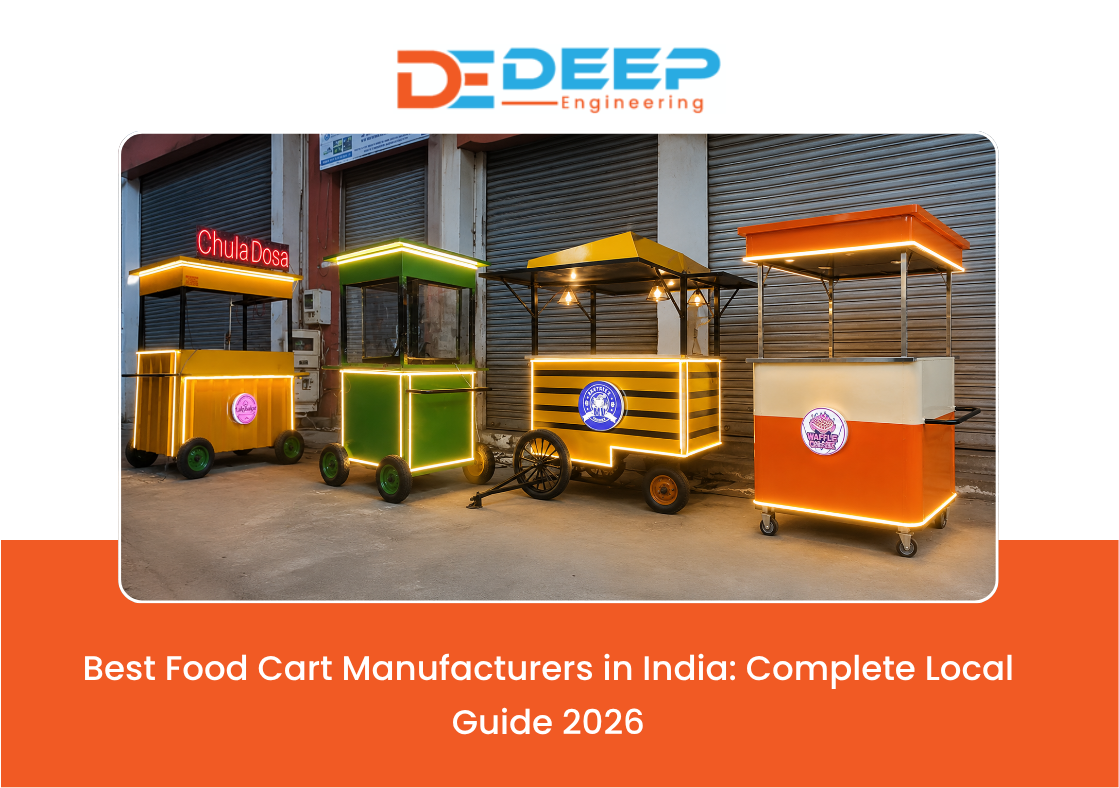
Choosing among the best food cart manufacturers in India is not simply about finding a cart that looks attractive. The right food cart needs to support your menu, daily preparation process, hygiene requirements, storage, mobility, and future business plans.
For a momos seller, panipuri vendor, waffle business, fast-food startup, café, caterer, or growing food brand, cart design directly affects how efficiently the business operates. A well-planned cart can make ingredients easier to organize, improve service flow, simplify cleaning, and present a more professional setup to customers.
This guide explains how to compare manufacturers, understand food cart types and pricing factors, select practical designs, and choose a cart suited to your business.
What Should You Look for in the Best Food Cart Manufacturers in India?
The best food cart manufacturers in India should offer durable construction, suitable stainless steel options, menu-specific customization, hygienic work surfaces, organized storage, reliable mobility, clear communication, and transparent quotations. Buyers should compare manufacturers based on practical design capability rather than appearance or price alone.
You can also explore a specialist Food Cart Manufacturer in India to understand different food vending solutions before finalizing your requirements.
Why Choosing the Right Food Cart Manufacturer Matters
A food cart becomes the working space of your business. Poorly planned equipment placement or inadequate storage can create unnecessary movement during busy service periods.
For example, imagine a momos cart where the steamer is positioned far from the preparation counter while sauces, packaging, and serving tools are stored in different areas. The vendor may repeatedly move from one side of the cart to another for every order.
A better layout keeps frequently used equipment, ingredients, serving materials, and storage within practical reach.
The right cart can support:
- Faster food preparation and serving
- Better organization of ingredients and tools
- Cleaner working surfaces
- Efficient use of limited space
- Easier movement between locations
- A professional customer-facing appearance
- Better equipment organization
- Long-term business expansion
Buyers can review different Food Cart options before deciding which configuration best matches their menu.
What Makes a Good Best Food Cart Manufacturers in India?
Material and Build Quality
Start by understanding the materials used in the cart.
Food vending equipment experiences regular cleaning, movement, heat, moisture, spills, and daily operational wear. Material selection should therefore be based on the intended use rather than appearance alone.
Ask which materials are being used for the frame, worktop, panels, storage areas, and other important components.
Customization Options
A customized food cart manufacturer can adapt the layout according to the menu and equipment requirements.
Useful customization may include:
- Counter dimensions
- Equipment spaces
- Storage compartments
- Shelves
- Electrical fittings
- Water-storage arrangements where required
- Branding panels
- Lighting
- Serving counters
- Roof or canopy configurations
Customization is particularly useful when standard cart layouts cannot accommodate your equipment or service process.
Hygiene-Friendly Design
Food-contact and preparation areas should be easy to access and clean.
Smooth surfaces, sensible equipment placement, organized ingredient areas, and practical waste-management space can make routine cleaning easier.
A hygienic-looking cart also supports a more professional customer-facing setup.
Storage and Workspace Planning
Storage should be planned around actual operations.
Frequently used packaging, utensils, ingredients, cleaning supplies, and tools should have suitable places without unnecessarily reducing preparation space.
Good storage is not simply about adding more compartments. It is about putting storage where it helps the vendor work efficiently.
Mobility and Wheel Quality
A mobile food cart needs wheels and structural support appropriate for its size and expected usage.
Discuss how frequently the cart will be moved, the approximate operating environment, and whether the cart will normally remain in one location or be relocated regularly.
Branding and Modern Finishes
A food cart is also a customer-facing business asset.
Branding panels, menu-display areas, signage space, and a coordinated finish can help customers identify the business and understand what it sells.
For inspiration, review different Food Cart Design options before approving the final layout.
Practical Design for Daily Operations
Good food cart design should follow the sequence in which food is prepared and served.
Think about:
Storage → Preparation → Cooking → Finishing → Serving → Waste handling
Reducing unnecessary movement between these stages can make the limited working area more practical.
Clear Quotation and Communication
Before ordering, request a detailed quotation and confirm what is included.
Ask about dimensions, material specifications, storage, fittings, customization, finishes, and other agreed features. Clear communication helps both buyer and manufacturer understand the expected final configuration.
Types of Food Carts Available for Indian Food Businesses
Momos Cart
A momos business generally needs space for steaming equipment, preparation, sauces, packaging, and ingredient storage.
A well-planned Momo cart can organize these areas while maintaining sufficient serving space and mobility.
Panipuri Cart
Panipuri service involves multiple ingredients that need to remain organized and easily accessible.
A suitable Panipuri Cart should provide a practical serving counter, ingredient arrangement, storage, and easy-to-clean working areas.
Waffle Cart
Waffle businesses usually require a relatively compact preparation process but need sensible placement for electrical equipment, toppings, packaging, and serving materials.
A customized Waffle Cart can also provide branding space that suits a dessert-focused business.
Fast Food Cart
Burgers, sandwiches, fries, snacks, and multi-item menus can require more preparation and equipment space.
A Fast food stall should prioritize workflow, equipment placement, ingredient storage, and sufficient preparation space.
Stainless Steel Food Cart
A Stainless steel food cart is worth considering where cleaning, durability, frequent food preparation, and professional presentation are important priorities.
Buyers should confirm the exact construction specifications with the manufacturer rather than assuming every stainless steel cart uses the same material configuration.
Multi-Purpose Street Food Cart
A multi-purpose street food cart is useful for businesses that sell several products or expect the menu to evolve.
Instead of designing the entire cart around one appliance, the workspace can be planned to provide greater flexibility in storage, preparation, and equipment positioning.
Buyers comparing food carts for sale should evaluate whether the internal layout actually supports their intended menu.
Food Van
A food van may be more appropriate when the business needs a larger mobile workspace, more equipment, greater storage, or a more extensive menu.
Businesses considering this format can compare Food Van configurations and investigate factors affecting food van price before requesting a quotation.
Pan Counter
A pan counter can suit businesses requiring compact vending space and organized product display.
The design should make products accessible to the operator while maintaining a clean, customer-facing presentation.
Food Cart Comparison Table
| Food Cart Type | Best For | Space Requirement | Key Design Priority | Customization Need |
|---|---|---|---|---|
| Momos Cart | Momos and steamed snacks | Compact to medium | Steamer and serving workflow | Medium |
| Panipuri Cart | Panipuri and chaat | Compact to medium | Ingredient organization | Medium |
| Waffle Cart | Waffles and desserts | Compact | Equipment and topping layout | Medium |
| Fast Food Cart | Burgers, fries, sandwiches | Medium to large | Preparation workspace | High |
| Stainless Steel Cart | Frequent food preparation | Varies | Hygiene and durability | Varies |
| Multi-Purpose Cart | Mixed menus | Medium to large | Flexible workspace | High |
| Food Van | Larger mobile menus | Large | Equipment and workspace capacity | High |
Customized Food Cart vs Ready-Made Food Cart
| Factor | Customized Food Cart | Ready-Made Food Cart |
|---|---|---|
| Initial budget | Depends on specifications | Usually easier to evaluate upfront |
| Menu-specific layout | High flexibility | Limited to existing design |
| Branding | Can be planned into design | May have limited options |
| Storage | Designed around requirements | Predetermined |
| Equipment placement | Can be menu-specific | Existing layout may restrict placement |
| Delivery timeline | Manufacturing may be required | May be quicker if available |
| Future scalability | Can consider planned growth | Depends on existing configuration |
| Best use case | Specialized or growing businesses | Simple, standard requirements |
A customized cart is usually worth considering when the menu requires specific equipment, unusual dimensions, specialized storage, or a defined customer-facing design.
Ready-made carts may work well where requirements are straightforward and the existing configuration already suits the menu.
How Much Does a Food Cart Cost in India?
There is no single food cart price in India that applies to every cart.
Pricing can vary according to:
- Cart dimensions
- Material selection
- Stainless steel grade or specification
- Number and style of counters
- Storage requirements
- Wheel configuration
- Cooking-equipment integration
- Electrical fittings
- Plumbing requirements
- Branding
- Lighting
- Canopy or roof
- Custom fabrication
- Finishing requirements
Instead of comparing quotations based only on the final amount, compare what each quotation actually includes.
Provide the manufacturer with your menu, equipment list, approximate dimensions, preferred material, storage requirements, and desired customization. This makes the quotation more relevant to the cart you actually need.
Food Cart Design Ideas for Better Daily Operations
Effective food cart design ideas focus on workflow first and appearance second.
Consider:
- Separate preparation and serving zones
- Vertical storage where practical
- Under-counter storage
- Easy-to-clean work surfaces
- Dedicated menu-display space
- Branding panels
- Appropriate task lighting
- Equipment-specific compartments
- Waste-management space
- Water storage where required
- Lockable storage
- Weather-protection features
- Comfortable counter height
- Unobstructed movement between tasks
Before fabrication, mentally walk through a complete customer order.
Where will you take the order? Where will food be prepared? Which equipment is used? Where is packaging stored? Where will the finished order be handed to the customer?
This simple exercise can identify layout problems before manufacturing begins.
Stainless Steel Food Cart — Is It Worth It?
A stainless steel food cart can be a practical choice for food businesses that prioritize cleaning, durability, frequent use, and a professional appearance.
Suitable stainless steel surfaces can help make routine cleaning easier and withstand the demands of regular food-service operations.
A stainless steel food cart manufacturer should be able to explain the proposed material specifications and how different areas of the cart are constructed.
This type of cart can be particularly relevant for momos, fast food, panipuri, snacks, beverages, and businesses where food preparation happens directly at the vending unit.
Food Cart vs Food Van — Which Is Better?
| Factor | Food Cart | Food Van |
|---|---|---|
| Initial investment | Generally simpler setup | Typically more extensive setup |
| Mobility | Suitable for compact vending | Vehicle-based mobility |
| Operating space | Limited | Greater working area |
| Menu capacity | Best for focused menus | Can support broader menus |
| Equipment capacity | Limited by cart dimensions | More room for equipment |
| Branding potential | Strong customer-facing panels | Larger exterior branding area |
| Best suited for | Street vending and focused menus | Larger mobile food operations |
A food cart works well when the menu and equipment can operate efficiently within a compact footprint.
A food van can make more sense when greater workspace, storage, or equipment capacity is required. Buyers looking for a mobile food van manufacturer India should first define their menu and operational needs before selecting the vehicle-based format.
For either option, check current municipal, food-safety, vending, parking, and vehicle-related requirements applicable to your location and business model.
How to Choose the Right Food Cart for Your Menu
Momos Business
Plan space for a steamer, preparation surface, sauces, serving materials, ingredients, and packaging.
Frequently used items should remain close to the serving area without interfering with hot equipment.
Panipuri Business
Prioritize ingredient organization and fast serving.
Separate spaces for puris, fillings, flavoured water, serving utensils, and supplies can make service more systematic while supporting a cleaner presentation.
Waffle Business
Identify electrical requirements and waffle-machine placement first.
Then plan topping storage, preparation space, packaging, and branding around that core equipment.
Multi-Item Fast Food Business
A larger menu generally creates more complex workspace requirements.
Burgers, sandwiches, fries, and snacks may require multiple preparation areas and equipment positions. In such cases, a larger cart, food stall, or food van may provide a more practical configuration.
Finding a Food Cart Manufacturer Across India
Buyers searching for top food cart manufacturers India should evaluate suppliers based on capability and specifications rather than choosing purely by geographic proximity.
For businesses searching for a food cart manufacturer in Ahmedabad, Rajkot, Surat, Vadodara, Bhavnagar, Himmatnagar, or elsewhere in Gujarat, start by sharing your menu and required specifications with the manufacturer.
The same approach applies to buyers researching manufacturers from Jaipur and Rajasthan, Indore and Madhya Pradesh, Delhi NCR, Gurgaon, Uttar Pradesh, and other Indian markets.
Before ordering from another city or state, discuss:
- Design capability
- Materials and specifications
- Custom fabrication requirements
- Transportation feasibility
- Product dimensions
- Communication process
- Quotation details
- Manufacturing expectations
- Delivery expectations
- After-sales communication
Do not assume a manufacturer has a physical branch, showroom, factory, or local delivery facility in your city unless the business confirms it.
Why Consider Deep Engineering Food Cart Manufacturer?
Deep Engineering Food Cart Manufacturer provides food vending solutions for street food vendors, startups, small businesses, cafés, food entrepreneurs, and established operators.
Its supplied product range includes food carts, food vans, kiosks, food stalls, pan counters, momos carts, panipuri carts, waffle carts, stainless steel food carts, and multi-purpose vending setups.
The focus on customizable designs allows buyers to consider practical factors such as storage, workspace, mobility, menu-specific configurations, hygienic working areas, and modern finishes.
You can learn more about Food Cart Manufacturers or explore Food Cart Manufacturer solutions when planning your setup.
If your menu needs a specific configuration, discuss the equipment, cart size, preparation process, storage, and desired finish with Deep Engineering before requesting a quotation.
Questions to Ask Before Ordering a Food Cart
Use this checklist before contacting a manufacturer:
- What food will I prepare and serve?
- Which cooking or preparation equipment must fit inside?
- How much preparation workspace do I need?
- How much ingredient and packaging storage is required?
- Do I need electrical fittings?
- Is water storage required?
- What wheel configuration is appropriate?
- How frequently will the cart be moved?
- Where should branding and menu information appear?
- What materials and specifications will be used?
- Which features are included in the quotation?
- What manufacturing and delivery expectations should I understand?
- What routine maintenance will the cart require?
A clear requirement list makes it easier to compare quotations fairly.
Step-by-Step Food Cart Buying Process
- Finalize your menu: List the main products you intend to prepare and sell.
- Determine equipment requirements: Identify cooking, preparation, refrigeration, or electrical equipment.
- Choose approximate cart dimensions: Estimate the workspace needed for staff and equipment.
- Decide between cart and food van: Base the decision on menu size, mobility, and equipment capacity.
- Select material and finish: Discuss suitable construction options with the manufacturer.
- Plan storage and workspace: Allocate areas for ingredients, tools, packaging, and preparation.
- Discuss customization: Add menu-specific counters, fittings, branding, or other requirements.
- Request a detailed quotation: Ensure important specifications and inclusions are clearly described.
- Confirm specifications: Review dimensions, materials, storage, equipment spaces, and finishes.
- Review manufacturing and delivery expectations: Clarify the process before confirming your order.
Frequently Asked Questions
The best manufacturer depends on your menu, budget, material requirements, design, storage, and customization needs. Compare suppliers based on build specifications, practical design capability, communication, and quotation clarity rather than relying only on promotional claims.
Start with your menu and equipment list. Then compare manufacturers based on material quality, customization capability, hygiene-friendly design, storage planning, mobility, finishes, communication, and quotation details. Ask questions about every major specification before ordering.
Food cart prices vary according to size, materials, stainless steel specifications, storage, counters, wheels, equipment integration, electrical or plumbing requirements, branding, lighting, canopy, fabrication, and finishing. Request a quotation based on your exact requirements rather than relying on a generic price.
Yes, customized carts can be planned around menu-specific equipment, storage, preparation areas, serving counters, branding, electrical requirements, and other operational needs. Discuss your complete menu and equipment list before approving the layout.
The appropriate material depends on the cart’s intended use, operating environment, cleaning requirements, budget, and construction design. Stainless steel is commonly worth considering for work areas where hygiene, durability, and easy cleaning are priorities.
It can be suitable for many street food businesses because appropriate stainless steel surfaces can support regular cleaning, durability, and professional presentation. Buyers should confirm the actual material specifications and overall construction before purchasing.
Final Thoughts — Choosing the Best Food Cart Manufacturer in India
Finding the best food cart manufacturers in India means finding a manufacturer whose cart can support your actual business requirements.
Build quality matters, but so do customization, hygiene, workspace, storage, mobility, menu compatibility, and future growth.
Start with your menu rather than the cart’s appearance. Identify your equipment and workflow, compare cart formats, review material specifications, and request a detailed quotation.
Deep Engineering offers multiple food vending configurations for buyers considering carts, stalls, counters, and mobile food solutions. Explore the available designs and discuss your menu, preferred dimensions, storage, equipment, and customization requirements before deciding on the right setup.
Contact Us: Deep Engineering