
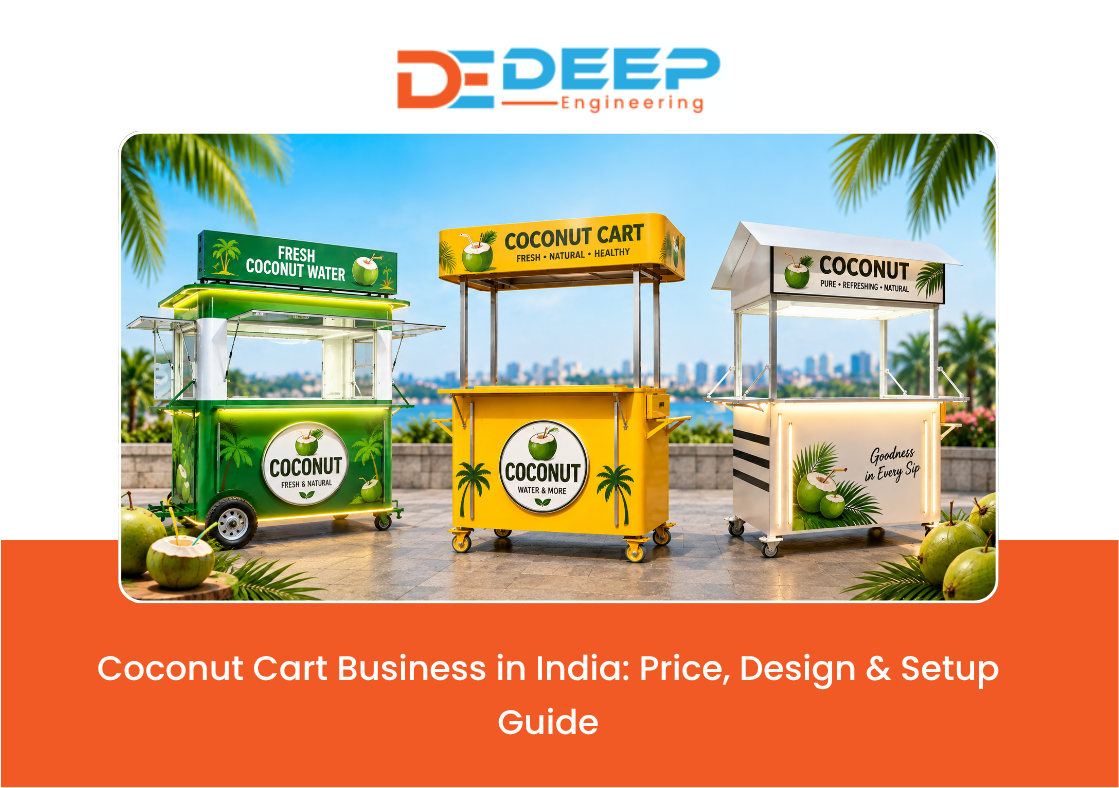
A coconut-water business can look simple from the roadside: keep tender coconuts ready, serve them quickly and collect payment. In practice, the cart has a major effect on how efficiently that business operates.
A well-planned Coconut Cart can make storage easier, keep the serving area organized, improve visibility and create a cleaner customer-facing experience. For a mobile vendor, the cart also becomes part of the business model because mobility, footprint, weather protection and location flexibility all matter.
For someone planning a tender coconut water business in India, the right question is not simply, “How much does a coconut cart cost?” It is “What cart configuration matches the way I actually plan to sell?”
That distinction matters whether you are starting a small summer beverage business in Ahmedabad, upgrading an existing roadside setup in Gujarat, or researching a mobile coconut-water concept for another Indian market.
Deep Engineering manufactures food carts, mobile food vans, kiosks, food vending equipment, street-food carts, stainless steel food carts and customized mobile vending solutions. Its approach is relevant to entrepreneurs who want to build a cart around their operating requirements rather than select equipment based only on appearance.
If you are comparing manufacturers, you can also explore the company’s information on a Food Cart Manufacturer in India before discussing a specific configuration.
What Is a Coconut Cart Business?
A coconut cart business is a mobile or semi-mobile beverage-selling setup focused primarily on tender coconuts and fresh coconut water. Depending on the business model, a vendor may sell whole coconuts, serve fresh coconut water and offer coconut pieces or complementary beverages. The cart provides the workspace, storage, presentation and mobility needed to serve customers efficiently.
The model can suit first-time entrepreneurs, existing coconut vendors and seasonal operators because it can be designed around a relatively focused product range.
However, the business is highly dependent on location, sourcing, seasonality, customer demand and operating efficiency. A cart does not automatically make a location profitable.
The cart becomes more useful when its layout reflects the actual service process:
- Where are coconuts stored?
- Where does the operator work?
- Where are tools kept?
- Where is waste placed?
- Where does the customer stand?
- How quickly can the vendor serve during busy periods?
- How will the cart be cleaned?
- How will it be moved when required?
These questions should be answered before finalizing the design.
How to Start a Coconut Water Cart Business in India
Starting a coconut water business involves more than purchasing a cart and finding coconuts. The better approach is to plan the operation first and then select the cart around it.
1. Choose the business model
Decide whether you will primarily sell:
- Whole tender coconuts
- Fresh coconut water
- Coconut pieces where appropriate
- Coconut water with seasonal beverages
- Coconut water alongside fresh fruit
- A broader mobile beverage menu
A focused menu may require a different cart from a larger beverage concept.
2. Research local demand
Look at the type of customers available in the proposed area.
Consider:
- Morning footfall
- Evening footfall
- Office workers
- Residential customers
- Students
- Fitness-oriented customers
- Tourists
- Event visitors
- Seasonal demand
Do not assume a busy road is automatically a good vending location. Visibility, safe customer access, competition and permission to operate can be equally important.
3. Select a suitable selling location
Potential environments can include markets, parks, residential areas, commercial districts, event zones and tourism-oriented locations where vending is permitted.
For entrepreneurs researching markets such as Ahmedabad, Rajkot, Surat, Vadodara or Jaipur, the same principle applies: evaluate the location before committing to the cart configuration.
4. Estimate daily coconut requirements
Start with a realistic sales assumption rather than buying inventory based on optimism.
Track:
- Coconuts purchased
- Coconuts sold
- Unsold stock
- Damaged stock
- Wastage
- Average selling price
- Peak sales periods
Actual requirements should be adjusted after observing real demand.
5. Decide the cart size
A compact cart can work well when the operator has limited space and a focused menu.
A larger setup may be appropriate if you need:
- More storage
- Larger working surfaces
- Additional beverages
- More branding
- More equipment
- Higher service capacity
6. Plan storage
Storage should be considered early.
A coconut vendor may need space for coconuts, serving materials, tools, cleaning supplies and waste-related items. The arrangement should prevent the operator from repeatedly moving around the cart during service.
7. Plan the cutting and serving workflow
The cart should support a logical sequence from product storage to preparation and customer service.
The exact equipment and layout will depend on the operator’s process. Do not assume that every coconut cart needs the same cutting equipment, refrigeration, electrical system or ice storage.
8. Plan waste management
Tender coconut shells create substantial physical waste. The cart design should account for how waste is collected, moved and removed from the selling area.
A clean waste-management process also contributes to the overall appearance of the business.
9. Plan branding
A coconut vendor cart can become a recognizable local business when its branding is easy to see.
Consider:
- Business name
- Logo
- Product display
- Price display
- Contact information where useful
- Color and visual identity
- Menu board if multiple products are offered
10. Check applicable local requirements
Requirements can vary according to the city, municipal authority, location, operating model and whether the setup is stationary or mobile.
Before starting, verify the latest applicable requirements for your intended location and business model.
11. Estimate working capital
The cart is only one part of the startup requirement.
Working capital may include:
- Coconut procurement
- Transportation
- Packaging
- Cleaning supplies
- Ice or cooling requirements if used
- Labor
- Location-related expenses
- Maintenance
- Other operating costs
12. Launch and test the location
A practical launch strategy is to observe customer behavior rather than assume the first location is perfect.
Measure:
- Customers approached
- Customers served
- Peak periods
- Average transaction
- Wastage
- Service time
- Repeat customers
13. Track sales and wastage
A coconut-water business can lose money through wastage even when sales appear healthy.
Track procurement and sales together.
14. Improve the setup based on customer flow
After operating for a period, identify bottlenecks.
Perhaps coconuts are too far from the work area. waste is difficult to remove. Perhaps customers crowd the serving counter.
These observations can guide future cart modifications or the design of a better second cart.
How Much Does a Coconut Cart Cost in India?
There is no single useful price for every coconut cart in India because the final cost depends on the configuration.
The coconut cart price in India can change based on dimensions, materials, mobility requirements, storage, branding, canopy, accessories, fabrication requirements and the actual workflow the cart needs to support.
A customized quotation is therefore often more useful than comparing a generic online price with another generic listing.
| Cost Factor | Why It Matters |
|---|---|
| Cart size | Determines workspace and storage |
| Material | Affects durability and maintenance |
| Stainless steel | Useful for practical food-service surfaces |
| Wheels | Affects mobility |
| Storage | Helps organize coconuts, tools and supplies |
| Branding | Improves visibility |
| Canopy | Provides practical weather protection |
| Customization | Matches the cart to the operating model |
| Accessories | Depends on the actual workflow |
Other considerations can include delivery and any equipment included in the final configuration.
For example, a simple coconut selling cart designed for a single operator may have very different requirements from a branded mobile beverage cart intended to handle several products.
The important point is to compare like with like.
When asking for a quotation, specify the dimensions, material preference, storage requirements, serving process, mobility requirements and branding needs. This makes it easier to understand what is actually included.
What Makes a Good Coconut Cart Design?
A good coconut cart design starts with workflow rather than decoration.
The operator should be able to reach commonly used items without unnecessary movement, while the customer should have a clear view of the product and serving area.
A practical design usually considers:
- Operator workspace
- Customer-facing counter
- Coconut storage
- Tool storage
- Work surface
- Waste collection
- Cleaning access
- Wheel arrangement
- Stability
- Canopy or weather protection
- Branding area
- Menu or price visibility
The best arrangement depends on how the cart will actually be used.
For example, if the business only sells tender coconut water, there may be little reason to dedicate large amounts of space to an extensive menu board. If the business also sells seasonal beverages, however, additional counter and storage space may become useful.
Visual examples can help when planning proportions and presentation. Deep Engineering’s gallery can be explored under Food Cart Design.
Coconut Cart Design for Small Investment
A beginner does not necessarily need the largest or most elaborate cart.
A practical small-investment design can prioritize:
- Compact footprint
- Essential workspace
- Practical storage
- Easy cleaning
- Simple branding
- Reliable mobility
- Manageable maintenance
The goal is not to remove every feature. It is to remove features that do not contribute to the actual business model.
Low upfront cost does not always mean low total cost.
A poorly designed cart can create problems with storage, cleaning, customer movement, maintenance or operator fatigue. Spending more on a useful feature may make sense when that feature directly improves daily operations.
Why Choose a Stainless Steel Coconut Cart?
A stainless steel coconut cart can be a practical choice for food and beverage vending because stainless-steel surfaces are generally suited to routine cleaning and can provide a professional food-service appearance.
Potential advantages include:
- Easy routine cleaning
- Professional appearance
- Durable food-service surfaces
- Practical maintenance
- Resistance to everyday wear
- Organized commercial presentation
Stainless steel should not be treated as completely maintenance-free or permanently rust-proof. The specification, fabrication, cleaning practices and operating environment all matter.
If you are considering stainless steel for your setup, see the Stainless steel food cart option for a broader reference point.
The right material decision should consider how the cart will actually be used rather than choosing a material simply because it sounds premium.
Mobile Coconut Water Cart vs Fixed Coconut Stall
A mobile setup and a fixed stall solve different business problems.
| Factor | Mobile Coconut Water Cart | Fixed Coconut Stall |
|---|---|---|
| Mobility | Higher location flexibility | Limited |
| Investment | Depends on cart specification | Depends heavily on premises and setup |
| Location flexibility | Useful where mobile vending is permitted | Usually tied to one location |
| Customer access | Can potentially serve different areas | Relies on one established location |
| Branding | Cart itself becomes a marketing surface | Branding can extend across the stall |
| Storage | Limited by cart dimensions | Usually more space possible |
| Operating environment | Must account for movement and weather | More controlled |
| Maintenance | Cart and mobility system require attention | Premises also require maintenance |
| Ideal user | Mobile or seasonal operator | Operator with a suitable fixed location |
| Scalability | Can support mobile expansion | Can support a larger permanent setup |
A mobile coconut water cart can make sense for an entrepreneur who values flexibility and has suitable permitted locations.
A fixed stall may be more appropriate where the operator already has access to a reliable commercial space and wants more storage or a more permanent customer environment.
Neither format is automatically better.
What Should a Mobile Coconut Water Cart Include?
A mobile coconut water cart should be designed around the operator’s actual workflow.
Potential components include:
- Serving counter
- Storage area
- Work surface
- Wheel system
- Canopy
- Branding area
- Waste collection area
- Cleaning access
- Operator workspace
Not every cart requires every component.
For example, a vendor selling only tender coconuts may need a simpler arrangement than an entrepreneur selling coconut water, fruit and several seasonal beverages.
The manufacturer should understand the intended operating process before finalizing the layout.
Coconut Cart Setup for Summer Business
Summer can create strong seasonal demand for cold and refreshing beverages, but higher demand also creates operational pressure.
A good coconut cart setup for summer business should be prepared for faster customer flow.
Practical preparation includes:
- Identifying high-footfall locations where permitted
- Planning inventory carefully
- Adjusting operating hours around actual customer demand
- Reducing unnecessary wastage
- Keeping the workspace organized
- Maintaining a visibly clean cart
- Preparing for higher customer volume
- Checking wheels and moving components
- Planning cleaning routines
- Keeping backup operating supplies
- Adjusting inventory based on sales data
Do not purchase excessive stock simply because summer demand is expected to increase. Actual sales should guide procurement.
If you are targeting a summer launch, starting the cart-design discussion early gives you more time for fabrication, branding, testing and location planning.
Coconut Cart Business Ideas in India
The basic coconut-water model can be adapted in several ways.
1. Tender coconut water cart
The simplest model focuses on fresh tender coconut sales and water service.
2. Fresh coconut stall
A more stationary setup can emphasize presentation and customer convenience.
3. Mobile coconut vendor cart
This model emphasizes mobility and location flexibility where permitted.
4. Coconut water plus seasonal beverage cart
Additional beverages can increase the product range, provided the cart is designed to support the extra workflow.
5. Coconut water plus fresh fruit concept
This can create a broader fresh-beverage proposition, but additional storage and preparation requirements need to be considered.
6. Event-focused beverage cart
A branded cart can be configured for suitable private events or permitted commercial locations.
7. Residential-area beverage cart
Where mobile vending is permitted, residential communities may provide a customer base with repeat local demand.
8. Tourist-location coconut cart
Tourist areas can be attractive for beverage vending, but location rules, access and permissions must be checked.
9. Beach-side or tourism-oriented model
This may work in appropriate permitted areas, but local operating requirements can vary substantially.
10. Branded mobile beverage cart
A more developed concept can use the cart as a recognizable mobile brand rather than simply as a vending counter.
Where Is a Coconut Cart Business Most Suitable?
The right location is usually more important than simply choosing a busy-looking road.
Potential environments include:
- Parks
- Markets
- Tourist areas
- Residential communities
- Business districts
- Sports and event areas
- Roadside commercial areas where permitted
- Transport hubs where vending is permitted
- Summer gathering areas
Evaluate each location according to:
- Footfall
- Visibility
- Accessibility
- Competition
- Permissions
- Operating costs
- Customer profile
- Peak hours
- Safety
- Space available for the cart
For example, an area with strong morning footfall may suit a different operating schedule from an evening-heavy commercial area.
Entrepreneurs searching for a food cart manufacturer in Ahmedabad, Rajkot, Surat, Bhavnagar, Vadodara, Himmatnagar or elsewhere in Gujarat should evaluate the manufacturer’s ability to support their actual cart requirements rather than selecting a supplier based solely on city-based search results.
The same principle applies to businesses in Rajasthan, including Jaipur, as well as markets such as Indore, Delhi NCR, Gurugram, Madhya Pradesh and Uttar Pradesh.
The important distinction is that serving a market does not necessarily mean a manufacturer has a branch, showroom or factory there. Confirm delivery and project arrangements directly.
Coconut Cart Business Cost and Profit Margin
The economics of a coconut cart business should be calculated from actual operating assumptions.
The first distinction to understand is:
Revenue ≠ Gross Profit ≠ Net Profit
A simple calculation framework is:
Daily Revenue = Number of coconuts sold × Average selling price
Then:
Gross Contribution = Revenue – Product Procurement Cost
And an estimated operating result can be considered as:
Estimated Net Profit = Gross Contribution – Labor – Transport – Location Costs – Packaging – Utilities – Wastage – Maintenance – Other Operating Expenses
This is a planning framework, not a profit guarantee.
Profitability can vary significantly according to:
- Coconut purchase cost
- Selling price
- Location
- Footfall
- Season
- Wastage
- Labor
- Operating hours
- Competition
- Transportation
- Local operating costs
- Applicable permissions or fees
Hypothetical example for understanding the calculation — not a price or profit guarantee
Suppose a vendor sells 100 coconuts in a day.
If the average selling price is represented by P, then:
Daily Revenue = 100 × P
If the average procurement cost per coconut is C, then:
Product Cost = 100 × C
The amount left after product procurement is not automatically net profit.
The vendor still needs to consider labor, transportation, packaging, wastage, maintenance and other expenses.
This is why two coconut vendors with the same number of daily sales can have very different financial results.
A business owner should track actual figures rather than rely on generic online profit claims.
How Can a Coconut Cart Improve Customer Experience?
A good cart does more than hold coconuts. It can reduce friction during the transaction.
Useful customer-experience improvements include:
- Faster service
- Organized workspace
- Clear price display
- Easy product visibility
- Clean presentation
- Professional branding
- Convenient payment options
- Consistent serving workflow
Consider the customer standing in front of the cart during a busy summer afternoon.
If the product is visible, the price is clear, the serving area looks organized and the operator can work without constantly searching for tools or supplies, the transaction becomes easier.
That is a practical benefit of good design.
How Important Is Hygiene in a Coconut Water Business?
Hygiene should be treated as part of the operating system, not as decoration.
A coconut cart should support practical cleaning and food-handling routines.
Important considerations include:
- Clean work surfaces
- Clean tools
- Proper waste handling
- Appropriate storage
- Regular cleaning routines
- Protection of ingredients and serving materials
- Avoiding cross-contamination
- Keeping the customer-facing area visibly clean
- Following appropriate food-handling practices
The exact hygiene process depends on what is being sold and how it is prepared.
A business selling only whole tender coconuts may have a different workflow from one that also prepares coconut pieces or additional beverages.
The cart should make the correct routine easier to follow.
How to Choose the Right Coconut Cart Manufacturer in India?
There is no universal “best coconut cart manufacturer” for every business. The right supplier depends on the configuration, quality expectations, budget, workflow and delivery requirements of the individual buyer.
Before ordering, compare manufacturers using a practical checklist.
Manufacturing capability
Can the manufacturer fabricate the type of cart you actually need?
Customization
Can dimensions, storage and workflow be adapted to the business?
Material options
Understand the material specification rather than relying only on the word “steel” or “stainless steel.”
Fabrication quality
Look at construction details, finishing and practical usability.
Dimensions
Confirm the external dimensions and usable workspace.
Storage planning
Ask how coconuts, tools, packaging and cleaning supplies will be organized.
Mobility
Understand the wheel arrangement and how the cart is expected to be moved.
Branding
Ask whether branding elements can be incorporated into the design.
Quotation transparency
Confirm exactly what is included and what is additional.
Delivery
Discuss the available delivery arrangement for your location.
Support
Clarify what assistance is available regarding the product and configuration.
Business understanding
A manufacturer should be able to understand that a coconut vendor has different requirements from a momo seller or fast-food operator.
Deep Engineering manufactures food carts, mobile food vans, kiosks, food vending equipment, street-food carts, stainless steel food carts and customized mobile vending solutions. Its stated focus includes durable construction, customization, hygiene, mobility, organized storage, practical workspace and modern finishes.
You can learn more about the company’s background through Food Cart Manufacturers.
Why Customization Matters for a Coconut Cart
Customization should not be viewed simply as adding decorative features.
The real value is creating a cart that fits the business.
Customization may address:
- Cart dimensions
- Operator height
- Storage
- Serving style
- Branding
- Wheel arrangement
- Worktop
- Canopy
- Waste management
- Customer flow
- Available location
- Product range
For example, a vendor working in a narrow commercial area may prioritize a compact footprint. Another operator serving several beverages may need additional counter space.
A cart that works well for one business may be inefficient for another.
This is why the most useful customization conversations start with questions about how the cart will operate, not only how it should look.
Deep Engineering as a Food Cart Manufacturing Partner
Deep Engineering is a manufacturer and supplier of food carts, mobile food vans, kiosks, food vending equipment, street-food carts, stainless steel food carts, customized food carts and mobile vending solutions.
Its product categories include specialized formats such as:
- Momo carts
- Panipuri carts
- Ice gola carts
- Fast-food carts
- Street-food carts
- Multi-purpose stainless steel carts
- Food vans
- Food kiosks
For a coconut-water entrepreneur, the relevant consideration is not whether a manufacturer has a product with the exact words “coconut cart” in its name. The more useful question is whether the manufacturer can create a practical mobile vending solution around the required workflow.
Deep Engineering’s stated capabilities around customization, storage, mobility, hygiene, workspace and construction are relevant to that decision.
Entrepreneurs can also explore the wider Food Cart range to compare different cart formats before discussing a coconut-specific configuration.
Coconut Cart vs Other Food Cart Businesses
Coconut vending is only one type of mobile food business.
The right cart depends on the product, preparation process and customer flow.
For example:
- A Momo cart may require a different preparation and serving arrangement.
- A Panipuri Cart has different ingredient storage and customer-service requirements.
- A Waffle Cart may require equipment and workspace for cooking.
- A Fast food stall can involve a broader preparation workflow.
- A pan counter serves an entirely different product category and customer process.
The lesson is simple: cart design should follow the business model.
If you are comparing different mobile food concepts, you can also review food carts for sale as part of your product research.
When Should You Consider a Food Van Instead of a Coconut Cart?
A food van becomes more relevant when the business requires significantly more equipment, storage, menu variety or service capacity.
| Factor | Coconut Cart | Food Van |
|---|---|---|
| Menu | Usually focused | Can support a broader menu |
| Footprint | Compact | Larger |
| Mobility | High | High, but vehicle-based |
| Storage | Cart-limited | Generally more space |
| Equipment | Usually focused on specific workflow | Can accommodate more equipment |
| Branding | Cart-based | Larger branding surface |
| Operational complexity | Lower for focused menus | Generally higher |
| Investment | Depends on cart configuration | Depends heavily on vehicle and fit-out |
| Suitable for | Focused beverage or street vending | Larger mobile food operation |
If you plan to sell only tender coconut water, a food van may introduce unnecessary complexity.
If you intend to operate a broader mobile food business with multiple products, equipment and larger storage requirements, a food van may be worth considering.
Deep Engineering offers a Food Van category, while a dedicated food van price page can be reviewed when researching that larger format.
Any actual price should be confirmed for the selected vehicle and configuration rather than assumed from a generic listing.
What Should You Ask Before Ordering a Coconut Cart?
Before placing an order, ask the manufacturer specific questions.
Buyer checklist
- What material is used?
- What are the external and usable cart dimensions?
- Can the layout be customized?
- How much storage is included?
- What is the wheel configuration?
- Can branding be added?
- Is a canopy available?
- What is included in the quotation?
- What delivery options are available?
- What maintenance may be required?
- Can the design be adapted to my workflow?
- Are accessories or equipment included or separate?
- How is waste expected to be managed?
- Is the work surface suitable for the intended service process?
- Can the cart accommodate future menu additions?
These questions make quotation comparisons much more meaningful.
A lower quoted amount is not necessarily a better deal if the cart excludes important components that you will need to add later.
Real-Life Coconut Cart Business Examples
The following are hypothetical examples for planning purposes, not actual Deep Engineering customers or documented business results.
First-time entrepreneur starting a summer coconut-water cart
A first-time entrepreneur wants a compact cart for tender coconut water and plans to operate during high-demand summer periods.
The priority may be:
- Compact footprint
- Practical coconut storage
- Easy operator access
- Simple branding
- Reliable mobility
- Easy cleaning
There may be little reason to build a large menu-oriented counter if the initial product range is narrow.
Existing vendor upgrading an improvised roadside setup
An existing coconut vendor already has customers but is operating from a basic improvised arrangement.
The upgrade could focus on:
- Better organization
- More professional presentation
- Cleaner work surfaces
- Improved storage
- Better customer visibility
- Easier workflow
The goal is not necessarily to build a larger cart. It is to create a more efficient version of the existing operation.
Entrepreneur developing a branded mobile beverage concept
An entrepreneur wants to sell coconut water along with selected seasonal beverages.
The design may need:
- Additional storage
- More counter space
- Stronger branding
- Better menu visibility
- A workflow that supports multiple products
- Space for additional supplies
Here, customization becomes more important because the business is no longer a single-product coconut cart.
Existing food-cart operator adding coconut water seasonally
An existing street-food operator wants to add coconut water during warmer months.
The existing business model matters.
If the operator already has a cart, the best solution may not be a completely separate setup. The operator should evaluate available space, customer flow, storage and whether the additional product can be served efficiently.
Frequently Asked Questions About Coconut Carts
The cost of a coconut cart in India varies according to its configuration. Dimensions, materials, stainless-steel specification, wheels, storage, branding, canopy, accessories, customization and delivery can all affect the final quotation.
For that reason, a configuration-based quotation is more useful than assuming one standard market price.
Start by defining the business model, researching demand, selecting a suitable permitted location and designing the cart around your workflow. You should also plan procurement, storage, waste handling, working capital, hygiene and local requirements before launching.
A practical coconut cart design should account for storage, operator workspace, serving space, mobility, waste collection, cleaning access and customer visibility. Canopies, branding and additional equipment can be included depending on the business model.
A coconut cart business can be profitable, but profitability is not guaranteed. Results depend on procurement costs, selling price, location, footfall, season, wastage, labor, transportation, operating hours and other expenses.
Cart size, material, fabrication, wheels, storage, branding, canopy, accessories, customization and delivery can affect the final price.
Compare manufacturing capability, material options, customization, dimensions, storage planning, mobility, branding, quotation transparency and delivery arrangements. A good manufacturer should also understand the workflow of the specific business.
Final Verdict: Is a Coconut Cart Business a Good Idea in India?
A coconut cart can be a practical small-business format for entrepreneurs who understand the realities of seasonal beverage vending.
The opportunity is not simply about selling tender coconut water. The business depends on getting several operational decisions right:
- Choosing a suitable location
- Understanding seasonal demand
- Controlling procurement and wastage
- Maintaining hygiene
- Organizing storage
- Designing an efficient workflow
- Creating a visible customer-facing setup
- Choosing the right level of mobility
- Understanding operating expenses
- Selecting a cart that matches the business model
For a first-time entrepreneur, a compact and practical setup may be more appropriate than an oversized cart packed with unnecessary features.
an existing vendor, customization can help solve specific workflow or presentation problems.
For a broader beverage business, a larger mobile setup may make sense.
The most important point is to design the cart around the business rather than designing the business around a generic cart.
Deep Engineering’s focus on food carts, mobile food vans, kiosks, stainless steel carts and customized mobile vending solutions makes it a relevant manufacturer to evaluate when planning this type of setup.
If you are preparing for a summer launch, starting the cart-design discussion early can give you more time for fabrication, branding, testing and location planning.
To discuss your requirements, dimensions and customization options, you can contact Food Cart Manufacturer and explain the products you intend to sell, your preferred cart size, storage needs, mobility requirements and intended operating environment.