
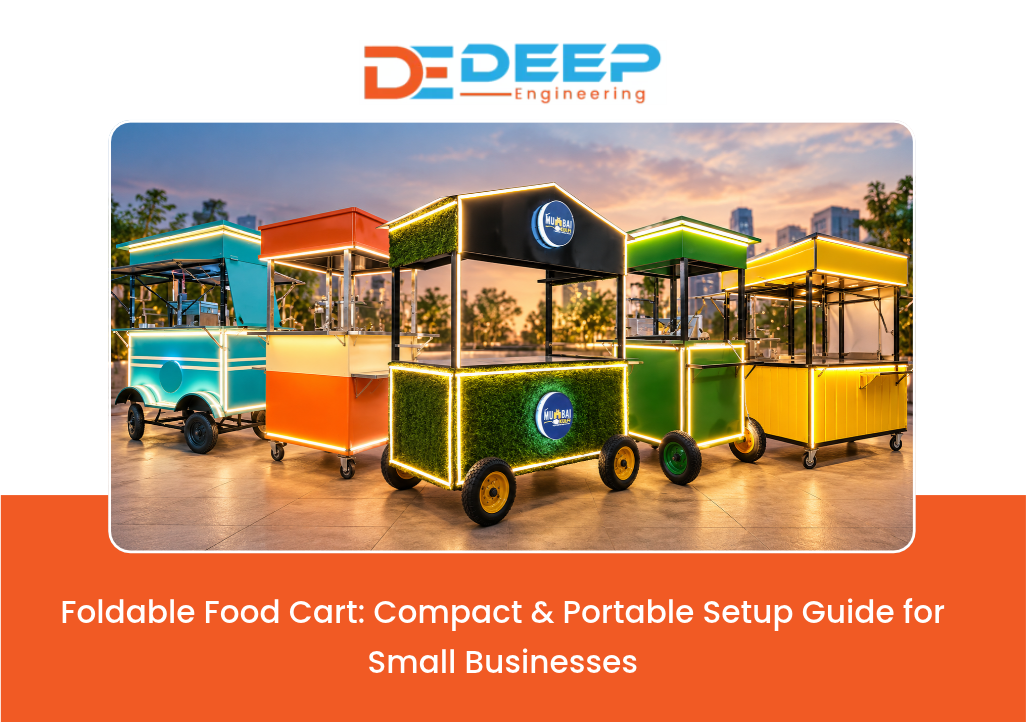
Starting a food business does not always require a large shop, permanent stall, or full-sized food van. For many Indian entrepreneurs, the bigger challenge is finding a setup that fits a limited space, can be moved when required, and still provides a professional working environment.
A Foldable Food Cart can be a practical option for this type of business. Its compact and collapsible approach can make transportation, storage, temporary vending, and location changes easier to manage.
This is particularly relevant for vendors operating at local markets, weekend events, exhibitions, college areas, festivals, and melas. It can also help an entrepreneur test a food concept before committing to a more permanent setup.
In this guide, we will look at what a foldable food cart is, who can use one, how to choose its design, what affects the foldable food cart price in India, and how to select a suitable manufacturer.
What Is a Foldable Food Cart?
A Foldable Food Cart is a portable food-selling setup designed with folding or collapsible elements so that the cart can be made more compact when it needs to be transported or stored.
Unlike a conventional fixed food stall, a foldable cart is intended to provide greater flexibility between operating, moving, and storage conditions.
For a small business, the basic advantages can include:
- Easier transportation between locations
- More convenient storage when not operating
- Better suitability for temporary vending
- Efficient use of limited operating space
- Flexibility for events, markets, and seasonal businesses
The important point is that “foldable” should not simply mean smaller. The design still needs to support the vendor’s actual workflow, including preparation, serving, storage, cleaning, and movement.
Why Are Foldable Food Carts Becoming Popular for Small Businesses?
Small food businesses often need to balance three things: operating space, mobility, and presentation. A portable food stall can address these requirements when the business does not need a permanent location.
Easier Transportation
A compact mobile kitchen cart can be easier to move than a large fixed setup. This can matter when a vendor participates in different markets or events.
For example, a snack seller might operate near a local market on weekdays and participate in a weekend event. A portable setup can provide more flexibility than building a separate stall for each location.
Better Use of Limited Space
Space can be expensive or difficult to secure in busy Indian markets. A compact food stall allows the entrepreneur to focus on the essential workspace rather than occupying unnecessary floor area.
Faster Setup and Pack-Down
For temporary businesses, daily setup and shutdown are important parts of operations. A thoughtfully designed collapsible street food cart can make this process more manageable.
The actual convenience depends on the cart’s construction and folding mechanism, so buyers should evaluate the complete design rather than assuming every foldable cart works in the same way.
More Location Flexibility
A movable food cart can support businesses that want to test different customer areas. An entrepreneur can learn where demand is strongest before considering a more permanent investment.
Professional Presentation
Portability does not mean sacrificing appearance. A well-planned cart can combine a customer-facing serving counter with organized workspace, storage, and a professional visual presentation.
For entrepreneurs comparing different options, the Food Cart Manufacturer in India resource can also help when evaluating the broader food-cart category.
Who Should Consider a Foldable Food Cart?
A foldable cart can be particularly useful for businesses where mobility and space efficiency are important.
It may suit:
- First-time food entrepreneurs
- Street-food vendors
- Mela and event sellers
- Seasonal food businesses
- College-area food sellers
- Home-based food entrepreneurs
- Small cafes testing another location
- Weekend food-stall operators
- Existing vendors testing a second selling point
- Entrepreneurs starting a compact food vending business
Consider an entrepreneur in Ahmedabad who wants to test a snack concept without immediately committing to a permanent shop. A compact setup could allow the entrepreneur to participate in a local market, weekend event, or seasonal gathering and learn more about customer response.
The same principle can apply in Surat, Rajkot, Vadodara, Jaipur, Indore, Delhi NCR, Gurugram, or other growing food markets.
What Makes a Good Foldable Food Cart Design?
A good foldable food cart design should be based on the food business rather than simply on the appearance of the cart.
Foldability and Stability
The cart needs a practical folding concept without compromising its intended working stability. The mechanism should fit the operating workflow and transportation requirements.
Workspace
Think about what the vendor actually does during service:
- Where is food prepared?
- Where are ingredients kept?
- Where does cooking happen?
- Where is the finished food served?
- How does the operator move between these areas?
A visually attractive cart can still be inefficient if the workflow is poorly planned.
Storage
Storage should be planned around the menu. A momo business may need different organization from a beverage or panipuri business.
Serving Counter
The customer-facing area should make serving straightforward while keeping the working area organized.
Mobility
Wheels, overall configuration, handling requirements, and transportation should be considered according to how and where the cart will be used.
Hygiene and Cleaning
Food businesses need practical surfaces and layouts that can be cleaned and maintained as part of their daily routine. Avoid designs with unnecessary areas that make routine cleaning difficult.
Customization
A customized food cart can be planned around a particular menu, serving method, branding requirement, and operating environment.
You can explore different visual approaches through Deep Engineering’s Food Cart Design collection.
What Food Businesses Can Use a Foldable Food Cart?
A foldable cart is not limited to one type of food. The right configuration depends on the menu and preparation process.
Possible concepts include:
- Momos
- Panipuri
- Waffles
- Fast food
- Snacks
- Beverages
- Ice gola
- Pan products
- Seasonal foods
- Festival foods
- Event-specific menus
For example, a vendor interested in momos can explore the Momo cart, while a panipuri business may benefit from reviewing the Panipuri Cart.
For dessert-focused businesses, a Waffle Cart can provide a more relevant reference point. Similarly, a fast-food concept can be compared with a Fast food stall.
For a pan business, a pan counter may be more appropriate than a generic food cart.
The lesson is simple: choose the cart around the menu, not the menu around the cart.
Is a Foldable Food Cart Good for Mela and Events?
Yes, a foldable food cart for mela and events can be useful when portability, temporary setup, and location flexibility are important.
Melas, exhibitions, college events, corporate gatherings, local fairs, festival markets, and seasonal events may have different space and operating requirements from a permanent roadside location.
A portable setup can help an entrepreneur move between opportunities rather than depending on one fixed selling point.
Imagine a hypothetical snack entrepreneur based in Gujarat. During one period, the business operates at a local market. On weekends, the entrepreneur participates in an event. During a festival season, the same business explores a mela opportunity.
A suitable portable food stall can support this changing operating model.
However, the cart should be selected according to transportation arrangements, available event space, menu, preparation method, storage needs, and daily setup requirements.
Foldable Food Cart vs Fixed Food Cart – Which Is Better?
Neither option is universally better. The right choice depends on whether your business prioritizes mobility or a long-term fixed operating location.
| Factor | Foldable Food Cart | Fixed Food Cart |
|---|---|---|
| Portability | Higher flexibility for movement | Generally designed around one location |
| Storage | More suitable when compact storage matters | May require dedicated storage space |
| Temporary events | Well suited to temporary operations | Better when setup remains in place |
| Location flexibility | Suitable for changing locations | More suitable for a fixed location |
| Setup convenience | Designed around setup and pack-down | Usually intended for longer-term setup |
| Space requirement | Can be useful where space is limited | May need a dedicated operating area |
| Long-term fixed location | Useful if mobility may still matter | Often more suitable for permanent operation |
| Best suited for | Events, testing locations, mobile vending | Fixed markets, established stalls, permanent sites |
If your business depends on moving between locations, a foldable model may make more sense. If your business has a stable location and does not need regular movement, a fixed configuration may be more practical.
What Affects Foldable Food Cart Price in India?
The foldable food cart price in India can vary because different carts are built for different business requirements. Instead of looking for one universal price, buyers should compare the complete specification and intended use.
Factors that can influence pricing include:
- Overall cart size
- Material selection
- Construction approach
- Level of customization
- Storage requirements
- Counter configuration
- Mobility requirements
- Finishing
- Food preparation requirements
- Branding requirements
- Equipment integration
- Design complexity
For example, a simple serving-focused cart and a cart requiring more organized preparation space may have very different requirements.
Therefore, the lowest quoted price is not necessarily the best business decision. Compare the design, construction, workflow, storage, mobility, and customization against your actual operating needs.
How to Choose the Right Foldable Food Cart Manufacturer in India?
Choosing a manufacturer should begin with your business requirement, not just a product photograph or quoted price.
Use this checklist when evaluating a manufacturer:
- Manufacturing experience: Look for relevant experience with food carts and vending setups.
- Customization capability: Check whether the design can be adapted to your menu and workflow.
- Material quality: Ask what materials are proposed and why they suit the application.
- Hygiene considerations: Review whether the layout supports practical cleaning and food preparation.
- Design quality: Examine workspace, serving areas, storage, and customer-facing presentation.
- Mobility and stability: Make sure the proposed setup fits your transportation and operating conditions.
- Storage planning: Discuss where ingredients, utensils, packaging, and other essentials will be kept.
- Product-specific expertise: A momo cart, panipuri cart, waffle cart, and beverage cart may require different layouts.
- Portfolio: Review previous designs or product examples where available.
- Communication: The manufacturer should understand what you actually plan to sell.
- Requirement assessment: Explain your menu, location, operating hours, transportation, and expected workflow.
- Clear specifications: Before ordering, make sure the proposed configuration is clearly understood.
Deep Engineering’s Food Cart Manufacturers information can be reviewed alongside its Food Cart Manufacturer in India resource when evaluating the company for a food-cart requirement.
This approach is relevant whether you are sourcing in Ahmedabad, Rajkot, Surat, Bhavnagar, Gujarat, Vadodara, Himmatnagar, Rajasthan, Jaipur, Indore, Delhi NCR, Gurugram, MP, or UP. The important point is to evaluate the manufacturer’s ability to understand your specific business rather than choosing purely on location.
Foldable Food Cart vs Food Van: Which Setup Makes More Sense?
A foldable food cart and a food van solve different business problems.
A food cart is generally more focused on compact vending, while a food van provides a vehicle-based mobile food business format with a different amount of available space and operating requirements.
A cart may be worth considering when:
- You need a compact setup
- Your business operates in limited spaces
- You participate in events or markets
- You want a movable food-stall concept
- Your menu can operate from a smaller workspace
A food van may make more sense when the business model requires a vehicle-based operation and additional operating space.
You can compare the broader category through Food Van and review the dedicated food van price page without assuming that a van is automatically a better investment.
The right choice depends on menu, location, transportation, scale, workflow, and business goals.
Why Stainless Steel Can Matter for Food Cart Businesses
Food carts need surfaces and layouts that can support everyday food-service activities and routine cleaning.
A stainless steel food cart can be worth considering when the business prioritizes practical maintenance, a clean professional appearance, and a surface suitable for food-service operations.
However, buyers should look beyond the material name. The overall design, construction, workspace arrangement, cleaning access, and intended use also matter.
For a reference point, explore Deep Engineering’s Stainless steel food cart option and consider whether its format matches your business requirements.
How to Plan Your Foldable Food Cart Before Ordering
Before discussing a design with a manufacturer, prepare a simple business checklist.
1. Define Your Menu
Write down every major food item you plan to sell. The menu determines the workspace and storage requirements.
2. Understand Your Cooking Method
Decide whether preparation happens on the cart, before arriving at the location, or through a combination of both.
3. Plan the Workspace
Identify where preparation, cooking, storage, serving, and cleaning-related activities will happen.
4. Decide Your Operating Location
A roadside market, college area, exhibition, mela, and corporate event can have very different space requirements.
5. Plan Transportation
Think about how the cart reaches the location and where it will be stored after business hours.
6. Consider Branding
Plan the customer-facing appearance, signage, brand identity, and menu visibility without allowing branding elements to interfere with practical workflow.
7. Plan Cleaning
Daily cleaning should be realistic. A complicated design can create unnecessary maintenance challenges.
8. Think About Future Expansion
If you may add menu items or operate at different locations later, discuss that possibility before finalizing the design.
For entrepreneurs who want to compare broader options, Deep Engineering’s food carts for sale selection can provide another starting point for evaluating different food-vending formats.
Real-Life Business Example: Starting Small With a Portable Food Stall
Consider this hypothetical example.
A new entrepreneur wants to start a snack business but is unsure whether one location will generate enough demand. Instead of immediately building a permanent stall, the entrepreneur plans to test the concept at three types of locations: a local market, a weekend event, and a seasonal mela.
A compact portable food stall could allow the business model to remain flexible.
At the local market, the entrepreneur focuses on regular customers. At the weekend event, the focus shifts toward faster service. During the mela, the entrepreneur may need to handle higher customer movement and a different serving pattern.
The example shows why cart design should be connected to the business model. Portability alone does not guarantee success; the workspace, menu, storage, customer flow, transportation, and daily setup all need to work together.
Why Choose Deep Engineering for Your Food Cart Requirement?
Deep Engineering Food Cart Manufacturer provides food carts, mobile food vans, kiosks, and food-vending equipment for street-food vendors, small businesses, cafes, and food entrepreneurs.
Its product range includes different food-business formats, allowing entrepreneurs to explore options according to their menu and operating requirements.
For a business considering a customized setup, relevant factors include:
- Practical workspace planning
- Mobility
- Organized storage
- Customer-facing presentation
- Different food-business formats
- Customization based on requirements
- Compact vending solutions
Rather than choosing a cart only because it looks attractive, discuss the actual business workflow with the manufacturer.
You can explore the Food Cart Manufacturer website and use the available food carts for sale options as references while deciding what type of setup fits your business.
FAQs About Foldable Food Carts
A foldable food cart is a portable food-vending setup designed with folding or collapsible elements to make transportation and storage more convenient.
Yes. A foldable food cart can be suitable for small businesses that need a compact setup, flexible operating locations, or temporary vending capability. It can be particularly useful for first-time entrepreneurs, event sellers, seasonal businesses, and vendors testing demand in different locations.
A foldable food cart can be a practical option for melas and events because these businesses often operate at temporary locations. Portability can make movement and storage easier. The right design should still consider event space, menu, preparation method, customer flow, transportation, and setup requirements.
Start with your menu and workflow. Consider preparation, cooking, storage, serving, cleaning, transportation, customer flow, branding, and operating location. The best foldable food cart design is one that supports your actual business process rather than simply looking compact or attractive.
Neither is universally better. A foldable cart is generally more suitable when portability, temporary vending, storage, or changing locations matter. A fixed cart may be more appropriate for a stable long-term location. The right choice depends on your operating model, space, menu, and mobility requirements.
Compare manufacturing experience, customization capability, materials, design quality, hygiene considerations, mobility, storage planning, product-specific expertise, portfolio examples, communication, and clarity of specifications. Before ordering, explain your menu, operating location, transportation needs, and workflow so the manufacturer can understand the actual requirement.
Final Takeaway
A Foldable Food Cart can be a practical solution for Indian entrepreneurs who need a compact, movable, and flexible food-business setup. It can be especially useful for small businesses, temporary stalls, events, melas, seasonal markets, and entrepreneurs testing different locations.
The biggest advantage is not simply the ability to fold the cart. The real value comes from combining portability with an efficient workspace, suitable storage, practical serving space, easy maintenance, mobility, and a design that matches the food being sold.
Before making a purchase, define your menu, operating location, preparation process, transportation method, storage requirements, branding needs, and future business plans. Then compare manufacturers and designs based on those requirements.
If you are exploring options for a portable food business, review the available Food Cart options and discuss your specific requirement with Deep Engineering. A well-planned cart can give a small food business the flexibility to start compactly, test opportunities, and adapt as the business grows.