
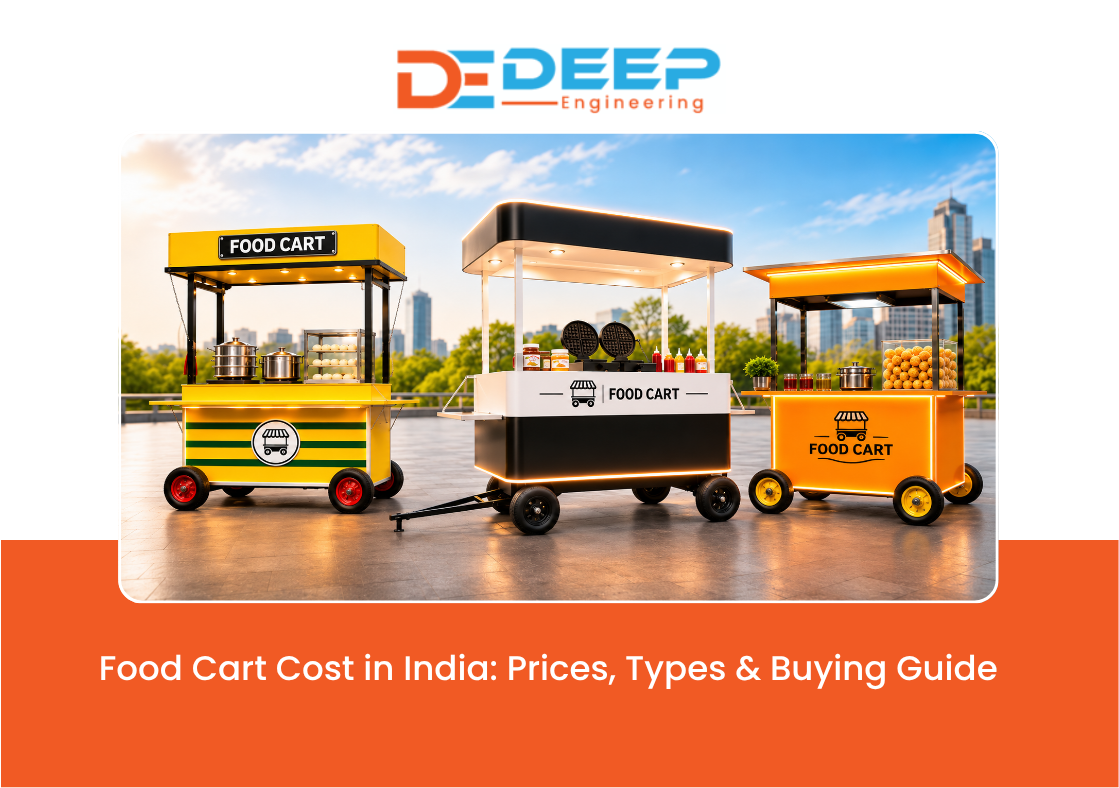
Starting a street food business in India can be an exciting opportunity. Whether you want to sell momos, panipuri, waffles, sandwiches, dosa or other popular snacks, a well-designed food cart can help you establish your business without investing in a full restaurant.
However, one of the first questions most entrepreneurs ask is: How much does a food cart cost in India?
The answer depends on several factors, including cart dimensions, construction materials, design, cooking equipment, storage arrangements and customisation requirements.
Understanding the actual food cart cost before purchasing equipment can help you plan your investment, avoid unnecessary expenses and select a cart that suits your menu and daily operations.
This guide explains food cart prices, different cart types, manufacturing considerations, additional startup expenses and how to choose a suitable Food Cart Manufacturer in India.
How Much Does a Food Cart Cost in India?
The food cart cost in India generally starts at around ₹28,000 for some basic models and can exceed ₹1 lakh for larger, specialised or customised setups. Publicly listed supplier prices vary according to material, dimensions, fabrication, equipment and finishing. A fully equipped mobile food van requires a separate budget because vehicle and conversion costs are involved.
For example, Deep Engineering publicly lists food carts ranging from ₹28,500 for its Pani Puri Cart to ₹98,500 for its Fast Food Cart. These are listed product prices, not personalised manufacturing quotations.
A basic push cart and a fully equipped commercial food cart are not directly comparable. Buyers should evaluate what is included before deciding which option offers better value.
Food Cart Price Comparison Table in India
The following table combines publicly displayed Deep Engineering prices and indicative supplier-market listings checked on 3 November 2026.
| Food Cart Type | Indicative Listed Price | Best For | Key Cost Factors |
|---|---|---|---|
| Basic push food cart | ₹28,000–₹80,000 | New vendors | Size, wheels, frame |
| Stainless steel food cart | ₹42,500–₹85,000 | Hygiene-focused businesses | Steel specifications, fabrication |
| Momos cart | ₹52,999–₹59,000 | Momos vendors | Steamer, storage, counter |
| Panipuri cart | ₹28,500–₹45,000 | Chaat vendors | Containers, water storage |
| Waffle cart | ₹35,000–₹50,000 | Dessert businesses | Electrical setup, equipment |
| Fast food cart | ₹42,000–₹98,500 | Snack businesses | Cooking and preparation equipment |
| Custom food kiosk | ₹45,000 onwards; larger designs may exceed ₹1 lakh | Branded outlets | Design, size, finishing |
| Mobile food van | Separate quotation required | Mobile food businesses | Vehicle, conversion, equipment |
Price references: Deep Engineering’s published shop and product listings, TradeIndia and other supplier listings. These are advertised prices, not independently verified transaction prices. Specifications, GST, delivery and equipment inclusions may differ. Shop Now+8
What should buyers understand about these prices?
- A lower-priced cart may include only the basic structure and counter.
- A premium model may have additional storage, finishing and mobility features.
- Specialised cooking equipment can increase the overall investment.
- Custom designs require a quotation based on actual specifications.
- Delivery, installation, taxes and accessories should be confirmed separately.
If you are comparing different models, explore the available Food Cart options and compare their listed specifications before selecting a design.
What Factors Affect Food Cart Cost?
The food cart manufacturing cost is not determined by appearance alone. Two carts of similar dimensions can have different prices because of their construction, equipment and intended use.
1. Food Cart Size and Dimensions
Cart size directly affects the quantity of materials required and the overall manufacturing process.
A compact cart may be suitable for tea, panipuri or a limited snack menu. A larger cart may be necessary for businesses selling multiple food items.
Consider these points:
- Length, width and working height.
- Number of preparation counters.
- Storage space for ingredients.
- Space for cooking equipment.
- Customer-serving area.
- Available operating space.
For example, a vendor selling only tea and coffee may need a smaller working area than someone preparing burgers, sandwiches and noodles.
However, choosing a larger cart without considering the available vending location can make movement and daily operations difficult.
2. Stainless Steel vs Mild Steel
Material selection is another important factor influencing food cart price.
Both stainless steel and mild steel can be used in commercial cart construction, but they have different characteristics.
| Comparison | Stainless Steel | Mild Steel |
|---|---|---|
| Initial material cost | Generally higher | Generally lower |
| Corrosion resistance | Better, depending on grade | Requires suitable protective coating |
| Cleaning | Smooth surfaces are easy to clean | Depends on coating and finish |
| Maintenance | Usually easier in suitable applications | May require repainting or corrosion protection |
| Appearance | Professional metallic finish | Can be customised with paint |
| Suitability | Food-contact surfaces and commercial workspaces | Structural frames and budget-conscious designs |
Stainless steel is often preferred for food preparation surfaces because it is relatively easy to clean and maintain.
However, buyers should not assume that every stainless steel cart has the same quality. Ask the manufacturer about:
- Stainless steel grade.
- Sheet thickness.
- Frame construction.
- Surface finishing.
- Weld quality.
- Material used for the countertop and storage sections.
A mild steel food cart can also be a practical option when the frame is properly fabricated and protected against corrosion.
3. Custom Food Cart Design
A customised food cart is designed around the specific requirements of a business.
For example, a vendor selling dosa may need a cooking counter and space for batter containers. A momos seller may require a dedicated steamer area, ingredient storage and a serving counter.
Customisation may involve:
- Different cart dimensions.
- Special counter arrangements.
- Additional storage compartments.
- Brand colours and signage.
- Roof or canopy arrangements.
- Special equipment placement.
- Additional shelves and working surfaces.
The more complex the design, the more manufacturing work and materials may be required.
Before approving a customised food cart design, ask for a drawing or layout showing the position of the major components.
4. Cooking Equipment and Accessories
A food cart without the required cooking equipment may not be ready for business.
Depending on the menu, buyers may need:
- Gas burners.
- Commercial steamers.
- Grills and tawa.
- Waffle makers.
- Deep fryers.
- Refrigeration equipment.
- Water tanks and sinks.
- Electrical fittings.
- Lighting.
- Ingredient containers.
For example, a waffle cart requires a different equipment arrangement from a panipuri cart.
Always confirm whether the quotation includes cooking equipment or covers only the cart structure.
5. Mobility and Wheel Quality
Food cart wheels influence convenience, stability and daily handling.
A mobile vendor may need to reposition the cart regularly, while a stationary stall may require less frequent movement.
Check:
- Wheel diameter and load capacity.
- Wheel material.
- Locking mechanisms.
- Frame stability.
- Handle positioning.
- Performance on the intended surface.
A cart that looks attractive but is difficult to move may create operational problems.
6. Manufacturing Quality and Finishing
The manufacturing process also affects the final price.
Important areas to inspect include:
- Strong and properly aligned frames.
- Neat welding and joints.
- Smooth countertop finishing.
- Secure storage compartments.
- Properly fitted doors and drawers.
- Stable wheels and support structures.
- Safe placement of electrical and cooking components.
A low quotation should not be the only deciding factor. Compare the construction quality and specifications before placing an order.
Food Cart Cost by Business Type
Different food businesses require different cart layouts. Selecting equipment according to your menu can prevent unnecessary spending.
Momos Cart Cost in India
A momos cart requires a practical preparation and serving arrangement.
Deep Engineering lists two relevant products:
- Momos Cart: ₹52,999.
- Momo Cart and Mobile Food Cart: ₹59,000.
These are publicly displayed product prices. The final requirements and equipment inclusions should be confirmed before purchasing. Shop Now+1
A typical momos business may need:
- A dedicated steamer area.
- Ingredient storage.
- Sauce and condiment containers.
- Serving counter.
- Utensil storage.
- Space for disposable packaging.
Illustrative example: A beginner planning to sell steamed momos and fried momos should first calculate the required steamer capacity, preparation space and ingredient storage.
There is little benefit in purchasing a large cart if the menu and expected service volume can be managed with a compact setup.
Explore the Momo cart to understand one available mobile food cart option.
Panipuri Cart Cost in India
Panipuri is a popular street food category, and the cart layout should support quick serving and hygienic ingredient handling.
Deep Engineering lists its Pani Puri Cart at ₹28,500. Other supplier listings show panipuri cart prices around ₹40,000–₹45,000, depending on the model and supplier. Durable Street Food Cart for Vendors+1
Important requirements include:
- Separate puri storage.
- Containers for flavoured water.
- Space for potatoes and masala.
- Serving bowls and disposable items.
- Easy-to-clean preparation surfaces.
- Organised storage.
Buyers should check how water containers are positioned and whether the cart can accommodate the required quantities without becoming unstable.
Waffle Cart Cost in India
A waffle cart requires a different setup because the business depends on electrical cooking equipment and toppings.
Deep Engineering lists its Waffle Cart at ₹50,000, while a TradeIndia listing shows a waffle food cart at ₹35,000. These are separate advertised products and should not be treated as equivalent specifications. Deep Engineering+1
Before purchasing, consider:
- Number of waffle makers.
- Electrical load.
- Power availability.
- Ingredient and topping storage.
- Refrigeration requirements.
- Worktop space.
- Menu display and branding.
You can review the available Waffle Cart design when comparing mobile dessert vending options.
Fast Food Cart Cost in India
Fast food carts can be used for burgers, sandwiches, noodles, pizza, fries and other snacks.
Their price depends on the number and type of cooking stations.
A simple serving counter may cost less than a setup containing multiple burners, grills, preparation areas and storage compartments.
Deep Engineering publicly lists a Fast Food Cart at ₹98,500. TradeIndia listings also show other fast food cart options at lower advertised prices, including ₹42,000–₹55,000. The difference highlights the importance of comparing specifications rather than price alone. Shop Now+1
If your business will serve multiple food items, plan the preparation sequence before finalising the cart layout.
Stainless Steel Food Cart Cost in India
A stainless steel food cart is worth considering when cleaning, surface maintenance and a professional appearance are priorities.
Deep Engineering lists its Premium Food Cart, described as a stainless steel model, at ₹85,000. Premium Food Cart – Deep Engineering
The listed product description highlights a strong body, organised workspace, storage and mobility.
Before purchasing, confirm the steel grade, sheet thickness, frame material and which sections are actually stainless steel.
Do not compare a compact stainless steel serving trolley with a fully fabricated stainless steel food vending cart as if they were identical products.
Food Cart vs Food Van: Which Is More Cost-Effective?
A food cart and a mobile food van serve different business requirements. The better option depends on your operating model, budget, mobility needs and available space.
| Comparison | Food Cart | Mobile Food Van |
|---|---|---|
| Initial investment | Generally lower | Generally higher |
| Mobility | Push, pull or specialised wheel system | Vehicle-based movement |
| Space | Compact working area | Larger enclosed or converted area |
| Operating expenses | Depends on equipment and location | Includes vehicle-related expenses |
| Equipment capacity | Limited by cart dimensions | Generally accommodates more equipment |
| Maintenance | Frame, wheels and surfaces | Vehicle and kitchen equipment |
| Best suited for | Street vendors and compact stalls | Larger mobile food operations |
A food cart may be appropriate for someone testing a small street food business.
A mobile food van may be more suitable when the business requires an enclosed preparation area, larger equipment capacity or vehicle-based movement.
However, a food van price should not be compared with a cart price without considering the vehicle itself, conversion work, equipment and operating costs.
For a better understanding, review the food van price information and compare it with the Food Van options.
Neither option is universally better. Your business model should determine the investment.
How Much Does It Cost to Start a Food Cart Business in India?
Purchasing a cart is only one part of starting a street food business. You should also budget for cooking equipment, ingredients, packaging, transportation and other operating expenses.
The total food stall setup cost depends on the menu, location, equipment and business size.
Expenses to Include in Your Startup Budget
| Expense Category | What to Consider |
|---|---|
| Food cart purchase | Basic or customised cart |
| Cooking equipment | Burners, steamers, grills or waffle makers |
| Raw materials | Ingredients and food supplies |
| Packaging | Containers, paper plates, boxes and bags |
| Branding | Signboards, menus and business identity |
| Location-related charges | Applicable vending or site-related fees |
| Electricity or fuel | Power supply, LPG or other energy requirements |
| Transportation | Moving the cart to the operating location |
| Maintenance | Cleaning, repairs and replacement parts |
| Permits and registrations | Applicable food safety and local permissions |
| Working capital | Money reserved for ongoing operations |
Sample Food Cart Startup Budget Framework
Rather than assuming that every food cart business needs the same investment, prepare a budget using actual supplier quotations.
Here is an illustrative calculation for a small food business.
| Budget Component | Illustrative Amount |
|---|---|
| Cart purchase | ₹50,000 |
| Cooking equipment | ₹20,000 |
| Initial ingredients | ₹5,000 |
| Packaging materials | ₹3,000 |
| Branding and signage | ₹5,000 |
| Transportation | ₹3,000 |
| Location-related expenses | ₹5,000 |
| Maintenance reserve | ₹2,000 |
| Working capital | ₹15,000 |
| Illustrative Total | ₹1,08,000 |
These figures are hypothetical planning assumptions, not verified market quotations or Deep Engineering prices. Actual costs may be lower or higher. Registration, permits, taxes and equipment requirements must be checked separately.
The important point is to avoid spending your entire budget on the cart itself. Keep sufficient funds for ingredients, packaging and day-to-day operations.
Food Business Registration and Local Permissions
Food entrepreneurs should understand the applicable registration and vending requirements before starting operations.
The Food Safety and Standards Authority of India (FSSAI) regulates food business registration and licensing. Recent government reforms announced in July 2026 include deemed registration provisions for eligible street vendors registered under the Street Vendors Act, along with fee exemptions for eligible street food vendors and hawkers. Press Information Bureau+1
You should also check:
- Applicable municipal vending permissions.
- Local vending-zone restrictions.
- Requirements of the Town Vending Committee.
- Food safety and hygiene requirements.
- Applicable electricity and fire safety requirements.
The Street Vendors (Protection of Livelihood and Regulation of Street Vending) Act, 2014 provides a framework for regulating street vending, including certificates of vending and designated vending zones. India Code+1
Requirements can differ depending on the business activity and location. Check the latest applicable rules through FSSAI and your local municipal authority.
How to Choose the Right Food Cart for Your Budget
Choosing the right food cart involves more than finding the cheapest available option. A suitable cart should support your menu, working style and future business requirements.
Use the following buying checklist before placing an order.
1. Finalise Your Food Menu
Start by identifying what you intend to sell.
For example:
- Momos and steamed snacks require preparation and steaming space.
- Panipuri requires organised ingredient and water storage.
- Waffles require electrical cooking arrangements.
- Burgers and sandwiches need preparation counters and cooking equipment.
Your menu will determine the type of cart you need.
2. Decide Your Available Budget
Decide how much you can invest in the cart and how much should remain available for other startup expenses.
Request quotations for different configurations instead of selecting the first available model.
3. Select Suitable Cart Dimensions
Measure your available operating area before ordering.
Consider the space needed for:
- Food preparation.
- Cooking.
- Serving customers.
- Storage.
- Staff movement.
- Cart repositioning.
A compact cart can be more practical for a narrow vending location.
4. Compare Material Quality
Ask about the construction material and specifications.
If you prefer stainless steel, confirm the grade and thickness. If you choose mild steel, check its coating, welding and corrosion protection.
5. Check Storage and Equipment Placement
Your cart should provide enough room for ingredients, utensils and cooking equipment.
Avoid layouts where equipment blocks access to storage or makes food preparation difficult.
6. Evaluate Cleaning and Maintenance
Food preparation surfaces should be easy to clean.
Check whether corners, joints and compartments can be accessed for regular cleaning.
7. Consider Mobility
Check wheel quality, stability and the ability to move the cart in your intended operating environment.
8. Compare Manufacturers
Before selecting a supplier, evaluate:
- Product specifications.
- Material details.
- Customisation options.
- Manufacturing quality.
- Quotation transparency.
- Transportation arrangements.
- After-sales communication and support.
A good buying decision balances price, practicality and construction quality.
Why Consider Deep Engineering Food Cart Manufacturer?
Selecting the right manufacturing partner is an important part of establishing a food vending business.
Deep Engineering Food Cart Manufacturer is based in Ahmedabad, Gujarat, India, and manufactures and supplies food carts, mobile food vans, kiosks and food vending equipment for entrepreneurs, street vendors, cafes and small businesses.
Its product range includes:
- Momos carts.
- Panipuri carts.
- Ice gola carts.
- Fast food carts.
- Stainless steel food carts.
- Waffle carts.
- Mobile food vans.
- Food kiosks.
- Multipurpose food vending carts.
- Custom food cart designs.
The company focuses on practical cart layouts, organised storage, mobility, durable construction and hygienic food preparation surfaces.
What Should Buyers Evaluate?
When considering a Food Cart Manufacturer, buyers should focus on whether the product meets their actual business requirements.
Deep Engineering offers different cart models that can be explored through its product collection.
You can also review its Food Cart Manufacturers company information to understand its business background.
For entrepreneurs who want to compare different configurations, reviewing the Stainless steel food cart is another useful starting point.
If you are planning a new food business or upgrading an existing stall, discuss your preferred cart dimensions, materials, equipment placement and storage requirements with Deep Engineering before finalising your purchase.
Food Cart Manufacturer in Ahmedabad: Buying Considerations for Indian Entrepreneurs
Ahmedabad is an important starting point for entrepreneurs looking for food cart manufacturing options in Gujarat.
However, buyers from other cities should also evaluate the manufacturer based on specifications, product suitability and transportation arrangements.
Here are some considerations for different markets.
Ahmedabad, Gujarat
Local buyers can compare available cart designs, discuss material requirements and clarify manufacturing specifications before ordering.
Surat, Rajkot and Vadodara
Entrepreneurs in these cities should compare the cart dimensions, equipment requirements and transportation arrangements when requesting quotations.
Jaipur and Other Rajasthan Markets
Buyers planning food vending businesses should consider the menu, local operating conditions and the type of cart required.
Indore and Madhya Pradesh
Food vendors should evaluate storage, cooking equipment and cart mobility according to their planned food business.
Delhi NCR and Gurugram
Entrepreneurs should consider available vending space, cart dimensions and transportation costs when comparing manufacturers.
Uttar Pradesh and Other Indian Markets
Buyers should provide their delivery location and specifications to obtain a more accurate quotation.
When evaluating a Food Cart Manufacturer in India, avoid choosing solely on the basis of a low advertised price.
Compare the manufacturing details and understand exactly what you will receive.
How to Get an Accurate Food Cart Price Quote
The easiest way to receive a useful food cart quotation is to provide the manufacturer with complete business requirements.
A vague request such as “What is your food cart price?” may not provide enough information for accurate costing.
Instead, share the following details.
1. Food Business Type
Explain whether you plan to sell momos, panipuri, waffles, fast food, tea, coffee or another food category.
2. Preferred Dimensions
Mention the approximate length, width and height required.
3. Material Requirements
Specify whether you prefer stainless steel, mild steel or a combination of materials.
4. Equipment Requirements
List the cooking equipment, electrical fittings, storage compartments and other accessories required.
5. Available Budget
Share your approximate investment range so that the manufacturer can suggest an appropriate configuration.
6. Customisation Requirements
Explain whether you need special colours, branding, signage, a canopy, additional shelves or a customised counter.
7. Delivery Location
Mention your city and delivery location so that transportation arrangements can be discussed.
A Simple Example of a Quotation Request
You can use the following format when contacting a manufacturer:
- Business type: Momos and fast food.
- Cart size: Approximately 6 feet.
- Material: Stainless steel working surface with suitable frame construction.
- Equipment: Steamer and ingredient storage.
- Design: Mobile cart with organised serving counter.
- Budget: Based on manufacturer quotation.
- Location: Your city.
Providing these details helps the manufacturer understand the project and prepare a more relevant quotation.
If you are comparing food carts for sale, check the listed specifications and request confirmation of the final product configuration.
You can also discuss the Food Cart Design options to understand the different layouts available.
For a more specialised setup, review the Fast food stall and pan counter options.
Contact Deep Engineering Food Cart Manufacturer with your menu, preferred dimensions, material requirements, equipment list and delivery location to discuss a suitable food cart and request a customised quotation.
FAQs About Food Cart Cost
Food cart prices in India vary according to dimensions, construction materials, equipment and customisation. Publicly listed examples range from approximately ₹28,500 for a basic Pani Puri Cart to ₹98,500 for a specialised Fast Food Cart at Deep Engineering. These are advertised prices, and buyers should confirm the latest quotation and inclusions.
The price of a stainless steel food cart depends on its steel grade, sheet thickness, dimensions, frame construction and storage arrangement. Deep Engineering lists its Premium Food Cart, described as a stainless steel model, at ₹85,000. Buyers should confirm the material specifications and whether additional equipment is included.
The cost depends on the cart design and the equipment needed for the menu. Deep Engineering publicly lists a Momos Cart at ₹52,999, a Momo Cart and Mobile Food Cart at ₹59,000, and a Pani Puri Cart at ₹28,500. Confirm the final configuration and equipment inclusions before ordering.
A customised food cart can cost more when it requires special dimensions, additional storage, branding, electrical fittings or specialised cooking equipment. However, the final price depends on the design and manufacturing specifications. A customised cart may also help avoid purchasing unnecessary accessories that do not suit your business.
To receive an accurate quotation, share your food business type, preferred cart dimensions, material requirements, cooking equipment, storage needs, customisation preferences and delivery location. Ask the manufacturer to provide a detailed quotation explaining the cart structure, included accessories, taxes and transportation charges.
Final Thoughts
Understanding food cart cost in India is an important first step when planning a street food business.
The price of a food cart depends on its dimensions, construction materials, equipment, design, mobility and manufacturing requirements. A basic push cart may suit a small vending operation, while a customised stainless steel cart or mobile food van may be more appropriate for a specialised business.
Before purchasing, compare the product specifications, check the construction quality and consider your complete startup budget rather than focusing only on the cart price.
Deep Engineering Food Cart Manufacturer offers different food cart models, including momos carts, panipuri carts, waffle carts, fast food carts and stainless steel food carts.
Planning to start your food business? Explore the available designs, discuss your requirements and request a quotation from Deep Engineering to find a cart that matches your menu, working space and investment plans.