
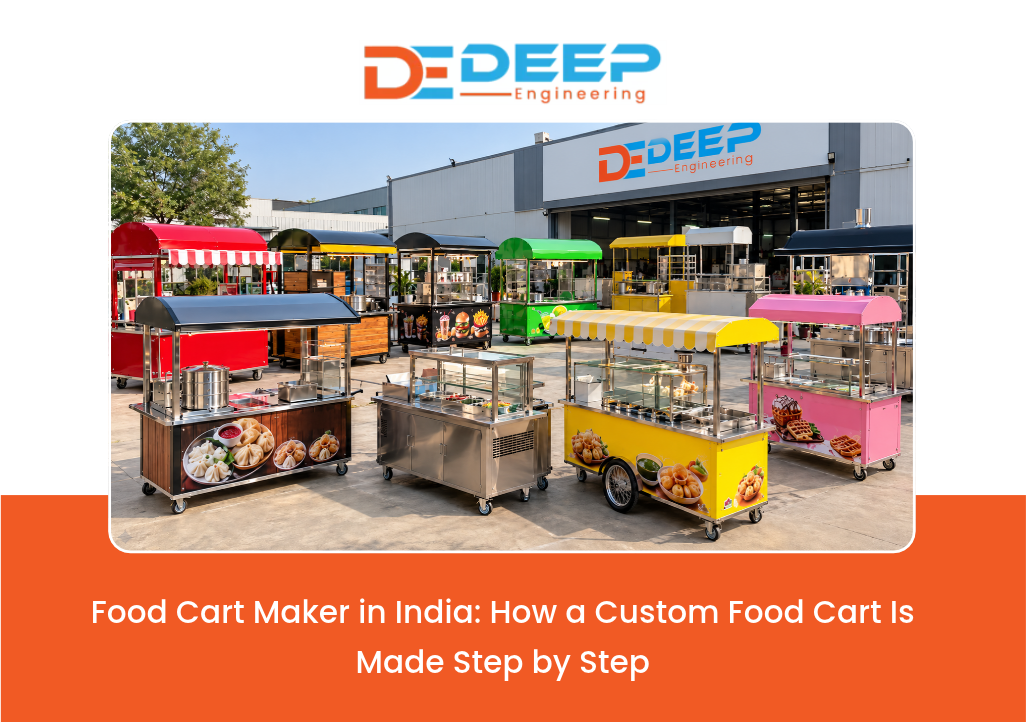
A food cart is much more than a counter with wheels. For an Indian food entrepreneur, the right cart can influence how quickly food is prepared, how ingredients are stored, how customers are served, and how comfortably the vendor works during busy hours.
That is why choosing a professional Food Cart Maker is an important business decision. A properly planned cart should match the menu, cooking method, equipment, storage requirements, available space, branding, and mobility needs of the business.
A professional manufacturing process typically moves through several stages: understanding the business requirement, developing the design, planning materials and construction, fabrication, customization, finishing, quality checking, and final preparation for delivery. This guide explains that journey in practical terms.
What Does a Food Cart Maker Do?
A Food Cart Maker designs and develops food carts according to the practical requirements of a food business. The work can involve design planning, workspace layout, material selection, fabrication, storage, counter construction, mobility, finishing, customization, and quality checking.
The important difference between a basic fabricator and a professional manufacturer is the approach. A basic fabricator may focus mainly on constructing a physical structure, while a capable manufacturer considers how that structure will actually be used during daily food service.
For example, a momo vendor, panipuri seller, waffle business, and fast-food operator may all need carts, but their workflows are different.
Businesses looking for a dedicated manufacturing partner can explore Food Cart Manufacturer in India to understand the type of food-vending solutions available.
How Is a Food Cart Made From Design to Delivery?
The food cart making process should start with the business requirement rather than immediately cutting or assembling materials. A well-planned process can be divided into eight practical stages.
Step 1 – Understanding the Food Business
The first step is understanding what the cart needs to do.
Before manufacturing begins, a food cart maker should consider:
- Menu and food items
- Cooking method
- Equipment requirements
- Number of people working at the cart
- Customer flow
- Storage requirements
- Operating location
- Mobility requirements
- Serving style
This information determines the layout.
A momo cart, for example, may need a different working arrangement from a panipuri cart because the preparation, storage, serving, and customer interaction are different. Similarly, a waffle business may need space planned around its equipment and serving process.
The objective is simple: the cart should support the business workflow instead of forcing the business to adapt to an unsuitable layout.
Step 2 – Creating the Food Cart Design
Once the business requirements are understood, the concept can be converted into a practical layout.
Important design considerations include:
- Counter placement
- Working height
- Storage areas
- Cooking zone
- Serving zone
- Customer-facing side
- Equipment position
- Branding area
- Mobility
Good Food Cart Design should consider both the vendor and the customer. The operator needs an organised working area, while the customer should be able to understand where to order and receive the food.
You can explore examples of Food Cart Design to understand how different cart concepts can be visually developed.
Step 3 – Selecting Materials and Construction Approach
Material selection affects several practical aspects of a commercial food cart, including durability, cleaning, maintenance, appearance, and suitability for regular use.
For many food businesses, stainless steel is an important material option because it can support a clean and professional-looking workspace when appropriately designed and maintained.
However, material selection should be considered together with the complete cart design rather than as an isolated decision.
For businesses specifically considering this format, a Stainless steel food cart can be explored as one example of a purpose-built food-vending solution.
Step 4 – Food Cart Fabrication
Food cart fabrication is the stage where the planned design becomes a physical structure.
Depending on the design, fabrication can involve elements such as:
- Structural framework
- Panels
- Counter surfaces
- Storage sections
- Wheels
- Shelves
- Working areas
- Service openings
The exact construction approach depends on the cart’s design and intended use.
The key point for a buyer is that fabrication should follow the approved business and layout requirements. A cart may look attractive from the outside but still be inconvenient if storage, working space, or serving areas have not been considered properly.
Step 5 – Stainless Steel Cart Fabrication and Finishing
Construction is only part of the process. The finishing stage also matters because the cart becomes part of the customer’s view of the food business.
A well-planned finish can contribute to:
- Smooth and practical surfaces
- A clean appearance
- Easier routine maintenance
- An organised workspace
- A professional presentation
For a street-food business, appearance can matter alongside functionality. Customers see the cart while ordering, waiting, and receiving their food, so the overall presentation should support the brand.
Step 6 – Customization and Branding
One of the main advantages of working with a custom food cart maker is the ability to adapt the cart to the actual food concept.
Customization can consider:
- Food concept
- Menu
- Brand identity
- Available operating space
- Storage requirements
- Serving style
- Mobility
- Customer interaction
For example, a momo business may need a layout built around momo preparation and serving. A panipuri business may require a different serving arrangement. A waffle business may prioritise equipment positioning and presentation.
For specific concepts, you can explore a Momo cart, Panipuri Cart, Waffle Cart, Fast food stall, or pan counter.
The best customization is not decoration for its own sake. It should make the cart more suitable for the business.
Step 7 – Quality Checking Before Delivery
Before a completed cart moves to the customer, the design and construction should be reviewed.
Areas to check can include:
- Overall construction
- Stability
- Storage functionality
- Doors or drawers where applicable
- Counter usability
- Mobility
- Surface finishing
- Overall design consistency
This stage is valuable because small practical issues are easier to identify before the cart reaches its operating location.
Step 8 – Final Preparation and Delivery
The final stage connects manufacturing with actual business use.
This is where custom food cart design and delivery come together. Buyers should discuss transportation, access to the operating location, and any final setup requirements before placing an order.
Thinking about delivery early can help avoid situations where a cart has been designed without considering how it will reach its destination.
What Makes a Good Custom Food Cart Maker?
A reliable manufacturer should be evaluated on more than appearance or price.
Consider these factors before making a decision:
- Ability to understand business requirements
- Custom design capability
- Practical workspace planning
- Suitable material options
- Manufacturing and fabrication capability
- Product-specific understanding
- Portfolio of designs
- Attention to storage
- Mobility considerations
- Finishing quality
- Clear communication
- Transparent product specifications
Deep Engineering operates in the food-cart and kiosk manufacturing space, offering customizable food carts, mobile food vans, kiosks, and food-vending equipment for food entrepreneurs and small businesses. More information about the company can be found through Food Cart Manufacturers and Food Cart Manufacturer.
Standard Food Cart vs Custom Food Cart
The right choice depends on how specifically the cart needs to match the business.
| Factor | Standard Food Cart | Custom Food Cart |
|---|---|---|
| Design flexibility | Limited to available designs | Higher flexibility |
| Menu-specific layout | General-purpose | Planned around the menu |
| Storage planning | Predefined | Can be adapted |
| Branding | May be limited | Can be incorporated into the design |
| Workspace customization | Limited | More adaptable |
| Equipment integration | Based on standard layout | Can be considered during planning |
| Best suited for | Straightforward requirements | Specific business workflows |
| Ideal buyer | Buyers with simple needs | Entrepreneurs needing a tailored setup |
A standard cart can make sense when the available configuration already matches the business. A custom cart becomes more useful when the menu, equipment, storage, branding, or working process requires a different arrangement.
What Should You Ask a Food Cart Maker Before Placing an Order?
Before ordering, ask questions that clarify both the product and the manufacturing process.
A useful checklist includes:
- Can the cart be customized for my menu?
- What layout would you recommend for my business?
- What material options are available?
- How will storage be planned?
- How will the cart be moved or transported?
- Can the design include branding?
- What is included in the quoted specification?
- What information is needed before manufacturing?
- How will the final design be confirmed?
- What should I prepare before delivery?
These questions can help you compare food cart makers in India on capability rather than simply comparing photographs or initial quotations.
How Much Does a Custom Food Cart Cost?
There is no single price that applies to every custom food cart. The final cost can depend on the requirements of the particular design.
Important cost factors can include:
- Size
- Material
- Design complexity
- Customization
- Storage
- Counter configuration
- Mobility requirements
- Branding
- Equipment integration
- Finishing
- Manufacturing requirements
Instead of asking only for the lowest possible price, buyers should compare what they are receiving for the quoted specification.
A cart that is better suited to the menu and workflow may provide more practical value than a cheaper cart that requires compromises during daily operation.
Entrepreneurs considering a larger mobile setup can also compare a Food Van and review the relevant food van price information before deciding which format fits their business model.
Food Cart Maker Near Me for Custom Orders – What Should You Look For?
Searching for a food cart maker near me can be a useful starting point, but proximity should not be the only selection criterion.
Look at:
- Portfolio and previous designs
- Product range
- Customization capability
- Communication
- Manufacturing capability
- Business understanding
- Design support
- Product specifications
An entrepreneur in Ahmedabad may initially search for a local manufacturer, while another buyer in Rajkot, Surat, Vadodara, Jaipur, Indore, Delhi NCR, or Gurugram may search using the same “near me” intent.
The important question is not simply, “Who is closest?” It is, “Who can build a cart that suits my business requirements?”
Which Food Businesses Can Benefit From a Custom Food Cart?
Custom food carts can be useful for many low-footprint and mobile food concepts, including:
- Momo businesses
- Panipuri businesses
- Waffle businesses
- Fast-food businesses
- Beverage businesses
- Ice gola businesses
- Pan businesses
- Snack businesses
- Seasonal food businesses
- Event food businesses
A vendor who is still comparing options can browse food carts for sale to explore different food-cart formats.
The important consideration is to select a structure around the business concept rather than choosing a cart simply because it looks attractive.
Food Cart vs Food Van – Which Is Right for Your Business?
A food cart and food van can both support mobile food businesses, but they represent different operating formats.
Businesses looking for a compact, customer-facing setup may find a food cart more appropriate for a particular location or operating model.
In contrast, a food van offers a different type of mobile workspace and may suit businesses that need a larger vehicle-based setup.
Consider:
- Available space
- Mobility
- Operating model
- Location
- Business scale
- Setup requirements
- Customer capacity
- Investment considerations
There is no universal winner. The suitable option depends on the entrepreneur’s operating requirements.
Real-Life Example – Turning a Food Idea Into a Custom Cart
Hypothetical example: Imagine an entrepreneur wants to start a momo and snack business in a busy local market.
Instead of immediately buying a generic cart, the entrepreneur first identifies the menu and expected working process.
The planning could follow this sequence:
Business idea → Menu → Layout → Storage → Serving counter → Mobility → Branding → Fabrication → Quality check → Delivery
The entrepreneur may determine which ingredients and supplies need regular storage, where preparation will happen, where customers will order, and how the cart needs to move.
The manufacturer can then use those requirements to develop a more relevant layout.
This example is hypothetical and does not represent a real customer, testimonial, or business result. Its purpose is to show why the food cart making process should begin with business requirements.
Why Choose Deep Engineering for Your Food Cart Requirement?
Deep Engineering provides food-cart and mobile-vending solutions designed for street-food vendors, small businesses, cafes, and food entrepreneurs.
Its range includes customizable formats such as momo carts, panipuri carts, ice gola carts, fast-food carts, street-food carts, multi-purpose stainless steel carts, food kiosks, and mobile food-vending equipment.
The practical value of a custom approach is that the cart can be considered around the business concept, workspace, storage, mobility, customer interaction, and overall presentation.
If you are comparing different formats or planning a new food business, explore the available Food Cart solutions and identify the format that best matches your operating requirements.
FAQs About Food Cart Makers
A food cart maker plans and manufactures food carts based on business requirements. The process can include design, layout planning, material selection, fabrication, storage, counter construction, mobility, finishing, customization, and quality checking before final preparation.
A food cart generally moves through several stages: understanding the food business, creating the layout, selecting suitable materials, fabrication, finishing, customization, quality checking, and final preparation for delivery. The exact process depends on the cart design and business requirements.
Ask about customization, recommended layout, material options, storage planning, mobility, branding, quoted specifications, information required before manufacturing, design confirmation, and delivery preparation. These questions help clarify whether the cart will actually suit your business.
Cost can vary based on factors such as size, material, design complexity, customization, storage, counter configuration, mobility requirements, branding, equipment integration, finishing, and manufacturing requirements. The final specification should be understood before comparing quotations.
Start by reviewing manufacturers’ product ranges, portfolios, customization capabilities, communication, manufacturing approach, and product specifications. Buyers can search across markets such as Ahmedabad, Rajkot, Surat, Gujarat, Rajasthan, Jaipur, Indore, Delhi NCR, Gurugram, MP, and UP.
Do not select a manufacturer based only on distance. Compare the manufacturer’s design capability, product range, customization, manufacturing approach, portfolio, communication, specifications, and ability to understand your food business. A suitable manufacturer may be more valuable than simply choosing the closest vendor.
Final Takeaway
A successful food cart starts with the business requirement, not simply the physical cart.
The complete process can be understood as:
Business requirement → Design → Material planning → Fabrication → Customization → Quality checking → Delivery
A good food cart should support the way you prepare, store, serve, move, and present your food. That is why working with a capable Food Cart Maker can be valuable when a business requires something more specific than a generic structure.
For Indian entrepreneurs starting or expanding a momo, panipuri, waffle, fast-food, snack, beverage, pan, or other mobile food business, the right cart can become an important part of the daily operating setup.
If you are planning a new food-cart business or upgrading an existing setup, explore Deep Engineering’s food-cart solutions and discuss your specific menu, workspace, storage, mobility, and customization requirements before finalising your design.