
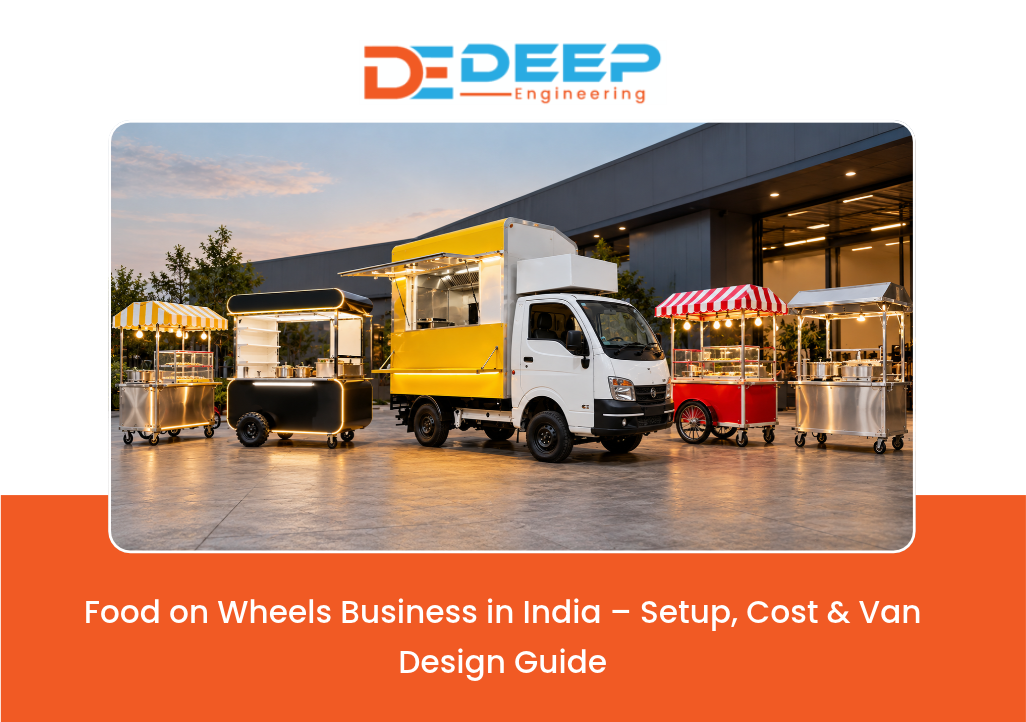
Starting a Food on Wheels business in India can be an option for entrepreneurs who want to sell popular food items through a mobile or compact vending setup instead of opening a conventional restaurant immediately. From momos and sandwiches to panipuri, waffles, beverages, and regional snacks, the right mobile food business combines a focused menu, a suitable selling location, practical equipment, and careful financial planning.
However, choosing a vehicle or food cart is only one part of the process. You also need to understand the investment, operating expenses, food safety requirements, local vending permissions, and kitchen layout before making a purchase.
This guide explains how to start a food-on-wheels business in India in 2026, compare carts and vans, estimate costs without relying on invented prices, calculate potential profitability, and select equipment suited to your menu.
What Is a Food on Wheels Business?
A Food on Wheels business is a mobile food vending operation that serves customers using a suitably equipped food cart, van, or truck. Depending on the business model, it may sell freshly prepared snacks, meals, desserts, or beverages at permitted locations or events. Its success depends on customer demand, food quality, operating costs, suitable equipment, and compliance with applicable regulations.
Key Takeaways
- Choose the right format: A compact food cart, kiosk, food van, or truck should match your menu, mobility needs, and budget.
- Validate demand first: Research customers, competitors, selling locations, and realistic order volumes before investing.
- Calculate total costs: Include equipment, fabrication, utilities, staff, ingredients, permissions, maintenance, and contingency funds.
- Plan the layout carefully: Storage, preparation, cooking, cleaning, and serving areas should support a safe and efficient workflow.
- Check compliance: Food registration or licensing and permission to use a vending location are separate matters that may both need attention.
- Measure profitability accurately: Revenue is not profit. Include food costs, packaging, labour, utilities, site charges, and other expenses.
- Evaluate manufacturers thoroughly: Compare written specifications, customization, materials, transport arrangements, and warranty terms where offered.
Why Is a Food on Wheels Business Worth Considering in India?
A mobile food business can offer flexibility in how you serve customers and organize operations. Unlike a conventional restaurant, a compact vending operation may require a different combination of premises, equipment, staffing, and service arrangements.
Several practical advantages make this model worth evaluating.
Flexible business format: You can investigate a push cart, wheeled food cart, kiosk, or vehicle-based kitchen depending on the menu and permitted location.
Focused menu: Selling a smaller selection of items can simplify ingredient purchasing, preparation, inventory management, and staff training.
Takeaway and event opportunities: Depending on permissions and demand, mobile vendors may serve customers at approved vending locations, private events, markets, and organized gatherings.
Brand visibility: A well-organized counter, readable menu, appropriate lighting, and consistent branding can help customers recognize the business.
Scalable operations: An entrepreneur can evaluate demand and operational performance before deciding whether to add equipment, expand the menu, or invest in another selling format.
There are limitations, too. Weather, parking restrictions, fluctuating footfall, fuel, equipment breakdowns, food spoilage, and limited storage can affect daily operations. A mobile setup does not automatically cost less than a restaurant or produce higher profits.
Before buying anything, compare the complete setup cost with the expected demand and operating requirements.
How to Start a Food on Wheels Business in India
Follow this practical startup process to organize your decisions before committing substantial funds.
Step 1: Choose Your Business Concept
Decide what you want to sell and who your customers will be. For example, a momos business may target office workers, students, and evening snack customers, while a beverage cart may depend more heavily on daytime footfall and seasonal demand.
Start with a menu you can prepare consistently using the available space, utilities, and staff.
Step 2: Research Customer Demand and Competition
Study potential locations at different times of the day. Observe nearby vendors, popular products, customer spending habits, queues, and competing prices.
Ask whether customers want quick takeaway service, freshly prepared food, affordable snacks, or a specialized menu. Where possible, test demand through a small permitted setup before investing in a full vehicle conversion.
Step 3: Finalize the Menu and Selling Price
Calculate the ingredient and packaging cost of every menu item. Include preparation time, expected wastage, utilities, and the portion size.
Avoid introducing too many products initially. A focused menu can make purchasing and inventory control easier.
Step 4: Select a Cart, Van, or Truck
Match the format to your selling model.
- A compact cart may suit a narrow menu and a permitted stationary selling location.
- A kiosk may work for a designated commercial space.
- A vehicle-based kitchen may suit businesses that need integrated preparation facilities and vehicle-based mobility.
Compare a manufacturer’s Food Cart Manufacturer in India information and product specifications before deciding which format to purchase.
Step 5: Plan the Kitchen Layout
Measure the available space and identify where cooking appliances, preparation counters, refrigeration, ingredients, utensils, water, waste, and serving areas will go.
Allow sufficient access for cleaning, equipment maintenance, and safe staff movement. Confirm the layout against actual equipment dimensions before fabrication.
Step 6: Prepare a Complete Budget
Separate initial purchases from recurring expenses. Your budget should include fabrication or vehicle modification, equipment, initial inventory, permissions, staff, utilities, maintenance, and a contingency reserve.
Do not spend the entire available budget on the cart or vehicle while leaving insufficient funds for working capital.
Step 7: Check Registrations and Permissions
Investigate the applicable FSSAI requirements, local vending permissions, site restrictions, vehicle rules, and safety requirements before starting operations. Confirm the rules with the relevant authorities for your particular business model and location.
Step 8: Arrange Suppliers, Packaging, and Staff
Identify reliable ingredient suppliers and packaging options. Establish storage procedures and a system for tracking stock, expiry dates, and wastage.
Train staff in food handling, cleaning, customer service, payment collection, and equipment operation.
Step 9: Build Your Brand and Payment Process
Choose a readable business name, a clear menu board, consistent signage, and appropriate lighting. Set up suitable digital payment options and a straightforward ordering process.
Step 10: Test Before Scaling
Run trial service sessions where permitted. Record orders, preparation time, popular products, ingredient consumption, customer feedback, and operational problems.
Use these results to adjust the menu, layout, pricing, and staffing before expanding.
Practical example: Suppose an entrepreneur wants to start a compact momos or sandwich business. Before purchasing a van, they could compare a smaller cart with a vehicle-based kitchen, estimate the equipment required, test demand at a permitted location, and calculate how many daily orders would be needed to cover costs.
After validating the model, they can compare a Momo cart with a Fast food stall according to their intended menu and space requirements.
What Are the Best Food on Wheels Business Ideas for Small Investment?
The most suitable concept depends on your budget, preparation process, local demand, storage needs, and operating location. The following table provides a starting point for comparison rather than a ranking of guaranteed returns.
| Business idea | Equipment requirements | Space considerations | Main cost factors | Important risks |
|---|---|---|---|---|
| Momos and steamed snacks | Steamer, preparation counter, storage | Space for preparation and steam handling | Ingredients, steamer, utilities | Temperature control, demand fluctuations |
| Sandwiches and burgers | Preparation counter, cooking equipment, refrigeration as needed | Separate preparation and cooking areas | Ingredients, refrigeration, power | Food spoilage, service delays |
| Tea, coffee, and beverages | Beverage equipment, water arrangements, cups | Compact counter with safe utility access | Equipment, ingredients, water, packaging | Seasonal demand, utility constraints |
| Panipuri and chaat | Serving counter, ingredient containers, water and washing arrangements | Organized ingredient and serving space | Fresh ingredients, containers, hygiene supplies | Food safety, perishability |
| Waffles and desserts | Waffle maker, preparation counter, storage | Appliance clearance and serving space | Equipment, batter, toppings, power | Appliance downtime, ingredient waste |
| Ice gola and seasonal refreshments | Ice storage, serving tools, suitable water arrangements | Compact setup with drainage and waste planning | Ice, ingredients, storage | Weather, seasonality, water hygiene |
| Regional snacks and takeaway meals | Menu-specific cooking equipment | Cooking, storage, and serving workflow | Ingredients, fuel, packaging | Menu complexity, inconsistent demand |
| Focused fast-food menu | Cooking appliances, preparation counter, refrigeration as needed | Depends on the number of items prepared simultaneously | Appliances, ingredients, utilities | High operating complexity if menu expands |
Which Concept Should You Choose?
Consider three questions before deciding:
- Can you prepare the menu safely in the available space?
- Is there evidence of demand at your intended location and operating hours?
- Can your selling price cover the direct costs and contribute enough toward fixed expenses?
For example, a waffle business may require a reliable electrical supply and appropriate batter storage, while a panipuri operation needs carefully organized ingredients, safe water, and suitable washing arrangements.
A specialized Waffle Cart or Panipuri Cart may be worth evaluating if the corresponding menu matches your business plan.
CTA 1: Compare cart and van formats according to your menu, mobility requirements, available investment, and permitted selling location before choosing a setup.
Food on Wheels Cost in India — What Should You Budget for in 2026?
The cost of starting a Food on Wheels business depends on the equipment specification, vehicle or cart format, menu, fabrication requirements, utilities, and operating location. There is no single price that applies to every mobile food business.
Rather than relying on an unverified market average, prepare a project-specific budget using written supplier quotations and current local fees.
Food on Wheels Startup Budget Checklist
| Expense category | What it covers | Cost type | How to estimate |
|---|---|---|---|
| Vehicle purchase or rental | Suitable vehicle, deposit, or rental charges | Initial and/or recurring | Obtain purchase or rental quotations |
| Cart fabrication or van conversion | Structure, counters, storage, and layout | Primarily initial | Request a specification-based quotation |
| Cooking equipment | Appliances selected for the menu | Primarily initial | Compare equipment models and installation requirements |
| Refrigeration and storage | Refrigerators, insulated storage, and containers as needed | Initial and recurring electricity costs | Check capacity, energy use, and supplier prices |
| Water and washing arrangements | Water storage, sinks, plumbing, and drainage as appropriate | Primarily initial | Obtain a layout-specific estimate |
| Electrical and ventilation systems | Wiring, power supply, ventilation, and associated installation | Initial and ongoing utilities | Seek qualified technical assessment |
| Fire and cooking-fuel safety | Appropriate fire equipment and safe fuel arrangements | Initial and maintenance | Verify requirements for the selected appliances |
| Branding and signage | Menu boards, signs, and exterior branding | Initial and replacement costs | Obtain design and printing quotations |
| Registrations and permissions | Applicable food, vending, business, and vehicle-related requirements | Initial and/or recurring | Verify current official fees and obligations |
| Initial inventory | Ingredients, condiments, and packaging | Initial and recurring | Estimate opening stock and replenishment needs |
| Staff and training | Wages, recruitment, and training | Recurring | Calculate staffing requirements and working days |
| Fuel, electricity, and utilities | Vehicle fuel, cooking fuel, electricity, and water | Recurring | Estimate usage from operating plans |
| Maintenance and insurance | Repairs, servicing, and applicable insurance | Recurring or occasional | Obtain quotations and maintenance estimates |
| Transport and installation | Delivery, positioning, and installation where required | Project-dependent | Confirm inclusions with the supplier |
| Working capital and contingency | Cash reserve for operating expenses and unexpected costs | Reserve | Base it on operating needs and project uncertainty |
How to Calculate Your Initial Investment
Use this formula:
Initial investment = Vehicle or cart cost + fabrication + equipment + installation + initial inventory + registrations and setup costs + working capital reserve
Include contingency funds appropriate to the uncertainty of your project. A customized vehicle conversion, for example, may introduce different risks from purchasing a ready-made cart.
For a specific food van price comparison, check the actual specification and quotation rather than assuming the same price applies to every vehicle.
Your total investment should also reflect whether you already own a suitable vehicle, need to rent one, or intend to operate from a stationary cart.
Initial Costs Versus Operating Costs
One-time expenses generally include the initial cart or vehicle purchase, fabrication, equipment installation, and initial branding. Recurring costs include ingredients, packaging, wages, utilities, site charges, vehicle running costs, and maintenance.
Some costs fall into both categories. Refrigeration, for instance, requires an initial purchase and ongoing electricity and maintenance.
Prepare a monthly operating budget before deciding how much capital you can safely invest.
Food on Wheels Business Cost and Profit Margin 2026
A mobile food business should be evaluated through its revenue, direct costs, fixed expenses, and net profit rather than sales alone.
Important Financial Formulas
- Daily Revenue = Number of Orders × Average Order Value
- Gross Profit = Revenue − Direct Food and Packaging Costs
- Contribution = Revenue − Variable Costs
- Operating Profit = Revenue − All Operating Expenses
- Net Profit Margin = Net Profit ÷ Revenue × 100
Gross profit generally subtracts direct food and packaging costs. Contribution accounts for the variable costs relevant to the calculation, while operating profit deducts operating expenses. Net profit should reflect all relevant business expenses, including applicable financing costs, taxes, and other charges when calculating the final result.
Illustrative Daily Profit Calculation
The following example is hypothetical and is not an industry benchmark or a forecast for any particular business.
Assume a mobile sandwich business operates for one day with these figures:
| Item | Illustrative amount |
|---|---|
| Orders | 80 |
| Average order value | ₹100 |
| Daily revenue | ₹8,000 |
| Ingredients and packaging | ₹3,000 |
| Staff cost | ₹1,200 |
| Fuel and utilities | ₹400 |
| Site charges | ₹500 |
| Maintenance and other operating allowance | ₹300 |
| Total listed expenses | ₹5,400 |
| Operating profit before omitted costs | ₹2,600 |
The operating profit in this example is ₹2,600, or 32.5% of the illustrative revenue, before accounting for any omitted expenses, such as vehicle depreciation, insurance, financing, taxes, or other applicable charges. It should not be interpreted as an expected profit margin for Indian food vans.
Actual results could be substantially different if order volumes, ingredient prices, selling prices, staff requirements, or site charges change.
Fixed Costs, Variable Costs, and Break-Even Analysis
Fixed costs are expenses that remain relatively stable over a period, such as a fixed rental payment or certain insurance costs. Variable costs change with business activity, including many ingredient and packaging expenses.
To estimate the break-even point, first determine your contribution per order.
Break-even orders = Fixed costs for the period ÷ Contribution per order
For example, if fixed costs for a chosen period are ₹30,000 and each order contributes ₹40 after variable costs, the break-even volume is 750 orders for that period.
This is an illustrative calculation. It assumes the contribution per order remains stable and excludes any fixed costs not included in the ₹30,000 figure.
Your actual break-even calculation should account for menu mix, discounts, waste, operating days, and changes in ingredient prices. Track results regularly so you can identify whether the business is covering its costs.
How to Choose the Right Food on Wheels Van Design
A well-planned food van design should support the menu and working process instead of prioritizing appearance alone.
Essential Design Considerations
1. Vehicle dimensions: Measure usable interior space, access points, counter height, and equipment clearances. Confirm that the vehicle can accommodate the proposed installation.
2. Preparation and cooking zones: Organize the sequence from ingredient storage to preparation, cooking, and serving. This reduces unnecessary movement and helps keep food-handling tasks organized.
3. Storage and refrigeration: Allocate suitable space for ingredients, dry goods, packaging, utensils, and temperature-sensitive products.
4. Water and washing: Plan handwashing, potable water where required, cleaning, and wastewater management according to the equipment and applicable rules.
5. Ventilation and heat management: Cooking appliances may produce heat, fumes, or steam. A qualified professional should assess ventilation and equipment clearances.
6. Electrical and fuel systems: Match the power supply to the appliances. Any electrical, LPG, or other fuel installation should be appropriate for the equipment and professionally assessed where needed.
7. Serving counter and branding: Make ordering and collection straightforward. Keep menu information visible without obstructing access or workflow.
8. Cleaning and maintenance: Ensure staff can reach equipment, remove waste, clean work surfaces, and service components.
Example: Sandwich Van Versus Momos Van
A sandwich van may need a preparation counter, refrigerated ingredient storage, a suitable cooking appliance, and a clearly organized assembly area.
A momos van may instead prioritize a steamer, organized raw and prepared ingredient storage, suitable temperature management, and a serving counter positioned for efficient collection.
The final arrangement depends on the selected equipment, menu volume, number of workers, and vehicle dimensions. Any proposed layout is a planning concept, not an approved engineering drawing.
For inspiration, review Food Cart Design examples and compare their suitability against your own dimensions, workflow, and equipment requirements.
Mobile Food on Wheels Setup — Essential Equipment Checklist
Use this checklist during planning and when reviewing supplier quotations.
Equipment planning checklist
Select the items relevant to your menu and setup. This is a planning aid, not a regulatory certification checklist.
Cooking and preparationMenu-appropriate cooking appliancesPreparation counterFood-grade utensils and containersIngredient storage
Storage and temperature managementRefrigeration or insulated storage where neededDry storageOrganized ingredient containers
Hygiene and cleaningSuitable handwashing arrangementsPotable water where requiredCleaning materialsWaste collectionSuitable cleanable work surfaces
Operations and customer serviceMenu board and signageOrder and serving areaDigital payment optionsTakeaway packagingAdequate lighting
Safety and utilitiesAppropriate ventilationSuitable electrical installationApplicable fire safety equipmentSafe cooking-fuel arrangements where usedVehicle and equipment maintenance
0 of 22 items reviewedReset checklist
The final equipment list should match the selected menu, appliance instructions, vehicle constraints, and applicable regulations. Do not install equipment without checking clearances, utility requirements, ventilation, and maintenance access.
After establishing the requirements, compare available Food Cart options and discuss any customization needed for storage, materials, dimensions, and equipment placement.
CTA 2: Explore suitable food vending products and request a specification-based quotation before committing to fabrication or equipment purchases.
Food on Wheels vs Food Cart — Which Is Better?
A food cart and a vehicle-based food van serve different operational needs. The right choice depends on whether you need a compact selling station, a kitchen integrated into a vehicle, or a setup designed around a specific vending location.
| Factor | Food cart on wheels | Food van or truck |
|---|---|---|
| Initial investment | Depends on cart specification and equipment | Depends on vehicle, conversion, and equipment |
| Mobility | Depends on whether it is pushed, towed, or transported | Vehicle-based mobility |
| Preparation space | Usually more compact | May provide more integrated workspace |
| Equipment capacity | Limited by cart dimensions and design | Limited by vehicle size, layout, and load constraints |
| Utilities | Depend on the cart and appliances | Depend on vehicle conversion and installed equipment |
| Setup and maintenance | Depends on construction and equipment | Includes vehicle-related servicing and maintenance |
| Suitable business model | Focused menus and permitted vending locations | Mobile kitchen operations where permitted |
| Main considerations | Stability, storage, weather protection, transport | Vehicle condition, safety, conversion, fuel, and running costs |
When Should You Choose a Food Cart?
A cart may suit a business selling a small selection of snacks, beverages, or ready-to-serve items from a permitted location. It may also be appropriate when a full vehicle-based kitchen is unnecessary.
For example, a compact pan counter may suit a specialized serving concept if its dimensions, storage, and intended use match the business plan.
When Should You Choose a Food Van?
A van may suit a business that requires integrated cooking, preparation, storage, and vehicle-based mobility. However, vehicle purchase or rental, conversion, insurance, fuel, and maintenance can add costs that a cart-based operator may not face in the same way.
Explore a Food Van option when evaluating a vehicle-based kitchen. Compare it with cart alternatives using the same menu, equipment, and operating assumptions.
Neither format is automatically cheaper or more profitable. Compare the total investment, daily operating costs, permissions, and service requirements before making a decision.
Food on Wheels Franchise vs Independent Business
An entrepreneur can establish an independent mobile food business or investigate a franchise arrangement. Each model has different financial and operational implications.
| Factor | Franchise | Independent business |
|---|---|---|
| Initial investment | May include franchise fees and setup costs | Depends on independently selected equipment and setup |
| Brand ownership | Usually governed by the franchise agreement | The entrepreneur develops and owns their brand |
| Menu flexibility | May be restricted by the agreement | Generally controlled by the owner, subject to regulations |
| Suppliers | May require approved suppliers | More flexibility to compare suppliers |
| Training and support | Depends on contractual commitments | Arranged independently |
| Recurring payments | May include royalties and marketing fees | Depends on actual business arrangements |
| Territory | May include defined operating restrictions | Depends on location permissions and other obligations |
| Business performance | Not guaranteed by the franchise | Depends on execution and market conditions |
Before signing a franchise agreement, investigate the complete investment, royalty structure, mandatory purchases, marketing obligations, territorial rights, renewal conditions, termination provisions, and exit clauses.
Request written evidence of any promised training or operational support. Review the agreement with an appropriate professional before paying fees.
A franchise is not automatically safer, and an independent business is not automatically cheaper. Choose based on the actual terms and your capacity to manage operations.
What Licences and Permissions Are Required for a Food on Wheels Business in India?
The requirements depend on your business activity, location, turnover, vehicle, and intended vending arrangement.
1. FSSAI Registration or Licence
India’s Food Safety and Standards Authority of India requires food businesses to follow the applicable registration or licensing framework. Its official resources explain eligibility and the process for food business operators.
Start with the official FSSAI registration information and FoSCoS portal to check the current requirements for your activity.
FSSAI published a regulatory amendment in March 2026 addressing, among other matters, registration of certain street food vendors, hawkers, food trucks, and carts registered under the Street Vendors (Protection of Livelihood and Regulation of Street Vending) Act, 2014. Because this may affect the applicable process, check the current rules and your eligibility directly rather than relying only on older summaries.
2. Municipal Vending and Site Permissions
Food safety registration does not necessarily grant permission to occupy any roadside location.
Check the relevant municipal corporation, vending authority, market administration, private property owner, or event organizer for the permissions that apply to your intended location.
3. Vehicle and Transport Requirements
If you operate a motor vehicle, verify its registration, permitted use, and any requirements associated with modifications or commercial operation. The official Parivahan portal is a starting point for vehicle registration information.
Do not assume that a vehicle can be converted for food preparation without checking the relevant technical and legal requirements.
4. Fire, LPG, and Electrical Safety
Cooking appliances, fuel systems, electrical installations, and ventilation must be appropriate for the equipment and operating environment. Consult qualified professionals and relevant local authorities about the requirements for your particular setup.
5. GST and Business Registration
Check whether GST registration applies to your activities and turnover, as well as any applicable business-registration or local trade requirements. These obligations vary with the nature and scale of the business.
Important: This section is a planning overview, not a universal licence checklist or legal opinion. Confirm current requirements with the relevant official authorities before opening.
How to Choose a Reliable Food Cart or Food Van Manufacturer
The manufacturer you select can affect how well your equipment fits the menu, how efficiently staff work, and how easy the setup is to maintain.
Use the following checklist when comparing suppliers.
- Menu suitability: Confirm that the proposed structure and equipment suit the food you intend to prepare.
- Fabrication and materials: Request written material specifications and construction details.
- Dimensions: Check actual usable space, counter height, storage capacity, and equipment clearances.
- Cleaning access: Ensure that staff can clean work surfaces and reach components for maintenance.
- Mobility and stability: Confirm that the design is suitable for its intended movement, placement, and load.
- Customization: Agree on dimensions, storage, equipment placement, and branding before fabrication.
- Utilities and safety: Review electrical, water, ventilation, and fuel requirements with qualified professionals.
- Written quotation: Confirm what is included and what costs extra.
- Warranty and support: Ask for written terms where offered rather than assuming they are standard.
- Transport and installation: Confirm the delivery arrangements, installation scope, payment terms, and any additional charges.
- Communication: Approve drawings or specifications before work begins.
A Stainless steel food cart may be worth considering when stainless steel construction suits the intended application. Compare the actual grade, thickness, fabrication quality, and cleaning requirements rather than relying on the material name alone.
For buyers comparing Food Cart Manufacturers, the goal should be to find a supplier whose documented capabilities and proposed specification match the project.
Deep Engineering Food Cart Manufacturer, based in Ahmedabad, Gujarat, is one option for entrepreneurs exploring food carts, kiosks, and food vending equipment. Buyers should review the available specifications and confirm customization, delivery, installation, and after-sales terms directly.
Food Cart Manufacturers in Ahmedabad, Gujarat, and Other Indian Cities
Entrepreneurs searching for a Food Cart Manufacturer may compare suppliers in Ahmedabad, Rajkot, Surat, Bhavnagar, Vadodara, Himmatnagar, Jaipur, Indore, Delhi NCR, Gurugram, Madhya Pradesh, Uttar Pradesh, and Rajasthan.
The location of a supplier matters, but it should not be the only selection criterion.
Deep Engineering is identified in the supplied business information as an Ahmedabad, Gujarat-based manufacturer. Buyers in other cities should confirm whether their preferred product can be supplied to their location and what the total transport, installation, and support arrangements would involve.
Before placing an order, request:
Change block type or style
Move Yoast FAQ block from position 201 up to position 200
Move Yoast FAQ block from position 201 down to position 202
blob:https://deepengineeringfoodcart.com/eea93a56-f5cd-40d7-b380-e907c32d9596Meta Boxes
Use up and down arrow keys to resize the meta box pane.
- A detailed product specification and dimensions.
- A written customization plan.
- An itemized quotation and payment terms.
- Confirmation of transport and installation arrangements.
- Written warranty and maintenance terms, if offered.
- Product photographs and relevant specification documents.
If you are comparing food carts for sale, compare the complete delivered configuration rather than the advertised base product alone.
Do not assume a manufacturer has a local branch or provides delivery to every city without direct confirmation.
Common Mistakes to Avoid When Starting a Food on Wheels Business
Even a well-designed cart or van can struggle if the underlying business plan is weak. Avoid these common mistakes.
1. Buying a vehicle before validating demand. Research customer preferences and test your concept at an authorized location before making a major investment.
2. Underestimating operating expenses. Include wages, ingredients, packaging, fuel, utilities, maintenance, site charges, and other recurring expenses in your calculations.
3. Choosing a layout without measuring equipment. Check the dimensions of every major appliance before finalizing fabrication.
4. Ignoring cleaning and storage access. Poorly planned storage can increase handling time and make cleaning difficult. Include suitable ingredient organization and waste management.
5. Spending too much on decoration. Prioritize safe construction, essential equipment, and working capital before optional cosmetic upgrades.
6. Ignoring vending permissions. Check the intended location and relevant local requirements before planning your operating schedule.
7. Offering too many menu items. A complicated menu can increase inventory requirements, training time, preparation delays, and waste. Start with products your setup can handle consistently.
8. Failing to monitor wastage. Record purchases, stock usage, unsold food, and expired ingredients to identify avoidable losses.
9. Ignoring vehicle and equipment maintenance. Include servicing, repairs, and equipment downtime in the operating plan.
10. Confusing sales with profit. Calculate contribution and operating expenses instead of treating every rupee of revenue as earnings.
11. Signing a franchise agreement without reviewing it. Verify fees, recurring payments, support obligations, and exit terms before making a commitment.
A simple monthly review of orders, revenue, ingredient costs, waste, operating expenses, and customer feedback can help identify problems before they become expensive.
FAQs About Food on Wheels
Choose a focused menu, research local demand, select a suitable cart or van, and estimate initial and recurring expenses. Finalize equipment and layout, arrange suppliers, test operations, and scale only after reviewing actual business performance.
The best concept is the one that fits your available budget, preparation space, equipment requirements, and local demand.
A food cart is generally a compact vending structure whose movement depends on its design and transport arrangements. A food van or truck is a vehicle-based setup that may accommodate a more integrated kitchen. The appropriate option depends on the menu, mobility requirements, space, vehicle costs, and permitted operating locations.
Depending on the business and location, requirements may include applicable FSSAI registration or licensing, vending or site permissions, vehicle-related compliance, and relevant fire, fuel, electrical, GST, or business-registration obligations.
Start with the menu, number of workers, vehicle dimensions, equipment specifications, storage needs, and expected service volume. Plan preparation, cooking, cleaning, and serving zones in a logical sequence.
Calculate fixed costs for the period and the contribution earned per order after variable costs. Divide fixed costs by contribution per order to estimate the break-even order volume. This calculation assumes contribution remains stable and that all relevant fixed expenses have been included.
Final Thoughts — Plan Your Food on Wheels Business Carefully
Starting a Food on Wheels business in India requires more than choosing an attractive cart or van. The strongest starting point is a clear menu, evidence of customer demand, realistic cost calculations, and an equipment layout designed around the actual work.
Before investing, compare cart and vehicle-based models, understand the applicable permissions, and reserve enough working capital to operate while demand develops. Evaluate manufacturers using documented specifications, itemized quotations, and clear delivery and service terms.
Deep Engineering Food Cart Manufacturer offers a starting point for exploring food vending equipment, carts, and mobile food business formats.
Ready to plan your setup? Explore the available products or contact Deep Engineering to discuss your intended menu, dimensions, storage needs, materials, equipment placement, and customization requirements. Confirm the final specification and quotation before proceeding with an order.