
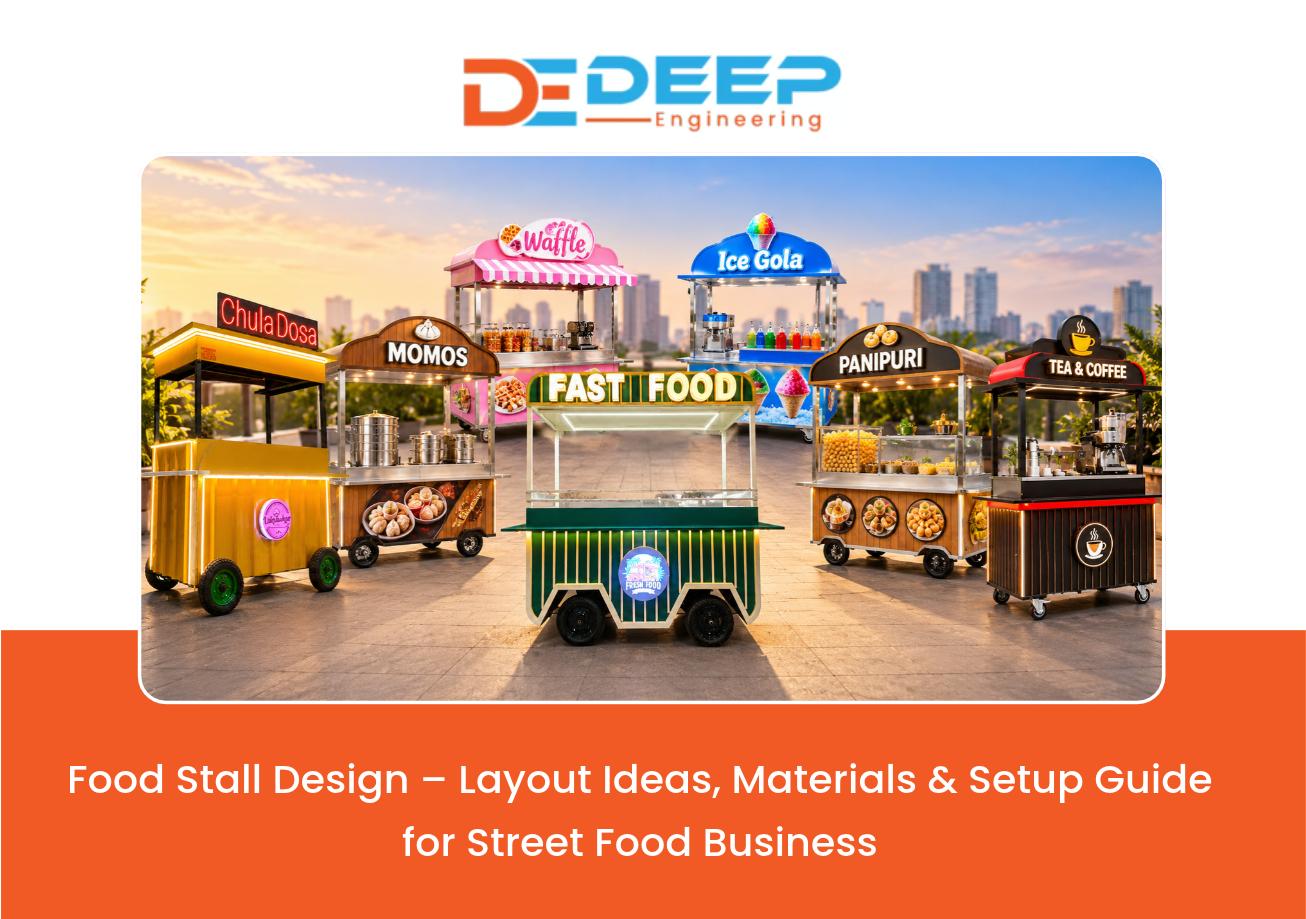
A well-planned Food Stall Design can help street food entrepreneurs create an organized, attractive, and practical business space without wasting valuable room or money. Whether you plan to sell momos, panipuri, dosa, waffles, chaat, ice gola, or fast food, your stall should support efficient preparation, convenient serving, easy cleaning, and a comfortable customer experience.
In India’s competitive street food market, the appearance of your stall matters, but functionality matters just as much. A beautiful counter will not solve problems caused by poor storage, inconvenient equipment placement, or slow order handling.
This guide explains how to choose the right layout, compare materials, plan a small-space setup, estimate cost factors, and select suitable food vending equipment for your business. It also explains when a fixed stall, push cart, kiosk, or food van may be the better choice.
What Is Food Stall Design and Why Does It Matter?
Food stall design is the process of planning a food business’s structure, layout, materials, equipment, storage, branding, and customer-serving areas to suit its menu and operating conditions. Good design balances appearance, hygiene, workflow, safety, and available space.
A practical layout helps vendors organize their daily work, reduce unnecessary movement, keep ingredients and utensils accessible, and maintain a clear separation between preparation and customer service.
The main benefits include:
- Better space utilization: Makes essential equipment and storage fit the available footprint.
- Organized preparation: Gives ingredients, utensils, and cooking equipment designated places.
- Easier cleaning: Uses suitable surfaces and accessible corners that can be cleaned regularly.
- Clear customer interaction: Makes ordering, payment, and food collection easier to understand.
- Professional presentation: Helps communicate the business name, menu, and product offering.
- More consistent operations: Gives staff a repeatable workflow during busy periods.
For example, a momo vendor needs convenient access to a steamer, fillings, serving plates, chutneys, and packaging. A panipuri vendor may prioritize ingredient containers, puri storage, water or pani containers, and a fast serving counter.
The best design depends on what you sell, where you operate, how many people work at the stall, and what equipment your business requires.
What Are the Best Food Stall Design Ideas for Indian Businesses?
The most useful food stall design ideas begin with the menu rather than decoration. Each food category requires a different combination of cooking space, ingredient storage, display, and serving access.
1. Momos and steamed snack stalls
Plan space for steamers, ingredient containers, chutneys, plates, and packaging. Keep frequently used items within easy reach and separate raw ingredient storage from the serving zone. A dedicated Momo cart can be considered when the equipment and counter layout need to suit a momo-focused menu.
2. Panipuri and chaat stalls
Prioritize ingredient containers, accessible puri storage, a clean serving surface, and space for plates and waste collection. A Panipuri Cart is worth exploring if your business specializes in pani puri and related snacks.
3. Dosa and fast food stalls
Allocate room for the cooking surface, ingredients, utensils, oil, plates, and takeaway packaging. Cooking heat, ventilation, fuel or electrical arrangements, and safe working distances must be considered during planning. A Fast food stall may suit a menu that requires several preparation and cooking functions.
4. Waffle and dessert stalls
Focus on a compact cooking area, topping containers, ingredient storage, attractive product presentation, and a clear pickup point. Explore a Waffle Cart when evaluating equipment and counter arrangements for a dessert business.
5. Ice gola and beverage stalls
Consider insulated ice storage where needed, syrup containers, cups, water arrangements, drainage, and an easy-to-clean serving area. Keep the workflow simple so the operator can prepare and hand over orders without repeatedly crossing the work area.
6. Multipurpose street food stalls
A multipurpose design may support snacks, beverages, or a changing menu, provided the counter, storage, utilities, and equipment can safely accommodate the intended tasks. Avoid adding so many functions that preparation becomes cramped.
When comparing these concepts, review actual dimensions, equipment placement, cleaning access, and material specifications. The Food Cart Design gallery can help you explore design concepts before finalizing your own requirements.
How to Design a Food Stall Layout for Maximum Sales
A good food stall layout cannot guarantee higher sales, but it can support smoother service, clearer ordering, and a more convenient customer experience.
Use these steps to plan the layout.
Step 1: Divide the stall into functional zones
Organize the space around the main tasks:
- Customer-facing counter: For ordering, payment, and handover.
- Preparation area: For assembling ingredients and preparing food.
- Cooking zone: For the stove, griddle, steamer, or other required equipment.
- Storage area: For ingredients, utensils, packaging, and cleaning supplies.
- Serving station: For plates, takeaway containers, and garnishes.
- Cleaning and waste zone: For appropriate waste containers and cleaning materials, away from exposed food.
- Queue area: For customers waiting without obstructing staff or pedestrians.
Not every stall needs a separate physical section for every task. Compact operations can combine functions when doing so remains practical and safe.
Step 2: Arrange equipment in working order
Place frequently used equipment and supplies near the point where they are needed. Avoid layouts that require staff to repeatedly walk around the cart to retrieve ingredients or packaging.
For example, a dosa stall may position ingredient containers near the cooking surface and place packaging closer to the serving counter. The exact arrangement must account for heat, ventilation, and safe access.
Step 3: Keep ordering and collection easy to understand
Customers should be able to identify where to order and where to collect food. A clearly visible menu, accessible payment point, and unobstructed serving counter can reduce confusion.
If the location becomes crowded, plan the queue and pickup area so they do not block the cooking zone or public walkway.
Step 4: Design around your actual menu
List every essential ingredient, utensil, machine, and packaging item before deciding on counter dimensions. This avoids paying for a structure that looks spacious but cannot accommodate the equipment needed for daily operations.
Example: A small Indian momo stall
A practical workflow could be:
- The customer reads the menu and places an order.
- The operator prepares the order using the designated cooking equipment.
- Chutneys and serving materials are accessed from the preparation area.
- The finished order is packed or plated at the serving station.
- The operator hands over the order while maintaining a clean preparation surface.
The aim is to minimize unnecessary movement while keeping food handling and cooking arrangements safe.
What Is the Best Food Stall Design for Small Space?
The best food stall design for small space uses a compact footprint, clearly defined work zones, appropriately sized equipment, and accessible storage. It should accommodate the menu without obstructing staff movement or compromising safe food handling.
Consider these practical strategies:
- Use vertical storage where suitable. Shelves or enclosed storage can free up counter space, provided they are stable and do not create contamination or falling-object risks.
- Choose multipurpose counters. A counter may support preparation and serving when the tasks can be performed hygienically and safely.
- Limit equipment to genuine needs. Select machines based on your menu and expected workflow rather than appearance alone.
- Make cleaning access a priority. Avoid unnecessary gaps and difficult-to-reach areas that collect grease, crumbs, or moisture.
- Plan the menu display carefully. Use readable lettering and place the menu where customers can see it before ordering.
- Provide appropriate weather protection. Consider shade, rain protection, and secure construction according to the location.
- Plan utilities early. Electrical connections, LPG equipment, ventilation, and drainage must be designed for their intended use and applicable safety requirements.
- Keep staff movement in mind. Make sure doors, drawers, shelves, and equipment do not obstruct normal working positions.
There is no universal dimension that suits every small food stall. The final footprint should be based on site measurements, the number of workers, the menu, equipment clearances, customer access, and local permissions.
Which Materials Are Best for Food Stall Design?
Material selection affects cleaning, appearance, maintenance, structural strength, weather resistance, and overall cost. The right combination depends on which parts of the stall will contact food, carry equipment, face the weather, or support daily operations.
| Material | Practical Advantages | Limitations or Considerations | Suitable Applications |
|---|---|---|---|
| Stainless steel | Generally easy to clean; corrosion-resistant grades are available; professional appearance | Cost varies by grade and thickness; finish and fabrication quality matter | Food preparation surfaces, counters, sinks, selected equipment enclosures |
| Mild steel | Can provide a strong, fabricated structure; adaptable to different shapes | Requires suitable coating and maintenance to manage corrosion, especially outdoors | Frames, supports, structural components |
| Aluminum | Lightweight and naturally corrosion-resistant under many conditions | Strength, dent resistance, joining method, and grade must be evaluated | Selected frames, panels, and lightweight components |
| Suitable countertop or panel materials | Can offer different finishes, appearances, and design options | Heat resistance, water exposure, cleaning compatibility, and food-contact suitability vary | Decorative panels, approved work surfaces, counters and enclosures as appropriate |
How should you choose?
First, identify the intended use of each component. A structural frame has different requirements from a surface used directly for food preparation.
For food-contact applications, select an appropriate material grade and finish that can be cleaned effectively and withstand the expected exposure. Not every stainless steel grade or surface finish is equally suitable for every application.
Also consider the local climate, rain exposure, cleaning chemicals, equipment weight, fabrication joints, and long-term maintenance. Ask the manufacturer to specify the material grade, thickness, finish, and intended application rather than relying on a general label such as “steel body.”
Why Consider Stainless Steel Food Stall Design?
Stainless steel is frequently considered for food preparation and serving equipment because suitable grades offer a smooth, cleanable surface and resistance to corrosion. Its appearance can also support a neat, professional presentation.
However, the result depends on the grade, finish, construction, joints, and maintenance. Stainless steel does not eliminate the need for cleaning, appropriate food-handling practices, or equipment maintenance.
When reviewing a Stainless steel food cart, consider:
- Whether the material is suitable for the intended food-contact application.
- Whether the surface finish is practical for routine cleaning.
- Whether edges, joints, corners, and fittings are finished properly.
- Whether the frame can support the expected equipment and operating loads.
- Whether the design includes sufficient storage and access for cleaning.
- Whether the structure is appropriate for indoor or outdoor use.
Confirm the construction details with the manufacturer before placing an order. A well-designed combination of materials may be more practical than choosing one material for every component.
Modern Food Stall Design India – Features Worth Considering
Modern food stall design in India combines functionality with an attractive, consistent visual identity. A contemporary appearance can help customers recognize your business, but decoration should never take priority over safe operations.
Useful features include:
Professional branding: Display your business name and logo clearly. Use a consistent set of colors rather than filling every panel with competing graphics.
Readable menus: Highlight the main items, available variations, and prices you have actually decided to charge. Keep text legible at the expected viewing distance.
Practical lighting: Ensure that customers can read the menu and staff can see the work surface. Outdoor electrical installations should be suitable for the environment and assessed by a qualified professional.
Organized storage: Keep utensils, ingredients, takeaway packaging, and cleaning supplies in appropriate designated areas.
Weather protection: Depending on the location, a suitable canopy or other protection may be needed. It should not interfere with ventilation, access, or safe equipment operation.
Appropriate equipment placement: Fit the cooking, refrigeration, or display equipment required by your menu without crowding the preparation area.
Consistent visual design: Use similar colors, lettering, and branding across the cart, menu, packaging, and other customer-facing materials.
Easy maintenance: Select finishes and construction details that support regular cleaning and repairs.
The most effective design is one in which visual appeal and practical workflow reinforce each other.
Food Stall Counter Design – How Should You Plan It?
Food stall counter design should support comfortable working positions, convenient serving access, appropriate storage, and clear interaction with customers. The right counter dimensions depend on the operator, equipment, available space, and the tasks performed at the stall.
Before finalizing the counter, consider the following features.
- Working height: The preparation surface should suit the operator’s height and the work being performed.
- Serving access: Customers should be able to place orders and collect food without interfering with preparation.
- Under-counter storage: Use suitable compartments for utensils, packaging, and other supplies that need protection.
- Display space: Keep frequently requested products or menu information visible without crowding the working surface.
- Packaging station: Position plates, bags, containers, and cutlery where they can be accessed easily.
- Cleaning access: Make sure the counter and surrounding components can be cleaned and maintained properly.
- Structural support: The counter should safely accommodate the expected equipment and working loads.
For example, a beverage stall may need more display and cup storage, while a dosa stall needs a layout designed around its cooking equipment and heat exposure. Avoid selecting counter dimensions from a generic drawing without checking the equipment and site.
Food Stall Design vs Food Cart Design – Which Is Better?
A fixed food stall, food cart, kiosk, and food van can all support a street food business. The most suitable format depends on location permissions, mobility, menu, equipment, available utilities, storage, and budget.
| Factor | Fixed Food Stall | Food Cart | Kiosk | Food Van |
|---|---|---|---|---|
| Space and setup | Depends on the allocated site and structure | Usually compact; depends on cart dimensions | Depends on kiosk footprint and installation | Depends on vehicle size and internal fit-out |
| Mobility | Usually limited | Push carts may be movable when designed for it | Usually limited after installation | Vehicle-based mobility |
| Storage | Can accommodate built-in storage within the space | Storage depends on cart design | Can include dedicated compartments | Can accommodate storage within the vehicle layout |
| Customization | Structure and counters can be adapted | Counter, storage, branding, and equipment layout may be customized | Layout and customer-facing panels may be customized | Interior layout, equipment, and branding may be customized |
| Typical use case | Fixed roadside or market location where permitted | Street vending or compact service points | Malls, commercial premises, events, and designated locations | Mobile vending and locations accessible to the vehicle |
| Key considerations | Site permission, utilities, weather protection | Stability, maneuverability, storage, transport | Installation requirements, access, ventilation | Vehicle suitability, conversion requirements, utilities, operating permissions |
Which option should you select?
Choose a fixed stall when your location is established and the site supports the required structure and utilities. Consider a push cart if a compact footprint and practical mobility are priorities. A kiosk may work well where a designated commercial space supports a permanent serving unit. A food van may be appropriate if vehicle-based operation suits your route and business model.
Before purchasing, verify location permissions, utility access, transportation arrangements, equipment requirements, and applicable local rules. Mobility does not automatically mean that a cart or van can operate anywhere.
To compare available formats, start with the Food Cart range. If vehicle-based vending is under consideration, review the Food Van options and check the food van price page for relevant product information. Confirm current pricing and specifications with the supplier rather than assuming that one format always costs less.
Mid-article CTA: Have you shortlisted a stall format? Explore the available food carts for sale and compare the design, counter space, and equipment arrangement against your menu before deciding.
How Much Does Food Stall Setup Cost in India?
The cost of setting up a food stall in India depends on the structure, materials, equipment, customization, location, and operating requirements. There is no single price that applies to every food stall.
The main cost factors are:
- Overall dimensions: Larger structures may require more material and fabrication work.
- Material grade and thickness: The specifications selected for frames, panels, and food-contact surfaces affect the quotation.
- Fabrication complexity: Curved panels, custom compartments, specialized counters, and non-standard designs may require additional work.
- Branding and finishing: Printed graphics, signage, paint, and decorative panels affect the final specification.
- Cooking equipment: Griddles, steamers, burners, and other machines vary according to type and capacity.
- Refrigeration and display: Chilled storage, display equipment, and electrical requirements depend on the menu.
- Utilities and storage: Electrical fittings, water arrangements, drainage, and storage compartments may affect the design.
- Transportation and installation: These depend on the destination, product size, and installation needs.
- Permissions and compliance: Local permissions and applicable safety or food-business requirements may add costs outside the cart quotation.
How can you plan a limited budget?
Start by separating essential operating features from optional decoration. Prioritize an appropriate structure, safe equipment placement, practical storage, cleanable surfaces, and necessary utility arrangements. Add decorative features after confirming the functional requirements.
Ask suppliers for an itemized quotation that specifies dimensions, materials, equipment inclusions, branding, transportation, installation, and any applicable warranty or after-sales terms. Compare quotations on equivalent specifications rather than choosing solely by the lowest total.
For product information, visit Food Cart Manufacturer in India and discuss your requirements before making a purchasing decision. Final pricing should be confirmed directly with the supplier.
Food Stall Design Checklist for Beginners
Use this checklist before approving a design or ordering a customized cart.
Pre-purchase checklist
0 of 15 completeFinalize the menu and service model.Measure the proposed site and available footprint.Plan customer entry, ordering, queue movement, and pickup.Allocate preparation, cooking, serving, and storage zones.Select appropriate materials and finishes for each component.List cooking equipment, refrigeration, and display requirements.Plan ingredient storage and packaging compartments.Provide suitable cleaning, waste collection, and maintenance arrangements.Confirm water and drainage arrangements where required.Arrange electrical, LPG, ventilation, and fire-safety provisions as applicable.Check weather protection and structural stability.Confirm menu visibility, branding, and lighting.Check applicable FSSAI requirements, local permissions, and site rules.Confirm transportation, installation, maintenance, and future expansion needs.Review the quotation, specifications, and final design before approval.
Reset checklist
The checklist is a planning aid, not a substitute for professional assessment. Cooking installations, LPG arrangements, electrical systems, ventilation, and fire safety should be evaluated against applicable requirements. Food businesses should also check relevant FSSAI requirements and local regulations.
How Can You Choose the Right Food Cart Manufacturer in India?
Choosing a manufacturer is not simply about finding a cart that looks attractive. You need a product that suits your menu, available space, operating conditions, and maintenance needs.
Evaluate these points before placing an order.
- Relevant product range: Check whether the manufacturer works with the type of cart, kiosk, or vending equipment you require.
- Material specifications: Ask about grades, thicknesses, finishes, coatings, and the intended use of each material.
- Customization options: Confirm whether counter dimensions, storage, equipment positions, and branding can be adapted to your needs.
- Workmanship and stability: Review construction details, joints, edges, supports, and the expected operating loads.
- Equipment layout: Confirm that the proposed design accommodates the actual machines, ingredients, and packaging you plan to use.
- Photographs and drawings: Review relevant product photographs, dimensions, and drawings. Ask for a final design approval process where applicable.
- Transparent quotation: Ensure the quotation identifies inclusions and exclusions rather than leaving important details unclear.
- Warranty and after-sales terms: Ask what terms are offered and obtain confirmation in writing.
- Transportation and installation: Clarify who arranges transport, unloading, installation, and any site preparation.
- Communication: Confirm that your requirements are understood before fabrication begins.
Deep Engineering Food Cart Manufacturer, based in Ahmedabad, Gujarat, manufactures and supplies food carts, mobile food vans, kiosks, and food vending equipment. Buyers can explore Food Cart Manufacturers information and assess whether the available products and customization discussions match their needs.
When comparing any Food Cart Manufacturer, use the same checklist for every supplier. Ask questions about the final specification and make sure the design supports your actual working process.
Food Stall Design Solutions for Businesses Across India
Food businesses operate in different environments, from busy urban markets to smaller commercial areas and seasonal vending locations. A design that works in one location may not suit another because site dimensions, customer movement, weather, utility access, and local permissions differ.
Entrepreneurs seeking a food cart manufacturer in Ahmedabad, Rajkot, Surat, Vadodara, Bhavnagar, or Himmatnagar should define their required dimensions, menu, equipment, and delivery arrangements before requesting a quotation.
The same approach applies to buyers in Jaipur and other parts of Rajasthan, Indore and Madhya Pradesh, Delhi NCR and Gurugram, Uttar Pradesh, and other regions of Gujarat.
Deep Engineering is based in Ahmedabad, Gujarat. Buyers outside the local area should confirm current transportation arrangements, delivery availability, customization options, and any installation or after-sales support directly with the business rather than assuming a local branch or service center exists.
The goal is to choose equipment that fits the business, location, and operating needs—not simply to select the most elaborate design.
FAQs
The best design uses available space efficiently while providing room for essential equipment, ingredients, preparation, serving, and cleaning. Choose a layout based on your menu and working process. A compact push cart or kiosk may suit a small operation, while a fixed stall may offer more flexibility if sufficient space is available.
Suitable stainless steel is often considered for food preparation and serving surfaces because it is cleanable and corrosion-resistant when the correct grade and finish are selected. Mild steel may be suitable for structural components with appropriate protection. Compare material specifications, weather exposure, maintenance needs, and budget before deciding.
Start by measuring the site and listing the equipment required for your menu. Divide the layout into preparation, cooking, storage, serving, payment, and cleaning zones. Position frequently used supplies within convenient reach, provide safe equipment clearances, and ensure customers can order and collect food without obstructing staff.
Yes, appropriately selected stainless steel can be suitable for many food stall components, including preparation surfaces and counters. Its suitability depends on the grade, finish, construction, and intended use. Regular cleaning and maintenance remain essential. Ask the manufacturer to confirm the specifications for surfaces that will contact food.
Review relevant product designs, material specifications, fabrication quality, customization options, and quotation details. Confirm dimensions, equipment placement, transportation, installation, warranty terms where offered, and after-sales arrangements. Ask for relevant photographs or drawings and approve the final specifications before ordering.
Final Thoughts – Plan a Food Stall That Works for Your Business
A successful food stall design begins with practical decisions: understanding your menu, measuring your space, selecting suitable materials, organizing equipment, and creating a convenient customer-serving area. Branding and decoration can strengthen your presentation, but the foundation should always be functionality, hygiene, and safe operation.
Before investing, compare a fixed stall, push cart, kiosk, and food van against your location, budget, mobility requirements, and long-term plans. Ask manufacturers for clear specifications and a quotation based on your actual needs.
Deep Engineering Food Cart Manufacturer in Ahmedabad, Gujarat, offers food carts, mobile food vans, kiosks, and food vending equipment for different business requirements.
Ready to plan your food stall? Explore the available food vending equipment and cart options—or contact Deep Engineering through its website to discuss your menu, dimensions, material preferences, equipment layout, storage needs, and customization requirements before requesting a quotation.