
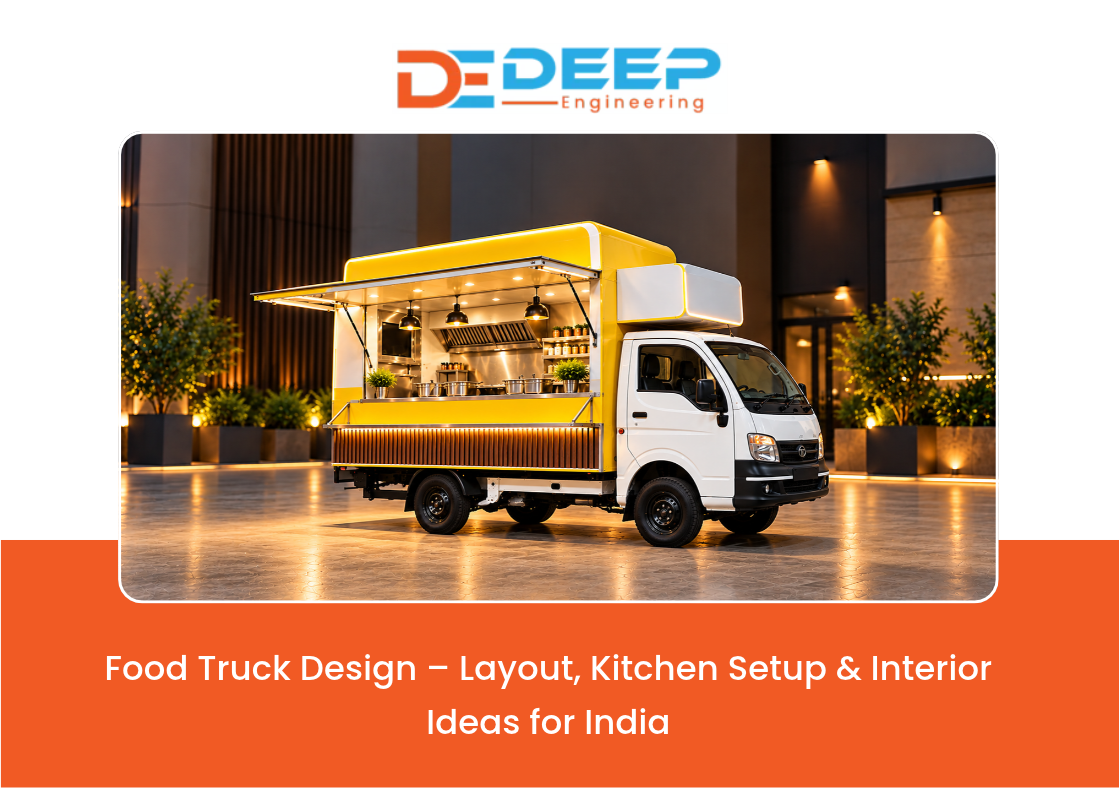
A successful mobile food business needs more than an attractive vehicle. Food Truck Design involves planning the kitchen layout, cooking equipment, ingredient storage, ventilation, hygiene, utilities, serving counter and exterior branding so that the setup matches your menu and operating conditions.
For Indian entrepreneurs selling momos, dosa, chaat, burgers, sandwiches, tea, coffee or desserts, every part of the available space matters. Poor equipment placement can slow preparation, while insufficient storage and cleaning access can make daily operations difficult.
This guide explains practical food truck design ideas, kitchen layouts, material choices, fabrication costs, safety considerations and manufacturer-selection tips. Whether you are starting a new business or upgrading an existing street food operation, the aim is to help you plan a functional setup before investing in fabrication.
What Is Food Truck Design?
Food truck design is the process of planning a vehicle’s usable space, kitchen workflow, equipment, storage, utilities, safety provisions, serving counter and exterior branding. A well-planned design considers the menu, number of workers, food preparation methods, cleaning requirements and customer service needs to create a practical mobile kitchen.
Key Takeaways
- Plan around the menu: Choose equipment and work zones according to the food you intend to prepare.
- Optimize workflow: Arrange preparation, cooking, assembly and serving to reduce unnecessary movement.
- Use suitable materials: Select cleanable, durable surfaces appropriate for food contact, moisture and maintenance.
- Plan utilities early: Account for ventilation, electricity, water, waste management and fire safety.
- Make the most of compact space: Use appropriate under-counter and vertical storage without obstructing movement.
- Confirm specifications before fabrication: Approve the equipment list, layout, materials and written quotation.
- Choose the right format: A food truck, food van, kiosk and push cart serve different operational needs.
Why Is Food Truck Design Important for an Indian Food Business?
A carefully planned mobile kitchen can help entrepreneurs organize preparation, store ingredients properly, keep work surfaces accessible and serve customers more efficiently.
For example, a burger operator may need separate areas for cold ingredients, cooking, assembly and packaging. A beverage vendor may need more space for cups, ingredients, water and refrigeration than for cooking appliances.
Practical food truck design can support:
- Efficient preparation: Equipment and ingredients are positioned according to the order of work.
- Better space utilization: Storage is planned around the actual dimensions of the vehicle.
- Improved cleaning access: Surfaces, equipment and corners can be reached for routine cleaning.
- Organized inventory: Ingredients, utensils and packaging have designated locations.
- Clear customer interaction: The counter and serving window support order placement and handover.
- Professional presentation: Branding communicates the business identity and menu.
- Consistent operations: Staff can follow a repeatable preparation and serving process.
Good design supports daily operations, but it does not guarantee sales, customer demand or profitability. Menu quality, pricing, location, permissions and business management remain important.
What Are the Best Food Truck Design Ideas for Indian Street Food?
The best design depends on how the menu is prepared, stored and served. Different food categories require different equipment and workflows.
1. Momos and steamed snacks
Organize the steaming or heating equipment, ingredient storage, preparation surface and order assembly area according to the menu. Keep raw ingredients separate from ready-to-eat food and provide practical utensil storage. Explore the Momo cart as a product option for a focused vending setup.
2. Dosa and South Indian food
Plan around the griddle, batter containers, ingredient refrigeration where required, preparation space and serving area. Consider heat exposure, ventilation and access for cleaning. Keep batter and other perishable ingredients under appropriate temperature control.
3. Chaat and panipuri
Arrange ingredients in a logical serving sequence. Protect ready-to-eat ingredients, plan clean water and handwashing arrangements as applicable, and ensure containers can be cleaned and replenished easily. Compare a Panipuri Cart if your business focuses on this menu.
4. Burgers, sandwiches and fast food
Plan the cooking station, cold ingredient storage, assembly counter and packaging area as a connected workflow. Cooking appliances may require dedicated extraction and suitable clearances. A Fast food stall is worth reviewing when comparing formats for a quick-service menu.
5. Waffles and desserts
Prioritize the waffle maker or other required appliance, batter and topping storage, clean preparation space and attractive product presentation. Check electrical demand and heat management before finalizing the equipment position. Review the Waffle Cart for a relevant vending format.
6. Ice gola, tea, coffee and beverages
Plan for beverage preparation, clean water, ice handling, cups, ingredients, refrigeration where needed and waste collection. Protect ice and ready-to-serve ingredients from contamination. Select equipment according to the actual menu rather than filling the cart with unnecessary appliances.
Design inspiration: Browse the Food Cart Design gallery for visual references, then confirm which features can be adapted to your menu, space and budget.
How to Plan a Food Truck Kitchen Layout
Follow these nine steps before approving food truck fabrication.
- Finalize the menu. List each item and its preparation method.
- Prepare an equipment list. Identify cooking appliances, refrigeration, preparation surfaces and cleaning equipment.
- Measure the usable interior. Account for doors, wheel arches, structural elements and access points.
- Define work zones. Identify storage, preparation, cooking, washing, assembly and serving areas.
- Plan staff movement. Check whether workers can move safely without repeatedly crossing each other’s paths.
- Allocate storage. Provide suitable places for ingredients, utensils, packaging and cleaning supplies.
- Plan utilities. Confirm electrical loads, water arrangements, ventilation, fuel systems and safety provisions.
- Check cleaning and maintenance access. Equipment should not block essential service points.
- Review the drawing with the fabricator. Confirm dimensions, materials, equipment positions and specifications in writing before manufacturing.
Example A: Compact burger truck
A hypothetical burger setup might place refrigerated ingredients near the assembly surface, with the cooking station positioned according to ventilation and safety requirements. Packaging and the order handover area should be close to assembly, while raw ingredients remain separated from ready-to-eat items.
Example B: Momos truck
A hypothetical momos setup may prioritize steaming equipment, ingredient storage, a preparation surface and a serving counter. Depending on the menu, it may require less griddle space than a burger or dosa setup but more room for steamers and organized food containers.
These examples are planning concepts, not certified engineering drawings. Actual arrangements must be checked against the vehicle, equipment specifications and applicable requirements.
Before investing, compare suitable Food Cart Manufacturer in India options and decide whether a cart, kiosk or vehicle-based kitchen better fits your menu and available space.
Food Truck Layout Design for Small Spaces
A compact commercial kitchen requires careful prioritization. Every appliance, container and work surface should serve a clear purpose.
Consider these food truck layout design ideas:
- Select compact equipment that can handle the intended menu and workload.
- Use under-counter storage where access, ventilation and equipment clearances permit.
- Consider secure vertical storage for lightweight utensils and supplies.
- Choose multipurpose preparation surfaces where different food-handling activities can be safely separated.
- Keep ingredient containers organized and protected.
- Position refrigerators for convenient access and appropriate ventilation.
- Maintain access to cleaning points and waste containers.
- Position the serving window so that customer handover does not obstruct kitchen movement.
- Keep electrical panels and safety equipment accessible.
- Avoid overcrowding the workspace with appliances intended for occasional use.
Space efficiency must never come at the expense of safe movement, cleanability, ventilation or maintenance access.
Food Truck Interior Design: How Should the Kitchen Be Organized?
A practical food truck interior design separates work into functional zones. Their exact arrangement depends on the menu, vehicle dimensions, staff count and expected operating volume.
| Zone | Main purpose | Design consideration |
|---|---|---|
| Ingredient storage | Store ingredients and supplies | Protect food and maintain appropriate temperatures |
| Preparation | Portion, cut and assemble ingredients | Use accessible, cleanable work surfaces |
| Cooking | Cook or heat menu items | Allow required clearances and extraction |
| Refrigeration | Keep perishable items at suitable temperatures | Confirm capacity and access |
| Washing and cleaning | Support hygiene and equipment cleaning | Plan water, drainage and cleaning access |
| Order assembly | Finish dishes and pack orders | Position near preparation and handover |
| Serving counter | Receive orders and deliver food | Keep customer and staff access clear |
| Waste management | Collect food and general waste | Prevent contamination and allow timely removal |
| Staff movement | Connect work zones | Preserve safe access and emergency exits |
A useful principle is to arrange the workflow in the order food is handled, while maintaining appropriate separation between raw ingredients, cooked food, cleaning supplies and waste.
For storage and work surfaces, a Stainless steel food cart is one option to investigate. Verify the actual material grade, dimensions, finish and intended application before purchasing.
Which Materials Are Suitable for Food Truck Kitchen Setup?
Material choice affects cleaning, durability, weight, maintenance and overall fabrication cost.
| Material | Potential advantages | Limitations or considerations | Suitable applications |
|---|---|---|---|
| Stainless steel | Cleanable surfaces and corrosion resistance when correctly selected | Grade, finish, fabrication and cost matter | Food-contact worktops, sinks and equipment surfaces where suitable |
| Mild steel | Can provide structural strength and may suit some budget-conscious fabrication | Requires suitable protection against corrosion and moisture | Frames and structural components when properly designed and finished |
| Aluminium | Relatively lightweight and potentially useful where weight matters | Strength, joining, corrosion behaviour and food-contact suitability must be assessed | Selected panels and components suited to the application |
| Suitable countertop panels | May offer different finishes and design options | Heat, moisture, chemicals and food-contact suitability vary | Selected non-cooking surfaces when approved for the intended use |
Stainless steel is frequently considered for food preparation surfaces because an appropriate grade and finish can be durable and easy to clean. However, not every stainless steel grade or fabrication method is suitable for every food-contact application.
Before fabrication, discuss the following with the manufacturer:
- Food-contact suitability and material grade.
- Exposure to moisture and cleaning chemicals.
- Structural strength and vehicle weight limits.
- Corrosion protection.
- Surface joints, corners and cleanability.
- Maintenance requirements and expected operating conditions.
- Total material and fabrication cost.
Do not select materials based only on appearance or price.
Food Truck Exhaust and Ventilation: What Should You Consider?
Cooking appliances can generate heat, smoke, grease-laden vapours and combustion products. The appropriate exhaust and ventilation arrangement depends on the appliances, fuel type, vehicle layout and applicable safety requirements.
Plan for:
- Extraction suitable for the cooking processes involved.
- Appropriate airflow and make-up air.
- Control of excessive heat buildup.
- Safe separation and positioning of equipment.
- Access for cleaning filters and servicing extraction systems.
- Ventilation that does not create additional contamination risks.
- Appropriate fire protection and fuel-system arrangements.
Electrical installation, LPG systems, exhaust design and fire safety should be reviewed by qualified professionals. Do not assume that a domestic exhaust fan or a single standard hood is sufficient for every mobile kitchen.
How to Plan a Food Truck Counter Design and Serving Window
The counter connects the kitchen with the customer. Its design should support the way orders are placed, prepared, paid for and handed over.
Plan for:
- A visible menu and clear ordering point.
- Space for payment equipment.
- An organized handover surface.
- Accessible packaging and disposable supplies where used.
- Weather protection and protection from contamination.
- A customer queue that does not obstruct staff or traffic.
- Easy cleaning and suitable drainage where necessary.
- A serving window that does not compromise safe interior movement.
If the menu contains multiple preparation stages, avoid making the serving counter the only available work surface. Separating order assembly from the busiest preparation area can help reduce congestion.
Food Truck Branding and Wrap: How Can You Make the Vehicle Stand Out?
Food truck branding and wrap design should make the business easy to recognize and the menu easy to understand.
Use a readable business name, consistent colors, a clear logo and a small number of prominent menu highlights. Choose lettering that remains legible from the expected customer viewing distance. Food imagery can help communicate the menu, but too many graphics may make the design difficult to read.
Consider contact information and social media details where useful. Check that branding does not obscure required vehicle markings, registration details or visibility elements.
Exterior branding and interior kitchen functionality are separate design tasks. A visually appealing vehicle still needs an appropriate layout, suitable materials and safe utilities. No particular wrap or color scheme guarantees increased sales.
Food Truck Interior Design on a Small Budget: Where Should You Spend First?
For a budget-conscious entrepreneur, the best food truck design for a small business in India is usually one that matches the menu and avoids unnecessary complexity.
Prioritize first:
- A suitable vehicle, cart or kiosk format.
- A functional layout and appropriate equipment.
- Safe electrical, water and fuel arrangements as applicable.
- Cleanable work surfaces.
- Necessary refrigeration and ingredient storage.
- Suitable ventilation and fire safety.
- Access for cleaning, repairs and maintenance.
Consider later, if the budget permits:
- Elaborate decorative finishes.
- Nonessential display fixtures.
- Complex graphics beyond basic professional branding.
- Decorative lighting that does not improve safe operation.
Avoid reducing the budget by compromising essential safety systems or food-handling requirements. A simpler layout with appropriate equipment can be more practical than an elaborate design that is difficult to maintain.
How Much Does Food Truck Design and Fabrication Cost in India?
There is no single reliable price for every food truck. The total cost depends on the vehicle, size, condition, conversion work, equipment, materials, utilities, branding and applicable compliance requirements.
| Cost category | What it covers | One-time or recurring | How to estimate |
|---|---|---|---|
| Vehicle purchase or rental | Base vehicle and associated charges | Purchase or recurring rental | Obtain vehicle-specific quotations |
| Fabrication and conversion | Structural work, interior fit-out and installation | Primarily one-time | Request drawings and itemized fabrication costs |
| Kitchen equipment | Cooking and preparation appliances | Purchase plus maintenance | Price each item against the menu |
| Refrigeration | Refrigerators, freezers or suitable cold storage | Purchase plus operating costs | Check capacity, power needs and intended use |
| Work surfaces and storage | Counters, shelves, sinks and cabinets | Primarily one-time | Specify material, finish and dimensions |
| Electrical and water systems | Wiring, power supply, plumbing and washing arrangements | Installation plus recurring use | Obtain qualified installation estimates |
| Exhaust and ventilation | Extraction, ducting and related components | Installation plus maintenance | Seek an assessment based on the cooking equipment |
| Branding and signage | Exterior graphics, menu boards and business identity | Initial cost plus possible updates | Compare design, printing and installation quotes |
| Safety provisions | Applicable fire protection and fuel-safety arrangements | Installation plus inspection or maintenance as applicable | Confirm requirements with qualified professionals |
| Transport and installation | Delivery, positioning and commissioning where applicable | Usually project-related | Confirm distance, scope and charges |
| Business compliance | Applicable registrations, permissions, taxes and fees | One-time or recurring, depending on obligation | Check the relevant authorities and professional advice |
For a product-specific starting point, review the available food van price information and request a current quotation based on your intended configuration. The page should not be treated as a verified price for every customized vehicle.
Food Truck Design vs Food Van vs Food Cart: Which Is Better?
The right format depends on whether you need a complete vehicle-based kitchen or a smaller vending unit.
| Factor | Food Truck | Food Van | Food Cart |
|---|---|---|---|
| Basic format | Vehicle-based mobile kitchen | Van-based mobile food setup | Push cart or cart-based vending unit |
| Workspace | Depends on vehicle size | Depends on van dimensions | Usually more compact |
| Mobility | Requires suitable vehicle operation | Requires suitable vehicle operation | Depends on design and transport method |
| Equipment capacity | Depends on the layout | Depends on the layout | Limited by available space |
| Setup complexity | Vehicle and kitchen integration | Vehicle conversion and equipment integration | Cart fabrication and equipment setup |
| Main cost factors | Vehicle, conversion and equipment | Vehicle, conversion and equipment | Fabrication and equipment |
| Suitable uses | Integrated mobile food service | Compact vehicle-based food service | Focused menus and permitted vending locations |
A food truck or food van may suit businesses requiring multiple cooking and storage zones. A cart may be more appropriate for a focused menu, a fixed permitted vending location or a business that does not need a complete vehicle-based kitchen.
Explore the available Food Van options and compare them with the Food Cart range before deciding.
Food Truck Design on a Small Budget: Compliance and Safety
Before fabrication, identify the legal and operational requirements that apply to your business.
- Food safety: Check the appropriate FSSAI registration or licence category through the official FSSAI licensing information and FoSCoS portal. Requirements depend on the nature and scale of the business, and applicable rules can change.
- Vending permissions: Confirm applicable municipal permissions, vending-zone restrictions and local requirements before choosing an operating location.
- Vehicle compliance: If converting a motor vehicle, consult the relevant registering authority about permissible alterations and registration requirements.
- Cooking fuel and fire safety: Obtain qualified advice on LPG or other fuel arrangements, appliance placement and appropriate fire protection.
- Electrical installation: Have the power supply, wiring, protective devices and equipment loads assessed by a qualified professional.
- Water and waste: Plan suitable water storage, washing, wastewater disposal and waste collection.
- Business obligations: Check whether GST registration, local trade permissions or other obligations apply to your business model.
Requirements can vary by city, vehicle type, equipment and operating location. Verify the current rules with the relevant authorities before investing.
How to Choose a Food Truck or Food Cart Manufacturer in India
Choosing a manufacturer involves more than comparing product photographs or the lowest quotation. Ask how the proposed equipment, materials and layout will meet your operational requirements.
Evaluate these points before making a decision:
- Product suitability: Confirm whether the supplier manufactures push carts, kiosks, food vans, vehicle-based kitchens or only selected categories.
- Customization: Ask whether the layout, dimensions, storage and equipment positions can be adapted to your menu.
- Material specifications: Request details of the material grade, surface finish and structural construction.
- Fabrication quality: Review relevant photographs, drawings and available examples of similar products.
- Utilities and safety: Clarify which electrical, ventilation, water and fuel-related components are included.
- Quotation transparency: Ask for itemized costs, exclusions and any additional installation or transport charges.
- Written terms: Confirm delivery arrangements, warranty terms if offered, maintenance support and after-sales responsibilities.
- Final approval: Make sure the approved drawing and specifications are documented before production begins.
Deep Engineering Food Cart Manufacturer is an Ahmedabad, Gujarat-based business to explore when researching food carts, kiosks and food vending equipment. Its supplied product range includes different cart formats for street food and small food businesses. Confirm whether a specific product or customization service meets your vehicle, kitchen and compliance requirements.
To investigate the supplier and its offerings, review Food Cart Manufacturers, explore food carts for sale, and visit the Food Cart Manufacturer website.
For businesses comparing specialized counters, the pan counter is another listed product to review for suitability.
CTA 2: Explore the available food vending products and compare designs, intended uses and specifications before choosing a solution for your business.
Food Cart Manufacturers in Ahmedabad, Gujarat, and Other Indian Cities
Buyers searching for a food cart manufacturer in Ahmedabad may be able to evaluate a local supplier more easily, but location alone does not establish product quality or suitability.
Entrepreneurs in Rajkot, Surat, Bhavnagar, Vadodara and Himmatnagar should compare the proposed design, fabrication specifications, transport costs, installation arrangements and after-sales terms. Businesses in Jaipur and other parts of Rajasthan, Indore and Madhya Pradesh, Delhi NCR and Gurugram, or Uttar Pradesh should also confirm delivery feasibility and the availability of any support they require.
When comparing manufacturers, ask for a written scope of work that covers materials, dimensions, equipment, utility provisions and exclusions. If the supplier is located outside your city, establish who is responsible for transport, installation, inspection and resolving any issues after delivery.
Searches such as food cart manufacturer in Gujarat, food cart manufacturer in Rajkot or food cart manufacturer in Jaipur describe buyer intent; they do not establish that any particular supplier has a branch or service centre in that location.
Change block type or style
Move Paragraph block from position 99 up to position 98
Move Paragraph block from position 99 down to position 100
Change alignment
Change text alignment
Displays more block tools
blob:https://deepengineeringfoodcart.com/0f777423-0dba-418c-9c49-04e00a3bdee2Meta Boxes
Use up and down arrow keys to resize the meta box pane.
FAQs About Food Truck Design
The best food truck design for a small business in India is one that fits the menu, available space and budget. Start with essential equipment, suitable storage, cleanable surfaces and safe utilities. A compact cart, kiosk or vehicle-based kitchen may be appropriate depending on the operating model.
Equipment depends on the menu. A burger setup might need cooking equipment, refrigeration, a preparation counter and packaging storage. A beverage setup may prioritize beverage appliances, cups, water and ingredient storage. Select equipment based on actual operating needs rather than a universal checklist.
Yes, the layout can be planned around a particular Indian street food menu, subject to the vehicle, equipment and applicable requirements. A momos setup, dosa kitchen and panipuri cart have different preparation and storage needs. Confirm the detailed specifications with the fabricator.
Compare product suitability, material specifications, fabrication quality, customization options and quotation transparency. Ask for relevant design references and confirm transport, installation and support arrangements. Verify that the selected product is appropriate for your menu and intended operating location.
Food truck design and fabrication costs vary with vehicle size, conversion work, kitchen equipment, refrigeration, materials, utilities, ventilation, branding and compliance.
Check the dimensions, layout drawing, equipment list, materials, storage, electrical and water requirements, ventilation, fire safety, cleaning access and written quotation.
Final Thoughts: Design a Food Truck That Works for Your Business
A practical food truck design begins with the menu and builds around the way food is stored, prepared, cooked, assembled and served. Appropriate materials, efficient use of space, ventilation, utilities, cleaning access and clear branding all contribute to a more organized mobile food operation.
Before fabrication, compare the cart, kiosk, van and food truck formats, document your specifications and check the requirements that apply to your location. A clear design brief can also make manufacturer quotations easier to evaluate.
Ready to explore your options? Browse the Food Cart Manufacturer in India product and manufacturer information, compare available designs and discuss your requirements with Deep Engineering. Be prepared to share your intended menu, dimensions, equipment needs, materials and preferred operating format so that you can assess whether a particular solution suits your business.