
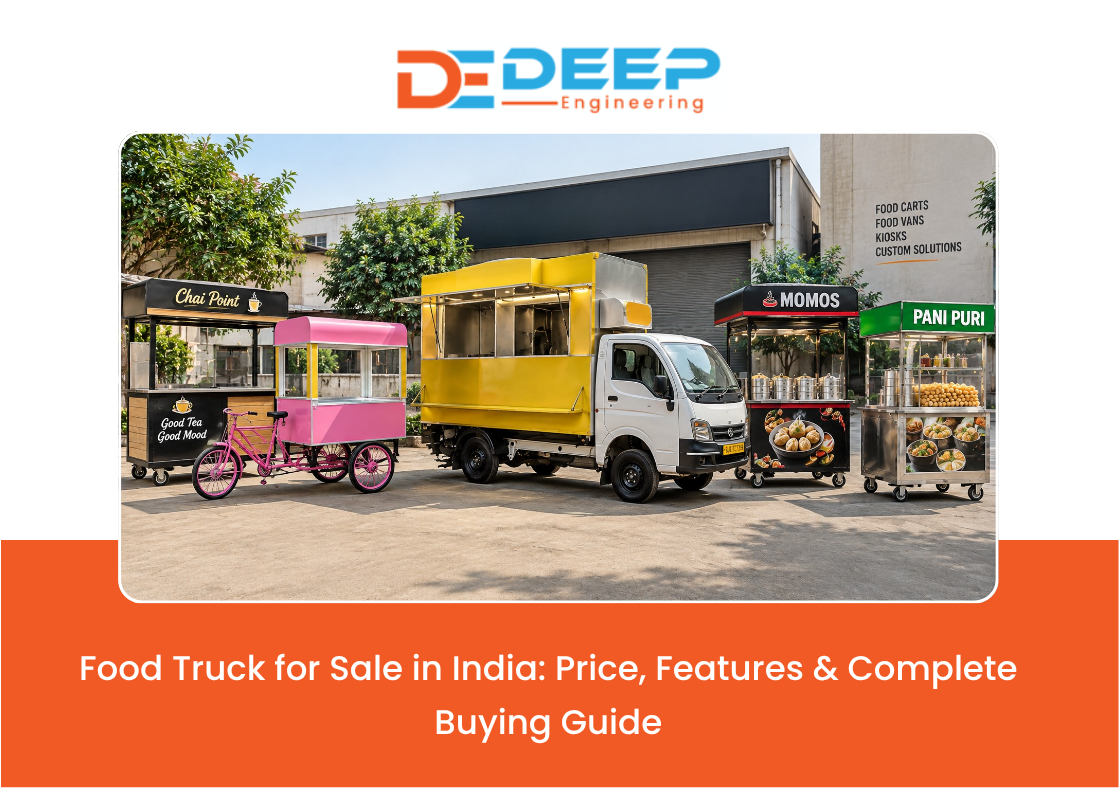
Food Truck for Sale Starting a mobile food business in India requires more than choosing a vehicle and adding cooking equipment. The right food truck needs to support your menu, daily workflow, storage needs, hygiene practices, customer service, and branding while remaining practical to operate.
If you are researching a Food Truck for Sale, the most important point is that there is no single price that fits every business. The final cost depends on the vehicle, fabrication, kitchen equipment, materials, electrical and plumbing requirements, storage, branding, and level of customization.
This guide explains what to check before buying, how food truck price in India is determined, the difference between new and used trucks, and how a custom setup can support different food concepts. Deep Engineering Food Cart Manufacturer also provides food carts, food vans, kiosks, and food vending solutions for businesses looking to build a practical mobile food operation.
What Is a Food Truck and How Does It Work?
A food truck is a commercial food vehicle converted into a mobile kitchen. It typically combines food preparation space, cooking equipment, storage, utilities, a serving counter, and customer-facing branding within a vehicle-based setup.
Unlike a fixed restaurant, a Food Truck for Sale can operate from different permitted locations, events, commercial areas, or other suitable business locations. The exact operating permissions and local requirements depend on the location and business model.
A typical food truck workflow may look like this:
- Raw ingredients are stored in designated storage areas.
- Ingredients move to the preparation counter.
- Cooking takes place using menu-specific equipment.
- Finished food moves towards the serving area.
- Customers receive orders through the service counter.
- Cleaning and waste-management processes are handled within the planned workflow.
For example, imagine a first-time entrepreneur starting a momo business. Instead of designing a large general-purpose kitchen, the entrepreneur could prioritise a steaming area, preparation counter, refrigerated storage where required, dry storage, serving counter, and space for packaging. This can make the truck more practical during busy service periods.
For businesses that need a smaller mobile setup, a specialist Food Cart Manufacturer in India can also provide an alternative to a full-size food truck.
How Much Does a Food Truck Cost in India?
The food truck price in India varies significantly because food trucks are usually configured according to the vehicle, kitchen requirements, materials, equipment, utilities, and branding specifications.
Instead of choosing a truck based only on a headline quotation, buyers should ask what is actually included in that quotation.
Important cost components can include:
- Base vehicle or vehicle structure
- Vehicle size and available working area
- Interior fabrication
- Stainless steel work surfaces
- Cooking equipment
- Refrigeration, where required
- Storage cabinets and shelving
- Electrical installation
- Water and plumbing systems
- Ventilation and exhaust arrangements
- Serving counter
- Branding and exterior finish
- Menu-specific equipment
- Interior layout and custom fabrication
For example, a simple beverage-focused truck may need a different setup from a pizza, burger, momo, or multi-cuisine truck. More equipment, utilities, storage, or specialised fabrication can change the final quotation.
This is why buyers should compare food truck price and features, rather than comparing only the total amount.
Businesses researching vehicle-based options can also review food van price and compare different configurations before deciding what their operation actually needs.
What Factors Affect the Food Truck Price?
Several factors influence the final quotation for a food truck.
| Cost Factor | Why It Matters |
|---|---|
| Vehicle/base structure | Determines available space, mobility and basic configuration |
| Truck size | A larger working area can accommodate more equipment and storage |
| Fabrication | Affects layout, durability and usability |
| Stainless steel work area | Supports food preparation and easier cleaning |
| Cooking equipment | Depends on the menu and production volume |
| Storage | Determines how efficiently ingredients, packaging and utensils can be organised |
| Electrical system | Required for appliances and planned electrical loads |
| Water/plumbing | Important for washing and operational requirements |
| Ventilation | Helps manage heat, smoke and cooking conditions |
| Branding | Exterior design can support business visibility |
| Customisation | Menu-specific fabrication can change the overall cost |
| Interior layout | Efficient placement can improve workflow and service speed |
A detailed quotation should ideally identify the major components instead of giving only one unexplained figure.
If you are comparing a Food Van with other mobile food options, check the included specifications carefully.
What Features Should You Look for in a Food Truck?
The right food truck should be designed around the way you actually prepare and sell food.
Durable construction
The structure should be suitable for regular commercial use. Pay attention to fabrication quality, joints, finishes, doors, counters, storage and areas that receive frequent use.
Hygienic food-contact surfaces
Food preparation surfaces should be practical to clean and maintain. A well-planned stainless steel work area can make routine cleaning easier while providing a professional preparation surface.
Businesses can also consider a Stainless steel food cart when a full vehicle is not necessary.
Efficient kitchen layout
A good layout reduces unnecessary movement. Preparation, cooking, storage and serving areas should be positioned according to the actual menu workflow.
Adequate storage
Storage is often underestimated. A working truck may need separate space for ingredients, packaging, utensils, cleaning supplies and other operational items.
Proper ventilation
Cooking equipment can generate heat, steam and smoke. Ventilation and exhaust planning should therefore be considered during the design stage rather than added as an afterthought.
Electrical and water planning
Equipment should have appropriate utility planning. Electrical loads, appliance placement, water requirements and plumbing should be discussed before fabrication.
Serving counter and branding area
The serving counter should support smooth order handover. Exterior branding can also help customers identify the business and understand the food concept quickly.
Easy maintenance
A food truck is a working commercial environment. Easy-to-clean surfaces, accessible equipment and practical storage can reduce daily operational complications.
New vs Used Food Truck – Which Is Better?
Both new and used food trucks can suit different business situations. The decision depends on budget, required customisation, vehicle condition, existing equipment and long-term plans.
| Factor | New Food Truck | Used Food Truck |
|---|---|---|
| Initial cost | Usually based on new configuration and specifications | May have a lower acquisition cost depending on condition |
| Customisation | Layout can be planned around the business | Existing layout may limit changes |
| Condition | New fabrication and selected equipment | Requires detailed inspection |
| Kitchen layout | Can be designed for the menu | May require modifications |
| Maintenance | New components may simplify initial planning | Older components may require attention |
| Equipment | Can be selected according to requirements | Existing equipment should be checked |
| Appearance | Branding and finish can be designed from scratch | Exterior may need refurbishment |
| Long-term suitability | Can be planned around future workflow | Depends heavily on vehicle and equipment condition |
| Documentation | Requirements should be verified before purchase | Vehicle and business documentation needs careful checking |
| Branding | Fully customisable | May require removal or redesign of existing branding |
Someone searching for a used food truck for sale should inspect the vehicle, fabrication, equipment, electrical system, plumbing, maintenance history and documentation before making a decision.
A used truck may make sense when an entrepreneur finds a suitable existing configuration and wants to minimise redesign. A new truck may be more suitable when the menu requires a specific workflow or specialised equipment.
Should You Buy a Custom Food Truck?
A custom food truck for sale can be useful when the business has specific preparation, cooking, storage or serving requirements.
Customization is particularly relevant for:
- Momos
- Fast food
- Pizza
- Sandwiches
- Tea and coffee
- Juice
- Desserts
- Waffles
- Indian street food
- Multi-cuisine concepts
For example, a momo truck may need steaming and preparation zones, while a waffle business may prioritise cooking appliances, batter preparation, topping storage and a customer-friendly serving area.
A waffle-focused entrepreneur can also explore a dedicated Waffle Cart if a full vehicle is unnecessary.
The key principle is simple: design the layout around the menu rather than copying another food truck.
What Is Included in a Food Truck Kitchen Setup?
A food truck for sale with complete kitchen setup can include several components, but the exact package depends on the menu and customer requirements.
A typical setup may include:
- Food preparation counter
- Cooking equipment
- Storage cabinets
- Shelving
- Sink and water system
- Electrical provisions
- Ventilation and exhaust
- Serving counter
- Refrigeration where required
- Menu-specific equipment
- Work surfaces
- Packaging and utensil storage
A burger business may require griddles, refrigeration and preparation space, while a tea and coffee truck may require beverage equipment, water facilities and dedicated storage.
The phrase “complete kitchen setup” should therefore be clarified with the supplier. Ask for an itemised list so you know exactly what is included.
Food Truck vs Food Cart – Which One Fits Your Business?
A food truck is not automatically the right choice for every food business. A food cart can provide a more compact operating model when a full vehicle-based kitchen is unnecessary.
| Factor | Food Truck | Food Cart |
|---|---|---|
| Mobility | Vehicle-based mobility | Usually designed for shorter-distance movement or repositioning |
| Investment level | Generally involves vehicle and conversion requirements | Can be more compact in design |
| Space | Larger working area | Smaller working area |
| Kitchen capacity | Suitable for broader kitchen setups | Suitable for focused menus |
| Menu size | Can support more equipment and menu items | Works well with selected food concepts |
| Location flexibility | Depends on vehicle access and local permissions | Suitable where cart operation is permitted |
| Branding | Large exterior branding area | Compact but visible branding opportunities |
| Storage | More available space can be planned | Storage is more limited |
| Suitable businesses | Larger mobile kitchens, multi-item menus, events | Focused street food and compact vending concepts |
If your business does not need a vehicle-based kitchen, exploring Food Cart options may help you compare a more compact approach.
Popular Food Business Concepts for a Mobile Truck
A mobile food kitchen can be configured around many Indian and international food concepts.
Momos
Momos require preparation space, steaming equipment, ingredient storage and an efficient serving workflow. A dedicated Momo cart can also work for smaller operations.
Fast food
Burger, sandwich and snack businesses need cooking surfaces, ingredient storage, refrigeration where required, preparation space and packaging storage. A purpose-built Fast food stall can be considered for compact operations.
Waffles and desserts
Dessert businesses generally need cooking appliances, batter or ingredient storage, topping space and an attractive serving counter.
Panipuri
A panipuri operation has different preparation and service requirements from a cooked-food truck. A dedicated Panipuri Cart may be more practical where the concept does not require a full vehicle.
Tea and coffee
Beverage businesses need beverage equipment, water arrangements, ingredient storage, cup storage and an efficient customer-serving area.
Pizza
Pizza trucks may require specialised cooking equipment, dough preparation, ingredient refrigeration and sufficient ventilation.
Multi-purpose street food
A multi-menu operation needs particularly careful planning because too much equipment in a small space can make the workflow difficult.
How to Buy the Right Food Truck for Your Business
Knowing how to buy the right food truck for your business starts with defining the operation before choosing the vehicle.
1. Define your menu
Write down every item you intend to sell. The menu determines cooking equipment, storage, preparation space and workflow.
2. Estimate daily customer volume
Consider expected order frequency and peak periods. This helps determine the required cooking and preparation capacity.
3. Decide kitchen requirements
Identify appliances, work surfaces, refrigeration, water requirements and ventilation needs.
4. Determine required storage
Plan space for ingredients, packaging, utensils, cleaning supplies and operational stock.
5. Select vehicle size
Choose a vehicle that provides enough working space without paying for unnecessary capacity.
6. Decide customization needs
Identify which components need to be fabricated specifically for your menu.
7. Compare fabrication quality
Inspect materials, welding, finishing, doors, counters and storage construction.
8. Check equipment specifications
Do not accept a vague “kitchen included” description. Ask for equipment details.
9. Review electrical and plumbing requirements
Make sure utility planning matches the selected appliances and operating process.
10. Confirm documentation and compliance requirements
Verify vehicle documentation and applicable food-business, local operating and safety requirements for your intended location.
11. Ask for a detailed quotation
The quotation should make it easier to compare suppliers on specifications rather than only total price.
12. Compare suppliers based on specifications
Consider fabrication, layout, equipment, customisation and communication alongside the quotation.
13. Plan branding
Decide where the business name, logo, menu information and visual identity will appear.
14. Confirm delivery and after-sales terms
Clarify what happens after fabrication, including delivery arrangements, modifications and support terms offered by the supplier.
What Should You Check Before Buying a Food Truck?
Before paying for a truck, use this practical checklist:
- Build quality
- Welding and fabrication
- Material quality
- Kitchen layout
- Storage capacity
- Equipment specifications
- Electrical setup
- Plumbing
- Ventilation
- Hygiene and cleanability
- Accessibility
- Maintenance requirements
- Customisation
- Vehicle documentation
- Quotation inclusions
- Delivery terms
- Applicable local compliance requirements
A physical inspection is particularly useful for used vehicles. For new fabrication, ask the manufacturer to confirm the proposed layout and equipment before production begins.
Why Choose a Food Truck Manufacturer Instead of a Generic Fabricator?
A specialist food truck manufacturer understands that a mobile kitchen is not simply a vehicle with counters installed inside it.
Food businesses require workflow planning. The distance between storage, preparation, cooking and serving areas can affect how easily staff work during busy periods.
A specialist manufacturer can also help with:
- Food-focused kitchen layouts
- Menu-specific customization
- Organized storage
- Commercial food preparation areas
- Equipment integration
- Serving counters
- Stainless steel work areas
- Mobile vending requirements
- Professional exterior presentation
When comparing Food Cart Manufacturers, review the types of food vending solutions they provide and whether their approach matches your menu.
Why Consider Deep Engineering for Food Trucks and Food Carts?
Deep Engineering Food Cart Manufacturer focuses on food carts, food vans, kiosks and mobile food vending solutions designed around practical business requirements.
Its product focus includes:
- Food carts
- Food vans
- Kiosks
- Mobile vending solutions
- Custom food vending equipment
- Stainless steel food carts
- Food-specific carts
For entrepreneurs comparing a Food Cart Manufacturer for a mobile food project, the important consideration is whether the proposed design fits the actual menu, workflow, storage requirements and customer-serving process.
Businesses can also explore food carts for sale when a cart-based setup is more suitable than a full truck.
For design inspiration, reviewing different Food Cart Design options can help you identify useful ideas for counters, storage, branding and customer interaction.
Buying a Food Truck Across Different Indian Markets
Food businesses operate in very different environments across India, so the sourcing decision should consider transportation, customization, local operating requirements and the type of food business being planned.
Entrepreneurs in Ahmedabad, Rajkot, Surat, Bhavnagar, Vadodara and Himmatnagar may compare suppliers based on fabrication requirements and logistics within Gujarat. Businesses in Rajasthan and Jaipur may have different location and transportation considerations.
Similarly, entrepreneurs in Indore, Delhi NCR, Gurgaon, Madhya Pradesh and Uttar Pradesh can compare manufacturers based on their specific vehicle, equipment, customization and delivery requirements.
Rather than choosing a supplier only because it appears close to you, compare the actual specifications, communication, fabrication details and quotation.
Three Illustrative Food Truck Business Examples
First-time momo entrepreneur
A new entrepreneur wants to sell steamed and fried momos. Instead of filling the truck with unnecessary equipment, the layout prioritises preparation, steaming, cooking, storage and fast serving.
This approach can keep the workflow focused and make better use of limited kitchen space.
Waffle and dessert business near colleges
A dessert entrepreneur plans to serve waffles, toppings and beverages near college or commercial areas where permitted. The truck could prioritise waffle equipment, batter storage, toppings, packaging and an attractive serving counter.
The example demonstrates why menu planning should happen before fabrication.
Existing cart owner upgrading
An entrepreneur already operating a food cart wants additional storage, cooking capacity and mobility. Moving to a mobile Food Truck for Sale can provide an opportunity to redesign the workflow rather than simply adding more equipment.
These are illustrative examples, not claims about actual Deep Engineering customers.
FAQs
There is no single price applicable to every food truck. The final cost depends on vehicle size, fabrication, kitchen equipment, materials, utilities, storage, branding and customization.
Major factors include the base vehicle, fabrication, kitchen equipment, stainless steel work areas, electrical and plumbing systems, ventilation, storage, branding and menu-specific customization.
Yes, food trucks can be designed around different menus and workflows. The required customization depends on cooking equipment, preparation, storage, serving and utility requirements.
A used food truck may suit buyers who find an appropriate vehicle and configuration. However, its condition, equipment, maintenance history, documentation and modification requirements should be checked carefully.
Equipment depends on the menu. A setup may include preparation counters, cooking equipment, storage, refrigeration where needed, sinks, water systems, electrical provisions, ventilation and serving counters.
A food truck is a vehicle-based mobile kitchen with more available working and storage space. A food cart is generally more compact and can suit focused menus that do not require a complete vehicle-based kitchen.
Yes. Menu-specific design can help determine equipment placement, preparation space, storage, ventilation, utilities and serving arrangements.
Compare manufacturers based on fabrication quality, food-focused design, customization, equipment specifications, materials, storage, quotation details, delivery terms and the suitability of the proposed setup for your business.
Conclusion
Buying a Food Truck for Sale should begin with your food concept, not just the vehicle. The right setup needs to balance fabrication quality, kitchen workflow, storage, cooking equipment, hygiene, utilities, customer service and branding.
The final food truck price depends on its configuration, so buyers should compare specifications instead of choosing purely on the lowest quotation. New and used trucks can serve different business situations, while customization can be particularly valuable when the menu requires specialised equipment or workflow.
If you are planning a mobile food business in India, start by defining your menu, estimating your operating requirements and preparing a clear equipment list. Then compare suitable configurations and discuss your requirements with a specialist supplier.
Explore Deep Engineering Food Cart Manufacturer’s Food Cart solutions, review suitable mobile food options, and discuss your requirements before finalising your food truck or food vending setup.