
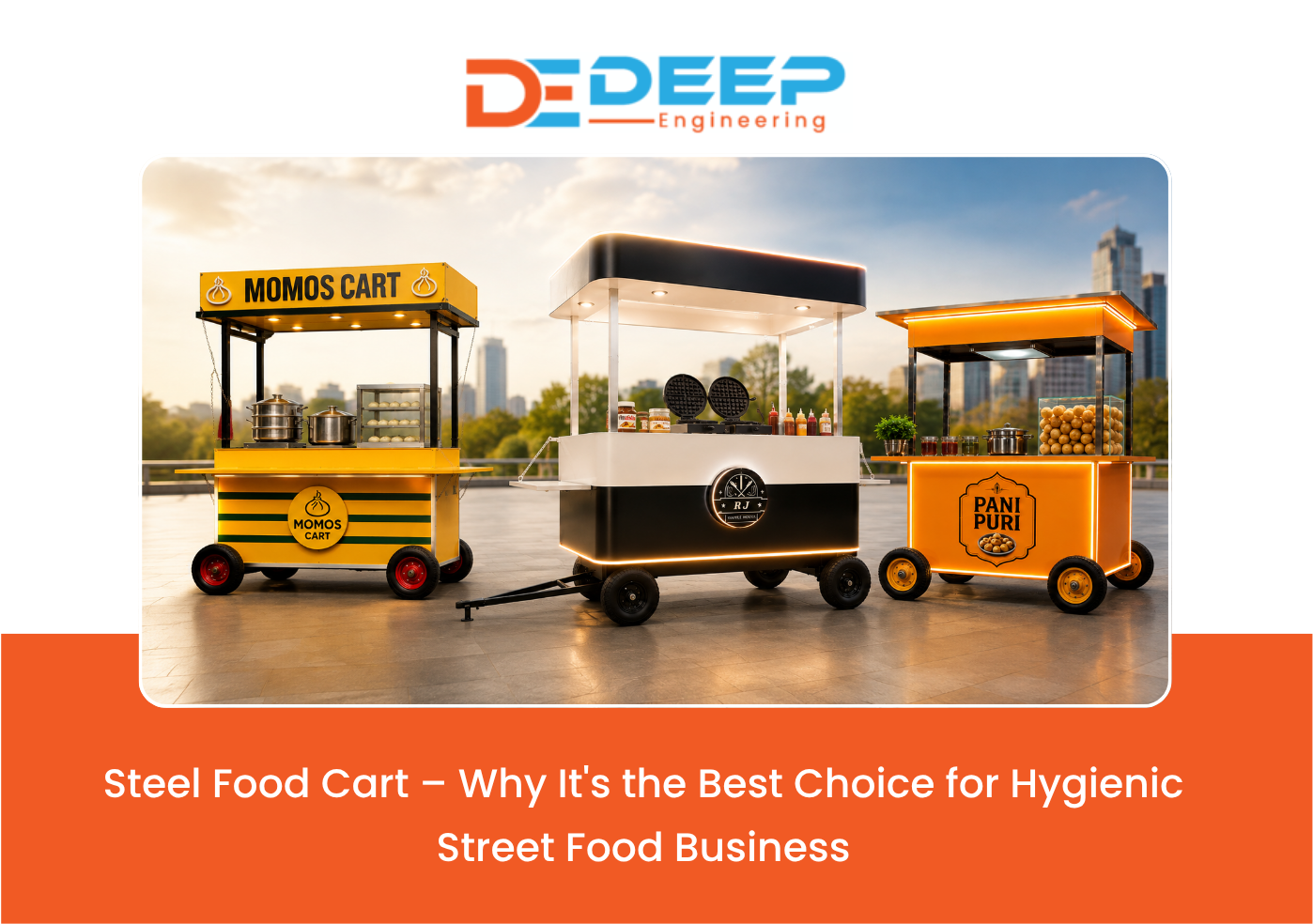
Why Are Steel Food Carts Becoming Popular in India?
For a street-food business, the cart is more than a place to keep ingredients. It becomes the cooking area, preparation station, serving counter, storage unit, and often the first visual impression customers have of the business. That is why choosing the right Steel Food Cart can affect everyday operations as well as presentation.
Steel, particularly stainless steel when appropriate for the application, is commonly considered for food vending because properly finished surfaces can be easier to clean and maintain. In addition, a well-planned cart can provide organized storage, defined cooking and preparation zones, practical mobility, and a professional customer-facing appearance.
For a new entrepreneur, the right approach is not simply to find the cheapest street food cart. It is to choose a cart that matches the menu, equipment, working space, storage needs, cleaning routine, and location. A thoughtfully designed cart can become a practical business asset for daily commercial use.
What Is a Steel Food Cart?
A Steel Food Cart is a mobile food-service unit built with steel or stainless-steel components and configured for preparing, cooking, displaying, storing, and serving food. It can be used for Indian street food, fast food, beverages, snacks, desserts, and other mobile food businesses, with the layout customized around the menu and required equipment.
Unlike a basic push cart, a commercial food cart can be designed as an organized workstation. In addition, it can combine preparation surfaces, cooking equipment, storage, serving areas, branding, and mobility in one unit.
Why Is a Steel Food Cart a Good Choice for Street Food Businesses?
1. Easier Cleaning and Hygiene
Food carts deal with ingredients, sauces, oil, water, steam, crumbs, and frequent customer service throughout the day. Smooth, properly finished food-service surfaces can make routine cleaning more practical.
However, steel does not automatically make a cart hygienic. Instead, good food hygiene still depends on regular cleaning, sanitization, safe food handling, clean water, waste management, and proper maintenance.
A hygienic food cart should therefore be designed with cleaning access in mind. Unnecessary gaps, difficult corners, inaccessible storage, and poorly planned equipment placement can make routine cleaning harder.
2. Durability for Daily Commercial Use
A cart used for several hours every day needs construction suitable for repeated commercial use. The durability of a durable food cart depends on the overall fabrication, joints, fittings, equipment loads, mobility system, finish, and maintenance—not simply the word “steel.”
For example, for a vendor operating during busy evening hours, the cart may experience frequent opening and closing of storage, continuous preparation, movement of equipment, and repeated cleaning. Therefore, a practical construction approach can help the setup remain functional over time.
3. Professional Appearance
Customers notice the serving counter, display area, cleanliness, signage, and overall presentation before they taste the food. Therefore, a clean and organized appearance can play an important role in how the cart is perceived.
A clean stainless steel food stall with organized equipment and clear branding can create a more professional impression than an improvised setup. The appearance should support the food brand without sacrificing the practical workspace required by the operator.
4. Organized Workspace
A good commercial food cart separates activities where possible:
- Ingredient preparation
- Cooking
- Serving
- Storage
- Equipment placement
- Waste handling
- Customer interaction
As a result, this organization can reduce unnecessary movement during busy periods and make the operator’s routine easier to manage.
5. Customization
A customized food cart should be designed around the menu rather than forcing a menu into a generic layout.
For example, a momo cart may need steaming and preparation space. Similarly, a waffle cart may require dedicated space for batter storage, cooking equipment, toppings, and a serving counter. Meanwhile, a pan counter has different display and storage requirements.
Menu-specific food cart fabrication can therefore be useful when the business has particular equipment, storage, branding, or workflow requirements.
6. Long-Term Business Value
For this reason, a cart with insufficient storage or an awkward cooking arrangement may create operational problems every day.
When comparing a food cart for business, consider total utility: construction, layout, equipment compatibility, cleaning access, mobility, storage, customization, and expected daily use.
Is Stainless Steel Better for Food Cart Hygiene?
Stainless steel is commonly used in food-service applications because smooth, properly maintained surfaces can be easier to clean. However, material selection alone does not guarantee hygiene. Therefore, regular cleaning, sanitization, safe food handling, and proper maintenance remain essential. Quality and how the cart is used.
For this reason, a stainless steel food cart should ideally have an easy-to-maintain layout, sensible food-contact areas, accessible storage, and minimal difficult-to-clean spaces.
Hygiene also depends on:
- Regular cleaning and sanitization
- Safe food handling
- Worker hygiene
- Proper waste management
- Clean water and appropriate water arrangements
- Equipment maintenance
- Suitable food-contact surfaces
- Good cart design
In other words, stainless steel can support a hygienic setup, but material selection is only one part of food safety.
Steel Food Cart vs Other Food Cart Materials
| Factor | Steel/Stainless Steel Cart | Other Common Cart Materials |
|---|---|---|
| Durability | Can be highly durable when properly fabricated | Depends strongly on material and construction |
| Cleaning | Smooth surfaces can simplify routine cleaning | Varies by surface and finish |
| Appearance | Can provide a clean commercial appearance | Depends on design and finish |
| Maintenance | Generally practical when properly maintained | Requirements vary |
| Customization | Can be fabricated around different layouts | Depends on construction method |
| Food-service suitability | Commonly used for food-service applications | Depends on material and food-contact design |
| Weather exposure | Performance depends on material, finish, and environment | Varies considerably |
| Long-term use | Suitable for many commercial applications when properly built | Depends on construction quality |
| Professional presentation | Supports modern food-service designs | Highly dependent on design |
| Business applications | Can suit many menus and vending formats | Suitability depends on intended use |
Overall, the important point is that “steel versus other material” should not be treated as a standalone decision. Instead, fabrication quality, intended use, maintenance, and cart design matter just as much.
What Should a Hygienic Steel Food Cart Design Include?
Most importantly, a useful food cart design starts with the operator’s workflow.
Important elements can include:
- Food preparation counter
- Cooking zone
- Serving counter
- Ingredient storage
- Equipment placement
- Customer-facing display area
- Waste disposal arrangements
- Handwashing and hygiene considerations
- Electrical organization where required
- Gas and cooking equipment planning where applicable
- Ventilation where applicable
- Branding and menu-display space
- Operator movement area
- Accessible cleaning areas
For example, placing frequently used ingredients near the preparation zone can reduce unnecessary movement. Similarly, keeping serving activities separate from raw-ingredient preparation can make the workspace easier to manage.
How Should You Plan a Steel Food Cart Design?
A menu-first process is usually more practical than buying a generic cart and trying to adapt it later.
1. Define the menu
List every product you intend to sell and identify the preparation steps involved.
2. identify the cooking equipment
Determine which appliances, burners, steamers, griddles, fryers, waffle makers, or other equipment may be required.
3. Estimate storage requirements
Plan for ingredients, packaging, sauces, utensils, cleaning supplies, and other daily necessities.
4. Plan customer flow
Decide where customers will approach, order, pay, wait, and receive food.
5. Plan Operator Movement
The person working inside or beside the cart should be able to move between preparation, cooking, and serving areas without unnecessary obstruction.
6. Allocate Preparation and Serving Space
Separate preparation from customer-facing service where practical.
7. Consider Cleaning and Waste Management
Plan accessible surfaces, waste collection, water arrangements, and cleaning access.
8. Add Branding Requirements
Decide where the logo, menu, signage, lighting, and display elements should go.
9. Finalize Customization With the Manufacturer
Discuss the equipment, dimensions, storage, finish, mobility, electrical requirements, and operating environment before fabrication.
For design inspiration and examples, explore Food Cart Design.
Planning a customized cart before fabrication can prevent expensive layout compromises later. Discuss the menu, equipment, and workflow with a manufacturer before finalizing the design.
What Types of Businesses Can Use a Steel Food Cart?
Momos Business
For example, a momo operation may need space for steaming, ingredient preparation, sauces, packaging, and serving. A dedicated Momo cart can be planned around these activities.
Illustrative example: A momo entrepreneur serving customers during an evening rush may benefit from keeping steamed momos, sauces, packaging, and serving utensils within easy reach while keeping the cooking station organized.
Panipuri Business
Similarly, a pani puri setup needs organized ingredient and serving areas, particularly because the operator may serve customers continuously. A Panipuri Cart can be configured around ingredient organization, customer-facing service, storage, and hygiene requirements.
Waffle Business
A waffle cart may need batter storage, a waffle-making appliance, toppings, packaging, and serving space. A Waffle Cart can therefore be designed around the complete preparation-to-serving sequence.
Fast Food Business
Meanwhile, Burgers, sandwiches, fries, snacks, and similar products require a combination of preparation, cooking, storage, and serving. A Fast food stall can be considered when a business needs a more structured food-service arrangement.
Pan Business
Finally, a pan business often benefits from organized ingredient display, storage, customer-facing presentation, and a practical serving counter. A pan counter can be relevant for this type of operation.
Steel Food Cart Price: What Determines the Cost?
There is no single steel food cart price that applies to every business. Instead, the final cost depends on the cart’s configuration and the buyer’s requirements.
| Cost Factor | Why It Matters | Potential Impact on Final Cost |
|---|---|---|
| Cart dimensions | Larger layouts require more fabrication and material | Can increase cost |
| Material selection | Material choice affects fabrication requirements | Can affect cost |
| Counter configuration | More work zones require more construction | Can increase cost |
| Storage | Cabinets, shelves, and compartments add fabrication | Can increase cost |
| Cooking equipment | Appliances and equipment vary by menu | Can significantly affect total cost |
| Electrical requirements | Lighting, appliances, and wiring may require additional work | Can increase cost |
| Water/sink arrangements | Plumbing-related provisions add complexity | Can increase cost |
| Branding | Signage and display elements require additional work | Can increase cost |
| Mobility | Wheels, movement requirements, and related construction affect design | Can affect cost |
| Finish quality | Surface treatment and finishing requirements vary | Can affect cost |
| Customization | Menu-specific fabrication requires additional planning and work | Can increase cost |
Therefore, a stainless steel food cart price should be evaluated against the actual specification rather than compared only by headline quotation.
In addition, a clear quotation should make it easier to understand what is included, what is optional, and which equipment or accessories are priced separately.
Is a Customized Steel Food Cart Worth the Investment?
The difference between the cheapest cart, a standard cart, and a customized commercial cart is mainly about how closely the setup matches the business.
Customization can potentially provide:
- Better workflow
- More useful storage
- Menu-specific equipment placement
- Cleaner organization
- Easier access to frequently used items
- Better customer-facing presentation
- More practical use of available space
Illustrative example: Suppose a new fast-food entrepreneur needs a cooking appliance, ingredient storage, packaging storage, preparation space, and a serving counter. A hypothetical customized layout may position these zones in the order the operator actually uses them. The benefit is not a guaranteed increase in sales; it is a potentially more practical daily workflow.
The right question is therefore not simply, “How cheap is the cart?” but “Does this cart solve the operational requirements of my business?”
How Does a Steel Food Cart Improve Daily Food-Service Workflow?
Consider an illustrative momo vendor preparing for an evening rush.
Ingredients and sauces can be organized in dedicated storage. Preparation can happen at one defined surface, cooking equipment can occupy a suitable zone, and completed orders can move toward a separate serving counter.
This type of arrangement can reduce unnecessary back-and-forth movement and make frequently used items easier to access. It can also make the working area easier to understand when more than one person is involved.
The exact benefit depends on the cart design, menu, operator habits, and volume of service. Good layout supports workflow; it does not guarantee business performance.
What Should You Check Before Buying a Steel Food Cart?
Use this buyer checklist before accepting a quotation:
- Construction quality and overall fabrication
- Surface finish and ease of cleaning
- Storage capacity
- Counter layout
- Cooking equipment compatibility
- Access for cleaning and maintenance
- Operator workflow
- Mobility requirements
- Branding and display space
- Customization options
- Electrical and gas planning where applicable
- Maintenance requirements
- Manufacturer experience
- After-sales support
- Quotation transparency
- What equipment and accessories are included
A useful food cart supplier in India should be willing to discuss how the cart will actually be used rather than quoting a generic model without understanding the menu.
How to Choose the Right Food Cart Manufacturer in India
Choosing a food cart manufacturer is an important part of the purchase because fabrication quality and design support directly affect the finished setup.
Evaluate a manufacturer based on:
- Manufacturing experience
- Relevant portfolio
- Customization capability
- Fabrication quality
- Understanding of food-service workflows
- Material transparency
- Communication
- Design support
- Menu-specific planning
- Clear quotations
- Delivery expectations
- After-sales support
Entrepreneurs researching a Food Cart Manufacturer in India can compare manufacturers based on these practical factors rather than relying only on price.
You can also review information about Food Cart Manufacturers before discussing your specific requirements.
Before placing an order, prepare your menu, equipment list, storage requirements, preferred mobility, branding needs, and operating location. This makes the customization discussion much more productive.
Why Choose Deep Engineering for Your Steel Food Cart?
Deep Engineering Food Cart Manufacturer provides food-vending solutions for street-food vendors, small businesses, cafes, restaurants, food startups, event vendors, and mobile food businesses.
Its product range includes food carts, mobile food vans, kiosks, and customized food vending equipment. The focus is on practical layouts, durable construction, organized workspaces, mobility, storage, hygiene-focused design, and menu-specific customization.
For businesses looking specifically for a Stainless steel food cart, the key consideration should be how the cart can be configured around the intended food-service workflow.
Deep Engineering operates from Ahmedabad, Gujarat, and serves the broader Indian food-vending market through customized manufacturing and supply solutions. Buyers can discuss their menu, equipment, storage, branding, and operational requirements directly with the Food Cart Manufacturer.
Steel Food Cart or Food Van: Which Should You Choose?
A food cart and food van solve different operating requirements. The right choice depends on the menu, budget, available workspace, parking situation, mobility requirements, equipment, and intended business scale.
| Factor | Steel Food Cart | Food Van |
|---|---|---|
| Initial investment | Depends on customization and equipment | Generally involves a larger vehicle-based setup |
| Space | More compact | Typically provides more enclosed workspace |
| Mobility | Practical for suitable locations | Vehicle-based mobility |
| Storage | Depends on cart configuration | Can offer more space depending on vehicle design |
| Menu capacity | Suitable for many focused menus | Can accommodate broader setups depending on vehicle |
| Equipment capacity | Depends on cart size and design | Can support more extensive equipment layouts |
| Parking | Requires suitable cart placement | Requires vehicle parking and operating space |
| Branding | Can provide a strong visible display | Can use the vehicle as a larger branding surface |
| Suitable businesses | Street food, snacks, desserts, focused menus | Larger mobile food operations and broader menus |
| Scalability | Useful for starting or focused operations | May suit businesses requiring greater workspace |
Entrepreneurs comparing a cart with a vehicle-based setup can review food van price and the Food Van option based on their actual requirements.
Where Can a Steel Food Cart Business Work in India?
A mobile food business can potentially operate in:
- Busy markets
- College areas
- Office districts
- Residential communities
- Commercial areas
- Events and food festivals
- Private campuses
- Tourist areas
- Other suitable high-footfall zones
However, permission is not automatic simply because an area has high footfall. Municipal rules, vending regulations, traffic restrictions, property permissions, event requirements, and local operating conditions can vary.
Entrepreneurs should verify the applicable permissions and operating requirements before selecting a location.
Steel Food Cart Manufacturer in Ahmedabad, Gujarat and Other Indian Markets
Ahmedabad is an important market for food entrepreneurs and a practical base for businesses looking for customized food vending equipment.
Entrepreneurs in Rajkot, Surat, Vadodara, Bhavnagar, Himmatnagar, Jaipur, other parts of Rajasthan, Indore and Madhya Pradesh, Delhi NCR, Gurgaon, Uttar Pradesh, and other Indian markets may compare manufacturers based on customization capability, fabrication quality, logistics, design support, and suitability for their particular menu.
The most useful comparison is not simply which manufacturer is geographically closest. Consider whether the manufacturer understands your workflow, can explain the proposed layout, provides a transparent quotation, and can customize the equipment around your business requirements.
Frequently Asked Questions About Steel Food Carts
A steel food cart is a mobile food-service unit fabricated with steel or stainless-steel components for food preparation, cooking, storage, display, and serving. Its configuration can be customized according to the menu.
It can support hygienic food service when properly designed, cleaned, sanitized, maintained, and operated. Material alone does not guarantee food safety.
There is no universal price. Cost depends on dimensions, material selection, equipment, storage, customization, branding, electrical requirements, mobility, finish, and other specifications.
Stainless steel is commonly considered because smooth, properly maintained surfaces can be practical to clean and suitable for many food-service applications.
Yes. A cart can be planned around a specific menu, cooking equipment, storage requirements, serving workflow, branding, mobility, and other business needs.
Momos, panipuri, waffles, fast food, pan, chaat, snacks, desserts, beverages, and many other food-vending businesses can use appropriately designed carts.
Follow a regular cleaning and sanitization routine, remove food residue promptly, keep storage organized, inspect equipment and fittings, and address maintenance issues early.
Final Verdict: Is a Steel Food Cart the Right Choice?
A Steel Food Cart can be a practical choice for entrepreneurs who need a durable, organized, customizable, and professional mobile food-service setup.
Its value comes from more than the material itself. A useful cart combines suitable construction with sensible food preparation surfaces, storage, cooking equipment placement, serving space, cleaning access, mobility, and branding.
For a street-food entrepreneur, the best approach is to begin with the menu and daily workflow, then build the cart around those requirements. Compare manufacturers carefully, understand what is included in the quotation, and consider long-term usability instead of focusing only on the initial price.
If you are planning a new food business or upgrading an existing vending setup, explore the available Food Cart solutions and discuss your menu, equipment, storage, mobility, and customization requirements before fabrication.
Contact Us: Deep Engineering